Tag Archives: logical libertarian

Alternative Medicine: The Grand, Ignorant And Immoral Oxymoron

There can be no doubt, many people suffer from iatrophobia ​—a fear of doctors. Being poked with needles, recommended for surgeries, or placed on never-ending drug regiments can make people want to curl up in a ball somewhere and hide forever.

As a result of this somewhat understandable fear, people often look to alternative medicine for the answers to their problems. Whether it be practices like chiropractic, homeopathic, holistic, acupuncture—the list is mind numbing.doctor_needle2[1]

So first, let’s look at the definition of the word medicine.

med·i·cine
ˈmedəsən/
noun
noun: medicine; plural noun: medicines
  1. the science or practice of the diagnosis, treatment, and prevention of disease (in technical use often taken to exclude surgery).
  2. a compound or preparation used for the treatment or prevention of disease, especially a drug or drugs taken by mouth.

When discussing the idea of alternative medicine, it should first be understood that there is essentially no such thing as alternative medicine.

  • There is medicine: practices or compounds that treat a medical condition or disease.
  • There is non-medicine: practices or compounds that  do not treat a disease or medical condition.

There is no middle ground here, the item in question either works, or it doesn’t work. The level of effectiveness may very, but there has to be a noted effect, above the margin of error or the placebo effect, or it cannot be considered medicine.medicine[1]

For hundreds of years, scientists have laid out the path to determine which is which. It’s called a clinical trial, an extension of the scientific method. While the concept goes back thousands of years, in the last century, the process is now pretty consistent and highly effective.

In a fictional example, I will create a drug called Libertol (I had to throw a little politics in this thing), and I will have invented it to treat a disease called oppressionitis.

Assuming I’m a drug company, I’m going to be biased to confirm that the millions of dollars I spent developing Libertol actually yielded a functional, and thus marketable product. Since that bias could either unintentionally skew my results, or raise concerns I might purposefully have skewed the results, I would find an independent party to test Libertol in order to rule out any actual or perceived biases I might have.

The independent testing facility would start by looking for a number of people with oppresionitis, and ask them if they’d be willing to submit to a study on a new drug to treat this horrible disease. For the sake of argument, let’s say we get 500 people to be our guinea pigs.

Clinical Study Map. Click for more info

Why 500? Because “anecdotal evidence isn’t evidence.” (Great science maxim #1, there will be more) But what do scientists mean by that?

Imagine you flip a coin once, and it lands heads up. Would you then assume that every time you flip a coin, it will land heads up because of that one flip? Of course you wouldn’t. That is essentially anecdotal evidence. One, or barely more than one, instance is almost never to be treated as if its results are indicative of what should be expected on a consistent basis. This is also why you are wise to often get a 2nd or even 3rd opinion when seeing doctors.

So maybe you flip the coin ten times? It lands heads seven out of ten due to random chance, which is not implausible. If I’ve done my math right, is likely to happen about 1 out of 8 times (15:125 to be exact). So does that mean a coin is prone to land heads up 70% of the time? Again, of course not. The more times you flip it, the closer it will get to its actual probability of 50:50 as the odds start to balance out.Coin[1]

So when doing a clinical trial, the more people you can test, the more accurate your results will be, and this is why we want 500 people in our above fictional example.

These trials are actually done in phases, with only about 20-80 people at first, if the drug ends up having detrimental side effects, you don’t want it to affect a large number of people, after all. But by the time the study hits phase 3, there will likely be thousands of participants being evaluated. But I’m simplifying the three phases down to one, and the process in general, for the purposes of this article.

Once volunteers are gathered up, half of them will be given the actual drug, the other half will be given a placebo (a non-drug). This placebo is designed to control for the placebo effect, a condition whereby a person will convince themselves a drug works, even if it doesn’t.

The placebo effect will generally not alter things that are purely quantitative, like blood pressure, heart rate, or other measurable conditions, but it can have quite the profound effect on subjective data, such as pain level and other issues the user merely reports on versus being tested with equipment.

The results of the group who took Libertol would then be tested against the people who took the placebo they thought was Libertol, and Bob’s your uncle—you have a result.

If Libertol actually worked, it would show as such by being more effective than the placebo was at treating oppressionitis. Otherwise, the results will come back as “no more effective than a placebo,” and Libertol would be sent to the ineffective drug graveyard in the sky, barring any noted side effects that may be beneficial elsewhere.

Viagra being one of the best examples of this phenomena, was originally designed for blood pressure issues, which it was horrible for, but turned out to be quite the rock star at “pitching tents.”viagra[1]

So the moral here, is that you shouldn’t take medical advice from someone who tried something once and it worked. There are infinite other possibilities to explain why it seemed effective, rather than it actually being effective. Instead, ask your doctor and if you’re a true skeptic, research yourself for clinical trial results.

I was recommended acupuncture by my neurologist for headaches, only to do my research using sites like sciencebasedmedicine.org. Much as I expected, I found that clinical trials showed acupuncture is “no more effective than a placebo.”

People who had actual acupuncture reported similar results, within the margin of error, to people who were treated with fake acupuncture where the needles were purposely misplaced. It has never been shown to be more effective despite its hundreds of years of history. The only “ancient Chinese secret” here, is that it doesn’t work.

Acupuncture
Acupuncture

While we place a lot of trust in doctors, not all of them adhere to the scientific method exclusively, some are flat-out quacks. But if you want medicine versus non-medicine, you should demand as such. So lesson learned, I won’t be seeing that neurologist again.

There are two types of alternative medicine practitioners:
Fraudsters who know they’re taking advantage of you, or
ignorant people who simply don’t know better. But why give your money to either one?

If someone is purposefully deceiving you for a fee, that is a horribly immoral practice where you take someone’s hard-earned money that could be used for something that would help them, and instead sell them something that won’t. If I lived in an anarchistic country, I would want to destroy every one of these sociopaths. They are valueless human beings, in my opinion.

But even if they’re just ignorant and think these practices actually work, they’re still taking your hard-earned money for something that doesn’t. Assuming you don’t have money to burn, why do exactly that?burning-money-e1340332352315[1]

It is true, an argument can be made that if the placebo effect does work for things like pain, giving someone a placebo might make them feel better without introducing foreign chemicals into their body. But it’s still inherently dishonest, and I would hope none of you would willingly pay someone to lie to you.

All health claims are scientific in nature, meaning there are biological processes that are either going to get better, stay the same, or get worse in your body after treatment. So trust in things that have passed the test of the scientific method, and understand that “that which can be destroyed by the evidence, should be.” (Great science maxim #2)

“Extraordinary claims, require extraordinary evidence.” (Great science maxim #3) This is what clinical trials provide beyond any reasonable doubt.

People like Harry Houdini spent their lives trying to debunk such fraudsters. Penn & Teller had a show called Bullshit on Showtime which aired for eight seasons debunking them as well. See an excerpt demonstrating the placebo effect here.

James Randi is famous for purposefully overdosing on homeopathy, taking a “lethal” dose, to show that if such a dose had zero effect, the prescribed amount surely must do nothing.

So if I am a libertarian, why do I care? Shouldn’t people be free to put into their body whatever they want? Absolutely!

While I would never prosecute a non-medicine consumer (I refuse to call it alternative medicine), fraud is a violation of your right to property, specifically, your money, and should be prosecuted to the full extent of the law.

These people get away with fraud by making non-scientific claims such as saying these things increase your energy or boost your immune system. An actual boosting of your immune system would essentially be an autoimmune disease where you body attacks its own cells. Something you really, REALLY don’t want. But it is effectively immeasurable since there is no number by which your immune system can be rated with, in a manner such as blood pressure or cell count.

I’d like to quickly dispel a couple of these myths by showing you the purpose, methodology and power of skepticism, or critical though, hopefully encouraging you to do your own.

Things like acupuncture, for instance, are said to be practices that are hundreds of years old (as if that is somehow evidence), and that doctors won’t often recommend them because there’s no money to be made. Might I point out that acupuncturists do in fact work for money? Therefore there is actually money to be made—they’re making it. In order to believe this argument, you must do no critical thinking whatsoever. I just dispelled it in one sentence.

People argue we have a cure for cancer, but drug companies are suppressing it to make more money on drugs that only treat cancer, not cure it. This one requires a little more skepticism, but let’s bring up some valuable points to debunk this.

  • Drug companies do make drugs that cure cancer. Chemotherapy and radioactive seeds are but a couple. We simply don’t have one drug that cures all cancer all the time, nor one drug that doesn’t have harmful and potentially fatal side effects as chemotherapy does.
  • This assumption also means that a drug company would have to invest the typically millions of dollars required to develop a drug that works, then shelve it without recouping any of that money as a return on their investment. Why would they develop it in the first place if they don’t want such a return? These conspiracy theorists are arguing how greedy drug companies are, then asserting a claim that they are purposefully throwing money away—an overwhelming contradiction.
  • Then we must also assume that the scientists who went to medical school, usually with the intent of saving lives, many of them specifically dreaming of being “the one” who cures cancer, spent years developing a drug that works. However, once realizing their dream of curing cancer, completely eschewed their ideals and agreed to suppress the drug for money. A theory that’s insulting to every moral medical student who ever slaved away for eight years in college to save your life.
  • Lastly, the above two bullets would both involve more than one person. The drug company has a board of directors, and the labs often have tens or hundreds of people on staff, yet not one of them headed over to CNN or Fox News to blow the whistle?

I could go on and on pointing out the logical fallacies and ignorance of thinking these ways. But hopefully my two examples of how to be a proper skeptic will inspire you to do more critical thinking of your own, instead of buying into these radical conspiracies. The life and the pocketbook you save could be your own.

P.S. I linked to an article debunking acupuncture above. Here is another debunking homeopathy with what is effectively simple, yet astounding math. I promise, it is worth the read. (Click the picture)

539838_10150934532972695_942140407_n-560x700[1]

Also, here’s a great video demo from Twitter’s @ScienceBabe

The Left vs The Right: Who Has The Moral High Ground?

Democrats often wish to portray Republicans and libertarians as immoral beings who are greedy and don’t want to help the little guy.

So far, it has been an effective tactic for getting votes. We’ve got plenty of historical evidence to show that statism doesn’t actually work, yet people who know very little about the historical effects of statism keep voting for more government on the principle of morality. But is it the more morally sound method?

Morality is a man-made concept where we behave in such a way as to either not do harm to others, or to help those who are in need. Even if you’re not religious, morality is an evolutionary trait social beings like humans use to advance our species—a subject Michael Shermer elaborates on quite well in this article.

Michael Shermer
Michael Shermer

So then the question begs, does capitalism or statism jive better with the concept of morality?

I’ve mentioned on several previous posts that there are four officially socialist nations in this world. North Korea, China, Cuba, and Laos. Two other former socialist nations worth mentioning—the USSR, and Nazi Germany. Is there anyone who honestly wishes to argue that those nations were either:

A) More moral than the United States

or

B) Had a citizenry whose poor had a better quality of life than the poor of the United States.

I don’t believe any honest debate can say that America is the less moral nation, but what about the idea of a happy medium? Is some socialism good?

I would argue socialism is like smoking, there’s a decent amount you may get away with without killing the user, but the safest amount is the least amount. That’s the libertarian opinion, but do the facts support it?Statism-c-c[1]

We know that all animals instinctively work to advance their species, it’s the underpinnings of evolution. Organisms on this planet have been innately competing with one another to become the dominant species since the day single-celled organisms first sprung into life.

You’ll notice I said competing—competition is the foundation for capitalism, not socialism. Therefore, I feel I can logically conclude that capitalism is congruent with the natural behavior of all living organisms. But that doesn’t necessarily make it more moral, does it?

All life competes with other life for food and resources. In doing so, through the process of natural selection, life as a whole is advanced. Without this, we would still be just single-celled organisms floating around in a primordial soup. Forcing inferior organisms to either improve, or die trying, advances life far greater than nursing a losing battle. While I don’t believe asking for help is immoral, demanding help at the point of a gun sure is.

If we look at communist era Russian cars, have you noticed there is no real collector’s market for them? There are plenty of 100-year-old model T’s puttering around the globe, the market for them is still quite strong. But look around for a communist era Russian car, and you’ll be hard pressed to find one. They were horrid and hateful machines that no one wants.

Even when America allowed the socialist made Yugo to invade our shores, it was clear that these things were racking up more miles on the back of a tow-truck than they were under their own power.9780809098910_custom-815d71859a4a1992cb9174e6290928df7b86bac7-s99-c85[1]

If we were under socialist rule, we’d still be driving them, or something similar, but free markets and competition brought us better cars at a lower price, and the Yugo, along with communist Yugoslavia took their rightful place in the annals of history as failed experiments.

Many Democrats accept this, and claim they are pro-capitalism, but still believe we should have more government regulation and assistance for the underprivileged. They argue that social programs help the poor and needy, something they feel rich people wouldn’t do voluntarily.

Warren Buffett and Bill Gates are two of the richest men in America, and they voluntarily give billions away to charitable causes every year. Even old stalwarts like Andrew Carnegie, someone famous for being a monopolous and ruthless businessman, gave away most of his money in the end.

Andrew Carnegie
Andrew Carnegie

There is plenty of evidence to show that people will give to charities, rich and poor alike, so long as they feel the money will go to a good cause, will be appreciated, or will benefit mankind in general. It’s effectively a capitalist charity system where the best and most worthwhile charities garner the greatest contributions, and the ones that are not so deserving rightfully lose out.

The part where Democrats go wrong is that they fail to understand that government is not a charitable organization, it is an agent of force. You cannot argue that putting a gun to someone’s head, and forcing them to give to a cause they do not support is moral. If the cause needs support, and is worthy of the assistance it asks for, it will gain support on its merits, not because glad-handing politicians decided it was worthy.

What Democrats are pushing for when asking for more government isn’t moral, it’s lazy and selfish. They have their causes that they wish to support, but instead of making a case in the marketplace of ideas as to why the rest of us should support it, they try to pass laws to force us to do so whether we like it or not. Does that really sound moral to you?

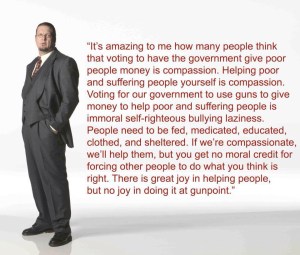
Penn Jillette
Penn Jillette

The argument that if they don’t, people won’t help has a lesson in there that they routinely fail to see. People don’t support it, because it’s often not a good idea. Just because someone’s intentions are well-meaning, doesn’t mean they are right.

I might want to help the doctor saving the life of a loved one, but any help I attempt to provide in an operating room would likely be less than helpful at best. I don’t know what I’m doing, and can help the most by staying out of the way, something government officials should understand, but the desire to do something always seems to overwhelm them.

Famous examples like Solyndra, where we invested $500 million taxpayer dollars with little knowledge of the solar industry, and lost it all. Or with General Motors, where we invested $49.5 billion that GM didn’t even want, only to lose $10.5 billion when all General Motors needed to do, according to ousted CEO Rick Wagoner, was to file bankruptcy, which they ended up doing anyway.

Rick Wagoner
Rick Wagoner

Both instances, Obama and his administration meant well, just as I would in the aforementioned operating room, but good intentions still yielded bad results.

The problem for many Republicans is that they are quick to paint Democrats as evil, or immoral in response to the Democratic attacks. Ultimately, they’re often just wrong, and we’d be smart to focus our message on the factual inaccuracies Democrats use to justify their agenda.

Name calling has never advanced society, and it never gives you the moral high-ground. Republicans and Libertarians alike, should acknowledge the altruistic intent of every Democrat-proposed item on their agenda, but then break down why they are bad ideas with logic and reason. People will respond to this better than bickering and insults.

Our government is designed to be a guarantor of rights, which it must do at the point of a gun. That is a morally sound thing to do when using an agent of force.

But deploying the might of government into free markets, free will, and the individual pursuit of happiness, is oppression. It isn’t oppression like we saw in the 1700’s under monarchies, or into the 1800’s with slavery, but it’s still forcing people to be subservient against their will. Much like government, oppression of any kind, should be minimized as much as reasonably possible and should never be portrayed as moral.

The fact is, both parties mean well, and should be portrayed as moral. We simply disagree on the methodology and implementation of how to best advance our nation. We on the right feel freedom accomplishes this best, Democrats believe government regulation does. Since the historical evidence is on the libertarian side of the argument, I will always contend we are effectively the most moral.

Dream Theater Better The Beatles? A Lesson In Art vs. Science.

I have a confession to make. I cannot endure country, Top 40, or hip-hop music for any lengthy period of time. You might as well waterboard me before subjecting me to their overly repetitive and simple riffs.

When I was younger, I would rail against these genres mercilessly, ridiculing the artists and their fans alike for being musically ignorant amoebas who can hardly count to four, nevertheless keep a 4/4 beat.

But as I got older, became a skeptic, and embraced the idea of critical thought, it dawned on me that I was wrong for doing this.

Aside from the fact I was just being a jerk, one must first understand that claims are generally broken in to two groups: quantifiable or subjective, and I believe they are essentially, mutually exclusive.

Quantifiable claims are things that can be proven to be true—a scientific claim of fact. But subjective claims have no right or wrong answer, they are merely opinion.

The reason I was such a music snob, is largely due to the influence of my former high school band director. A charismatic man who taught us the value of striving to be greater tomorrow than you are today, no matter how good you may already be.  Think of Dr. Lee played by Orlando Jones in Drumline, and you’re really close.

Orlando Jones as Dr. Lee from the movie Drumline (left)

It’s not that he taught us to be music snobs, it’s that he taught us the incredibly complex challenges advanced music can offer, the science of music—or what’s known as music theory.

Along the way, I learned about great musicians like Steve Morse, a guitarist and jazz major from Texas A&M, so talented, that from 1988-1993, he was voted Guitar Player Magazine’s Best Overall Guitarist. After winning it five straight years, including 1993, a year  he didn’t even release an album, he was removed from the competition.

Let’s be clear, that was not best rock, jazz, classical, or country guitarist, that was “overall” guitarist. The things he can do with six strings and a block of wood are scary. See just a smidgen of his prowess in this video.

The more I learned about great musicians like this, the more it upset me that people like Eddie Van Halen were hailed as the best guitarist ever. He’s good, but not “Steve Morse” good, and I believe Eddie himself would agree. But where Van Halen sold millions of albums, someone like Steve Morse was hardly known outside the music community. The idea that the most technically proficient musicians are rarely the most famous is a travesty of justice to me, so how could this be?

larry-bird-dribble300400[1]
Larry Bird
For instance, if we look at sports, Larry Bird was one of the greatest NBA shooters of all time. He was also one of the most popular. His raw talent, just like Michael Jordan after him, garnered him the recognition he deserved. So why is this often not true of musicians?

It boils down to understanding the difference between quantitative versus subjective claims.

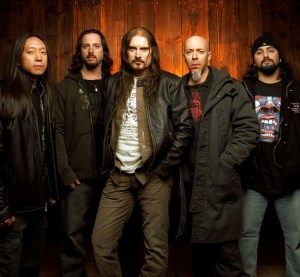
For instance, here’s a claim I would happily make that would garner a lot of opposition. Dream Theater, a band who met and studied at the Berklee School of Music, who now employ a keyboardist (Jordan Rudess) who was accepted and studied at Julliard at the tender age of 9, and who have won several Guitar Player Magazine, Modern Drummer Magazine, etc., awards are a better band than the Beatles will ever be, and I can essentially prove it.

Dream Theater
Dream Theater

First things first though, if we’re making a quantitative claim, the word “better” has to be defined—the word is quite ambiguous. In my claim, it refers to more technically proficient.

We would quantify that Larry Bird was better than other NBA stars by using his career statistics. But how can we quantify one musician as more technically proficient than another?

It’s simple. I could choose any Beatles song (and I do mean any), and challenge Dream Theater to play it. Knowing both band’s works as I do, I can all but guarantee that Dream Theater could easily perform the chosen piece within an hour or two, playing it note for note at the same tempo or faster than the Beatles recorded it at, without breaking a sweat.

Now if we flip the tables and ask the Beatles to replicate a Dream Theater song, the Fab Four would be hard pressed to replicate more than 1-2% of them, even if they were given months or even years to achieve said goal. This song should illustrate my point.

I’m not being overly mean to the Beatles, nor overly generous to Dream Theater. Any knowledgeable musician, if familiar with both bands, knows I’m being very fair and accurate here. It’s not that Dream Theater are superhuman (although it seems like it at times), or that the Beatles are incompetent, it has everything to do with the amount of hours both bands put in to mastering their instruments.

The Beatles, like many other famous bands, made catchy songs, sold a lot of albums, and did all they needed to do to make a damn good living as musicians. They likely never felt the need to go further.

Aside from Dream Theater’s Julliard and Berklee educations, something the Beatles did not do, having met Dream Theater on a couple of occasions, I can tell you that they are driven to challenge themselves technically and musically; there is clearly less focus on just selling records.

So why was I wrong for calling Dream Theater “better,” and behaving like such a music snob? While I defined “better” as more talented, I could just as easily have defined it as most record sales—then the Beatles obviously win in a landslide. I began to understand that the whole concept of “better” in relation to art, is innately flawed. If you’re going to use that word, you cannot use it for subjective things.

This was the impetus for my understanding of the difference between art and science.

While sports statistics are quantitative, music is an art form, and therefore largely subjective. It can be quantified to some extent as I did above, but unlike sports, technical prowess is no guarantor of success in music because art as a whole is not about achieving a measurable goal, but merely satisfying the artistic thirst of the user. This is something the Beatles must assuredly be declared the winners of, much to my dismay.

The Beatles
The Beatles

This knowledge began the transition of my love for music into my love for science, as the latter began to seem infinitely more attractive and important.

Art is like science without the burden of having to be correct and accurate. So in my mind, unlike science, art can never truly be important.

When lives are at stake and problems need solved, we don’t call painters, musicians, poets, or philosophers, we call doctors, engineers, and physicists. A 911 call will never yield the work of an artist.

So then I asked myself if science is “better” than art. Are art and science at odds with one another?

Actually, many scientific endeavors started with arts like philosophy or movies. A person simply dreamed without limits, and those dreams posed challenges that science brought to reality. Many scientists were inspired by the arts as children, such as scientists inventing things they saw in sci-fi movies as a child.

So how does this all affect me? My love for complex music is still great, but I no longer insult those who love the simpler stuff. My preference for the conservative-biased Fox News doesn’t prompt me to insult MSNBC watchers. My passion for Ferraris and Corvettes no longer prompts me to insult people who drive Porsches and Lamborghinis.

Corvette ZR1
Corvette ZR1

While I still maintain my preferences, I understand the difference between what I can quantify, and what is truly subjective. Not only am I more accurate in my perception, I’m no longer compelled to insult people for their varied tastes, but instead, often ask them why they appreciate something I do not.

Their answer may not sway me, but many times, it opens my mind to new and interesting things, some of which, allow me to grow my own creative mind by pointing me in a direction I would have never discovered on my own. If there’s anything a scientifically oriented person likes most, it’s learning new things.

So if you find yourself being a snob, calling one artistic endeavor better than another—stop! More often than not, claiming something is “better” is an inherently flawed thing to do. It is an ambiguous word, that without being clearly defined, and applying only to a quantitative bit of data, should never be used to compare one thing to another.

Coke isn’t better than Pepsi, but Coke’s sales are. Know the difference.

You are probably a libertarian if…

One of the struggles I believe libertarians face is convincing people who largely embrace libertarian principles to know and/or admit they are actually libertarians.

A good number of people I interact with state they are socially liberal, but fiscally conservative. I’m sure you’ve probably heard this. If you’ve ever said this yourself, you’re essentially a libertarian.

Yet many of these people are either not aware of what libertarianism really is, or just refuse to admit they’re a libertarian because of the unfair and inaccurate stereotype that libertarians are anarchistic drug addicts.

Einstein is quoted as saying, “Everything should be made as simple as possible, but not simpler.” Whether he actually said it or not, is questionable, but this is essentially the philosophy of libertarians regarding government. Most of us are not anarchists, we simply believe that government should be as simple as possible without resorting to anarchy.Don't Tread On Me

So with that in mind, I decided to put together a list of signs that might help you to understand whether or not you are indeed a Libertarian.

You’re probably a libertarian…

  • If you’ve ever driven without your seatbelt on, or ridden a motorcycle without a helmet, even though the law says you must, because, “dammit, it’s my head, and I’ll do what I damn well want with it.”
  • If you’ve ever noticed your neighbor who is on disability throwing his golf clubs in the car as you’re headed to work and thought to yourself, “Hey, something isn’t right here.”
  • If you think straight people trying to ban gay marriage makes about as much sense as you banning someone else from having a doughnut because you’re on a diet.
  • If you have ever questioned the logic of why a carmaker is required to put airbags on your car by law, which you are then allowed to turn legally turn off and never use.
  • If you’ve ever wondering how it’s legal to give sex away, but not OK to be compensated for sex.
  • If you’ve ever stated that Democrats and Republicans are both corrupt.
  • If you’ve ever gotten a ticket from a police officer in a situation where you were no danger to other motorists whatsoever and been mad about it.
  • If you’ve ever been upset because you went to buy liquor on Sundays and were restricted from doing so because of obvious religious underpinnings that should be clear violations of the 1st amendment, yet are allowed anyway.
  • If you’ve ever heard the phrase, “No victim—no crime” and thought, “Yeah, I’m down with that.”
  • If you’ve ever thought about opening your own business and were scared away due to the burden of regulations you were faced with and thought, “This shouldn’t be this complicated.”
  • If you’re a smoker and have been upset that an establishment wants to have a designated smoking area for people like you, but were advised they could not by law.
  • If you’re young, reasonably healthy, somewhat poor, and don’t really want to have to buy health care, but upset you are no longer given that choice.
  • If you have friends who smoke marijuana safely and without harming anyone and thought it’s basically nonsensical to throw someone like this in jail.
  • If you’ve ever heard your child’s school fired their favorite teacher in favor of the more tenured teacher and thought, “How dare they choose an older teacher over a better one when we’re talking about the future of my child.”
  • If you’ve ever received a traffic violation citation from a machine that took a picture of you and didn’t smile because you were on Candid Camera.
  • If you’ve ever witnessed a terminally ill person want to engage in assisted suicide, and were upset that government officials were intervening as if it’s any of their business.

These are but a few of my favorites I can come up with the top of my head, can you think of more? Tweet me at @LgclLibertarian, #MightBeLibertarian

Consenting Adults Amendment: How Columbus City Council Screwed The Little Guy

Gary Nolan (and THE Scrappy Doo)

Like many internet writers, I’m an amateur—I do this for the joy of spreading the liberty and rational thought message to any who will listen. If you’ve ever gotten the impression I’m rich, your hypothesis regarding my financial status, is indeed quite flawed.

Many on the left champion more regulation because they say such things protect and/or help the little guy, the underprivileged guy, the poor guy—that’s me!

So let’s see how this is working out for me so far.

In order to help lift myself out of financial distress, I ultimately need to either get promoted, find a new job, or obtain a second job—I’m ruling out the lottery due to statistical improbability. Of the three choices, the latter is the easiest and least risk-involved, so I endeavored to find additional ways to pad my pocketbook.

As I was watching an episode of The Independents on Fox Business, host Kennedy did a segment on Lyft, the peer-2-peer app based car service. It’s a very novel, yet simple, idea.Pinkout81-640x426[1]

  • You have a car and want to earn some extra cash.
  • You download the Lyft app and apply to be a driver
  • They do a quick background check to ensure you’re not one of Charles Manson’s kids.
  • Then a Lyft mentor comes out, shows you the ropes, inspects your vehicle, then gives you a big pink mustache to put on the front of your car signifying you’re a Lyft driver for users to easily identify
  • Once you’re ready, you launch the app, then signify you’re a driver awaiting a rider
  • Any riders needing a lift would launch the app and select a driver who is available and closest to them
  • You meet up, a ride is given, and upon completion, money is exchanged
  • The driver and rider then both rate each other on the experience. If either rates the other below three stars, they’ll never get matched again

Immediately I thought, this was for me. I have a very clean, well-maintained, low-mileage 2002 Honda Accord sedan that would be ideal.

2002 Honda Accord: According to Columbus City Council—death trap

So I installed the Lyft app, went on to the website, and signed up. I’m a personable guy, I love to talk to people, I can work when I want, and I don’t mind driving. Plus, I get to be self-employed again (I’m a previous small business owner), no jerk boss to deal with—it couldn’t be any more perfect, right? I was genuinely excited!

So Lyft contacted me, set me up with my mentor, but then an overreaching government hit me like a ton of bricks.

My 2002 Honda Accord is two years older than the 10-year-old or newer requirement a recently passed law by Columbus Ohio City Council requires, which meant that legally, I could not be a Lyft driver with my car; I’d need to buy a newer one. Generally speaking, if we had the money to buy newer cars, we likely wouldn’t be looking to drive for Lyft, right?

So these bureaucratic do-gooders, either guided by ignorant benevolence, or pressure from much-richer-than-I taxi company lobbyists (or both), who claim to be out for the little guy like me, took away this little guy’s right to go into business for myself in this manner.

Columbus City Council: AKA People Who Violated My Right To Earn A Living

I’m sure the Columbus City Council patted themselves on the back for their chicanery, touting out how they have protected would-be victims from someone with an unsafe automobile. But this assumes many things which cannot be deemed true with any certainty.

  • It assumes any car 10 years old or newer is safe. (False)
  • It assumes any car 11 years old or older is unsafe (False)
  • It assumes a would-be adult rider cannot make a reasonably intelligent decision about whether to get into a car and accept a ride from someone (Typically false)
  • It assumes that people who want to earn some extra money have the money to buy a newer car (Typically false)
  • It assumes Lyft mentors safety inspections aren’t good enough (Typically false). Remember, unlike Lyft,  government isn’t even inspecting your vehicle. Their regulation’s assumptions are solely based on the age of your car.

As I ponder the idea that I live in a free country where government exists solely to protect my rights, I am appalled that my city council, in a misguided effort to protect others, have harmed me with no legitimate justification—both me, and my car, are quite safe.

While I generally believe our Constitution’s framers did a pretty good job, if you’ve read my previous posts, you’ll recall I’m not afraid to propose constitutional amendments that I think would advance their principles of limited government, and deny power-hungry rights-infringers that which pleases them most.

The 1st Amendment
The 1st Amendment

That said, as a result of this incident, it got me thinking about a new amendment I wish legislators would adopt which would solve this problem and many like it—I’ll call it the “Consenting Adults” amendment.

The right for adults to engage in any agreement among themselves, barring any affected and unwitting third party, shall not be infringed.

It’s simple, and quite consistent with the Constitution’s intent as a limit on the how the government may deny your right to pursue happiness. Whether it be me providing a ride to someone for money; two or more people wanting to get married, regardless of their sex or preference; or any other act wherein consenting adults wish to engage. “We The People” should be able to do whatever we want to do, so long as we’re not hurting anyone else doing it. Libertarianism 101: No victim-no crime.

To be fair, I do understand our government usually acts with the best of intentions when they pass these laws. But sadly, many politicians neither have the intellectually capacity or knowledge to understand the ramifications of their actions to their full extent. Nor do they have the honor to admit when their actions have failed or had detrimental unintended consequences. Such instances should prompt them to repeal these regulations, but they rarely do.

They’re also sorely lacking in the understanding that everything they do, is ultimately done so, at the point of a gun. If such proposals were thought of in this manner, they would often be rejected.

Would you support cops showing up, guns drawn on me, screaming “Don’t you dare give that person a ride in your twelve-year-old death trap, or we’ll shoot!”? I sure hope not. But ultimately, if I defied this regulation long enough, that is precisely what would happen.

SWAT team: AKA People I'd eventually see if I used my 12 year old death trap to give people rides via Lyft
SWAT team: AKA People I’d eventually see if I used my 12-year-old death trap to give people rides via Lyft

Politicians should honestly understand that much of what people ask them to do is simply none of their business. Most of the time, when people say, “there ought to be a law,” they’re wrong. These days, our country is sadly free-ish at best thanks to such people. But if you vote for libertarian-minded politicians, we can correct that.

Is Evil A Passé term? An Atheist’s Thought Experiment.

Gary Nolan (and THE Scrappy Doo)

Lately, I’ve been reflecting on what it means to be an atheist. Since I wasn’t always one, how might I feel differently than someone who never had faith to begin with?

For instance, there are people who behave as though they hate their respective deity, then call themselves atheists. I’d argue those people are deists who hate themselves, yet blame their god for their own shortcomings instead of accepting personal responsibility for the way their lives are turning out.

zeus_1[1]
Mythological Greek God Zeus
In my mind, an atheist wouldn’t have any stronger feelings about God, Jesus, or Allah than they would about Zeus or Odin. To me, the only difference between mythology and religion is that the latter still has people who believe in it.

But one thing has curiously struck me lately; the concept of evil. Is this a passé term?

For those who are religious, evil is something put forth by the counterpart of their chosen deity. But I feel this term thwarts understanding of these acts by blaming a being like Satan instead of the perpetrator.

So let’s break down humans for a minute; or as we’re affectionately known in the biological community;  Animalia (Kingdom); Chordate (Phylum); Mammalia (Class); Primates (Order); Hominidae (Family); Homini (Tribe); Homo (Genus); H. sapiens (Species).

Regarding the kingdom classification of Animalia, that means that despite our own desire to feel special, we are ultimately just an animal in the animal kingdom. We are certainly the most intelligent, but there are many animals that are stronger, faster, or otherwise better adapted to their environment, as natural selection dictates.

So while we are special for our intellect, all animals have their own unique specialties, making us all special in different ways, or none of us particularly special at all; depending on how you want to look at it.

Homo-sapiens have evolved as well or better than any other species to life on Earth in many unique ways. For instance, because of our intellect, we’re the best at customizing our environment to suit our needs, instead of having to adapt like all the others. We build houses with air conditioning and heaters, after all.

We’re also intelligent enough to not only be excellent hunters, yet also quite adept at growing our own food. When’s the last time you saw an elephant planting a row of corn?

One trait that many overlook however, is our unparalleled linguistic skills. Because we are social animals, our advanced ability to communicate with others, whether it be face-to-face, or using technology such as the phone or internet, strengthens our society in ways other animals cannot achieve. Every time you ask for help and receive it, you’ve exemplified this.

Oddly enough, we’re the only animal smart enough to have observed and understood natural selection and the benefits it brings to life as a whole, yet we’re compassionate enough to try to prevent it by helping the weak among us instead of allowing them to succumb to whatever their inferior traits might be. If that’s not an ultimate display of commonly accepted morally benevolent societal behavior, I don’t know what is.

This can be seen in the way we help the disadvantaged through charity, medical care, etc. Or simply the endangered species list, where we actively work to preserve an animal that seems incapable of adapting to its environment as natural selection dictates it should.

stalin-hitler_1644235c[1]
Adolf Hitler and Josef Stalin
But back to the term “evil.” The term conjures up names like Adolf Hitler, Paul Pot, Saddam Hussein, Josef Stalin, et al., who are often touted out as examples, and it seems quite fitting on the face of it.

The reality is that if we define murder as the killing of an innocent life, the animal kingdom is full of mass murderers. Cheetahs are mass murderers of gazelles, but maybe we will give that a pass since they eat them to survive.

Lions however, will often kill cheetahs, not for consumption, but just to eliminate the competition for food. Not very sporting at all, if you ask me. So are they evil too? Of course not.

So what makes them different from human mass murderers? The fact that we are smarter, or that we understand the value of empathy and therefore can associate with the victim? In reality, it’s just that we are societal in ways that many other meat eaters are not.

The concept of morality is generally thought to be a religious one, where you are either with or against a particular dogma. Some people would argue that morals are universal, but this is a false premise. Whether it be gay rights, abortion, the death penalty, drugs, prostitution, gambling, etc., what is immoral to some is moral to others.

If we throw out the religious component, morality would generally describe behavior someone does for the good of society, immoral behaviors are to the detriment of it. While many deists would argue that without religion, there would be no morality, Professor of Psychology, Dr. Michael Shermer explains the evolutionary benefit of commonly held moral behaviors here. Evidence suggests we would be just as moral without religion.

When people think of natural selection, they often use the phrase “survival of the fittest,” which can be misleading. It conjures images of some unyielding beast who kills anything that gets in its way. But societal beings are actually “fitter.”

If a strong violent psychopath were going through the neighborhood killing people, he might be successful if everyone in the neighborhood were also a sociopath and failed to band together to combat him. But if the others unite, the psychopath would likely end up dead due to simple strength in numbers.

They wouldn’t do it for the thrill of killing as the psychopath does, but simply for the betterment of their group. Via the death penalty, war, self-defense, and vigilantism, we tend to weed out the violent psychopaths among us for our own mutual benefit.

Lethal Injection Table

Many like to think it’s because we’re exterminating evil, but if there is no deity or anti-deity, all we’re really doing is preserving our societal construct.

As for those we consider evil, they’re just psychopaths, pure and simple. People lacking empathy and the innate desire to contribute to the advancement of the human race through societal behavior.

When we think of them as evil, we feed their ego by giving them the impression that they’re somehow closer to a deity or otherwise superhuman. But if evolution has worked in our favor because we are societal, they are actually inferior—arguably, mentally handicapped beings.

As psychological research continues to advance our understanding of the human brain, there is hope we’ll find solutions to mental disorders like sociopathy and/or psychopathy. But in the meantime, it would be nice if we stop sensationalizing these people by calling them evil; they’re just genetically and behaviorally defective. Elevating their status to something superhuman by calling them evil, will only encourage their behavior.

Nothing will pervert the English language more than the advancement of political-correctness

Gary Nolan (and THE Scrappy Doo)

Being an American, I cannot refute the notion that we have changed the English language in such a way that the Queen would not be pleased.

Thanks in large part to Noah Webster, American-English is unique through economized spellings of words such as “color” versus “colour.”

Noah Webster
Noah Webster

But while those in the Eastern hemisphere may consider what we’ve done sacrilege, we think of it as merely more efficient. Us Americans, if nothing else, are historically quite productive, we simply don’t have time for superfluous letters—they just slow us down. (Yes, that was tongue-in-cheek; please hold the hate-mail.)

But unfortunately, we’ve launched a new breed of people who feel that we need to alter our language to make America a kinder nation as well. And so began the era of political-correctness.

The reasons for this practice generally fall into one of three categories:

  • A term has evolved into a status of disrespect; such as the anthropological word negroid devolving into a perverted version with such a hateful history, few people dare to utter it, and in so doing, almost completely eliminating its similarly sounding and scientifically accurate origin from normal discourse.
  • A marketing strategy to find a term that will sell your product better than a more accurate description. For instance, the PGA’s Champions Tour, formerly known as the Senior Tour until 2002, when the PGA decided to change the name. This despite the fact that in order to play on this tour, you don’t have to be a former champion, but simply a senior of at least fifty years of age, making this name change disingenuous at best.
  • A deceptive maneuver to somehow differentiate what you’re describing in a way that makes it unique, and somehow more palatable in the opinion of the person using it. Such as Gwyneth Paltrow’s “conscious uncoupling” from Chris Martin, which despite her best efforts to sugarcoat it, is simply a divorce.

    Gwyneth Paltrow/Chris Martin and Family
    Gwyneth Paltrow/Chris Martin and Family

My problem with political-correctness is the destruction of scientifically accurate terms in favor of touchy-feely ones, which often muddy the waters of what is trying to be said.

If you’re at least one generation older than children of today, you grew up referring to someone with a learning defect as mentally retarded. Anyone who works on cars knows the word retarded is simply the opposite of advanced. It is not an insult, it is accurate. It simply implies that they will learn at a slower pace than someone without a learning defect.
But today, we’re expected to say mentally disabled, a term that means, “unable due to injury or illness.”

I’ve known many people with this learning defect, and I can attest that they are quite capable of learning, it is simply more difficult for them to do so. As such, I find it insulting to call them disabled, when they are indeed able to learn, just merely slower at it than that which is considered typical for the average human.

The term “African-American” has almost completely replaced the biological term negroid, as was mentioned earlier, although black is still very common and widely accepted despite it not being any more accurate than calling Caucasians white. But isn’t this prejudiced in its own right?

The terms African and American refer to someone who is born, raised, or living in Africa or America, and when adjoined, should indicate someone who has been born, raised, or lived in both.

But if I were to encounter a Jamaican visiting the United States for instance, by calling him African-American, I’ve prejudged him by the color of his skin by referring to him as such. And in so doing, potentially insulted him if he’s a patriot who loves his home country of Jamaica.i-am-a-jamaican[1]

What is scientifically accurate should not be replaced by what is deemed friendlier or has better public perception. When we do this, we pervert our language in such a way as to confuse those who may not speak it fluently, and we erode the ability to have truly honest discourse.

But a more important issue for me is that there is only one time when it is acceptable to be offended, and that’s when someone is purposefully disrespectful with the intent to offend.

In giving the easily offended these linguistic victories, we enable their dishonesty and fake outrage. But no one likes the easily offended, and by enabling them, we merely encourage the attention-starved among us to be more like them.

Instead, we should strive to use words that are accurate, even if there is a negative connotation that may go along with them.

While I understand that divorce is rarely seen as a positive, are the Paltrow/Smith children really better off by calling a divorce a conscious uncoupling?

This differentiation insinuates divorce must somehow be unconscious, as if to say one day, in your sleep, you unwittingly drafted up divorce papers, and your partner woke up, and thought, “Hmm, I should sign this thing, whatever it is.”

At ten and eight years old, I’m pretty comfortable their children understand what is going on is a divorce, and calling it anything different is only serving to confuse them. It’s not what they call the process that matters, it’s how they present the situation to their children. As long as it’s done in an honest manner, and in such a way that the children understand that it won’t affect their love for them, semantics are completely unnecessary, and often counter-productive.

Maybe I’m a bit prejudiced since I call myself The Logical Libertarian, but can’t we all agree logic should trump opinion? That accuracy should trump fallacies? I will not lower myself to the level of the easily offended; it’s incumbent on them to be better at identifying that which is truly offensive, then learning to accept everything else. They’re the ones preaching tolerance and understanding, it’s time they practiced what they preached.