Category Archives: Libertarianism

Why Do We Only Complain About 2/3 Of Government

We libertarian-minded people often complain that presidents are ruining our nation or that congress are passing unconstitutional laws infringing on our rights. But oddly, you rarely hear complaints about the Supreme Court.

They work just as much as congress does, and with Obama’s golf game in high gear, it seems like they likely work more than him. So why is it that people complain ad nauseam about congress  and the president, yet give SCOTUS a pass?

Golfer-In-Chief: President Obama

We all know about National Federation of Independent Business v. Sebelius, where Chief Justice John Roberts famously provided the majority decision to treat the Affordable Care Act’s penalty as a tax, therefore accepting the legislation as constitutional, despite the fact that Sebelius’ side specifically argued it was to be a penalty and not a tax.

The administrations reason for calling it a penalty was largely political so that Obama would not be deemed as a willing participant in raising taxes on all Americans, including the poor.

So why would SCOTUS rule in such a way as to effectively rewrite law?

Supreme Court of the United States Chief Justice John Roberts

Sadly they shouldn’t have—the Constitution is quite clear. I accept that the idea of questioning SCOTUS from my layman’s Constitutional perspective seems mighty ambitious, but the Constitution enumerates quite clearly that the Supreme Court’s duty is to adjudicate laws on the basis of their constitutionality, in so doing, setting precedent for lower courts to follow.

Writing law is strictly the job of Congress, and therefore Roberts and the majority. were out of line. They should have just rejected it as it was, and let congress rewrite and repass it in a more Constitution-friendly form.

A million other op-ed writers have elaborated on this case well enough that I feel any opinion I would write would be redundant, so I am instead going to focus on the idea that much of our ire at government in general should be directed at SCOTUS.

First things first, let’s look at their oaths of office. (Yes, there are two.)

The Constitutional Oath

“I, _________, do solemnly swear (or affirm) that I will support and defend the Constitution of the United States against all enemies, foreign and domestic; that I will bear true faith and allegiance to the same; that I take this obligation freely, without any mental reservation or purpose of evasion; and that I will well and faithfully discharge the duties of the office on which I am about to enter.  So help me God.”

The Judicial Oath

“I, _________, do solemnly swear or affirm that I will administer justice without respect to persons, and do equal right to the poor and to the rich, and that I will faithfully and impartially discharge and perform all the duties incumbent upon me as _________, according to the best of my abilities and understanding, agreeably to the constitution and laws of the United States.  So help me God.”

If we break this down, it is clear that their personal opinions shall be suppressed, and rulings should be given solely based on what is contained in the Constitution and U.S. law.

Chief Justice Roberts Being Sworn In

There are two potential views on this. There are absolutists who feel the Constitution must be adjudicated as written. That rulings should be based solely on the verbiage of the Constitution, not what SCOTUS justices believed the legislature meant when writing it.

Others believe that the Constitution is a living document where justices are free to rule with the Constitution as their guide, but have license to issue judgments based on what they feel the framers of our Constitution may have meant. But this interpretation essentially allows for SCOTUS justices to rule however they want, so long as they can fabricate some story, no matter how ridiculous it may seem, to align their opinion with the framers’ intentions.

But clearly this makes the Constitution virtually irrelevant if we think this way, as it essentially means that SCOTUS is only limited by individual justice’s imaginations.

For example, in McGowan v Maryland, Sunday closing laws (blue laws, as they’re known) were challenged as a violation of the 1st amendment; the argument being that they were clearly a law establishing religion.alcohol1[1]

However, the courts ruled that the law was secular in nature and these communities were simply enforcing a day of rest. They ignored that the chosen day was Sunday, which aligns with Christian dogma, and contradicts Jewish dogma, infringing on the Jewish people’s own rights to work on Sunday.

If the justices had been absolutists, the law would have unquestionably been struck down with its clear religious underpinnings. But those who held this decision instead opted to find a way to allow it, despite the Constitution’s concise forbidding of laws establishing religion, because at the time, Christian opposition to overturning such longs would have been quite great. All people want to be loved, including Supreme Court justices I guess, their oath-of-office be damned.

Since the Constitution doesn’t address absolutism versus interpretationism specifically, sadly SCOTUS justices may take either tact at any time.

I find this notion troubling as it seems clear to me that the Constitution’s framers did not intend for this by virtue of the way the Supreme Court is set up.

The 1st Amendment
The 1st Amendment

Firstly, the Justices are appointed, not elected. Then once appointed, they are never reelected or reappointed; they’re a Supreme Court Justice until they retire, do something criminal, or death does them part.

The purpose of this is to ensure that they never make a decision based on popular opinion, nor make a decision based on what the legislature or the president who may have appointed them might want.

If Justice Sotomayor for instance, were to rule against Obama in every constitutional challenge he were to be involved in, despite the fact he appointed her, there is no recourse he has. Once she’s confirmed, her decision shall not affect her job status whatsoever. It’s the only true way that she makes her decisions, no matter how unpopular that decision may be, with sole regard to the constitutionality of it—assuming they adhere to their oaths.

This is the very point of the Constitution in general. Many forget we are not a democracy, but a republic. We have our Constitution, and thus SCOTUS, to protect the rights of the minority from the majority. By definition, there is no point in SCOTUS’ nor the Constitution’s existence, if government is simply to side with popular opinion.

The Supreme Court Of The United States

So the very act of considering congress’ or the people’s opinions when ruling on the constitutionality of something is a violation of the Constitution’s core principles. So in National Federation of Independent Business v. Sebelius, it was not the majority opinion’s right to essentially work with congress and the people to find away to allow an unconstitutional law.

While this was a landmark case, the fact is, this reasoning should apply to a majority of laws in the United States. The Tenth Amendment alone should be grounds for striking much of federal legislation. It states as follows:

The powers not delegated to the United States by the Constitution, nor prohibited by it to the states, are reserved to the states respectively, or to the people.

This essentially states that unless the law in question is of a subject matter that the Constitution defines as a federal issue, or forbids the states from legislating on, the law must be a state issue, or a matter between the people.

NHTSA (National Highway Traffic Safety Administration), the EPA (Environmental Protection Agency), and the DOE (Department of Education) are all effectively precluded via the Tenth Amendment. Where does the Constitution mention traffic, the environment, or education? (Hint: It doesn’t).

So while we lambaste congress and the president for violating our rights, let’s not forget that SCOTUS has the ability, and more importantly, the duty under the Constitution, to be the last line of defense of our rights—something they don’t seem to take too seriously these days. If anyone should know better, it’s them. Their forbidding of cameras in the courtroom, and rare amount of interviews given have kept them out of the limelight, likely by design. But I say let’s make sure we’re pissed at them too.

The Left vs The Right: Who Has The Moral High Ground?

Democrats often wish to portray Republicans and libertarians as immoral beings who are greedy and don’t want to help the little guy.

So far, it has been an effective tactic for getting votes. We’ve got plenty of historical evidence to show that statism doesn’t actually work, yet people who know very little about the historical effects of statism keep voting for more government on the principle of morality. But is it the more morally sound method?

Morality is a man-made concept where we behave in such a way as to either not do harm to others, or to help those who are in need. Even if you’re not religious, morality is an evolutionary trait social beings like humans use to advance our species—a subject Michael Shermer elaborates on quite well in this article.

Michael Shermer
Michael Shermer

So then the question begs, does capitalism or statism jive better with the concept of morality?

I’ve mentioned on several previous posts that there are four officially socialist nations in this world. North Korea, China, Cuba, and Laos. Two other former socialist nations worth mentioning—the USSR, and Nazi Germany. Is there anyone who honestly wishes to argue that those nations were either:

A) More moral than the United States

or

B) Had a citizenry whose poor had a better quality of life than the poor of the United States.

I don’t believe any honest debate can say that America is the less moral nation, but what about the idea of a happy medium? Is some socialism good?

I would argue socialism is like smoking, there’s a decent amount you may get away with without killing the user, but the safest amount is the least amount. That’s the libertarian opinion, but do the facts support it?Statism-c-c[1]

We know that all animals instinctively work to advance their species, it’s the underpinnings of evolution. Organisms on this planet have been innately competing with one another to become the dominant species since the day single-celled organisms first sprung into life.

You’ll notice I said competing—competition is the foundation for capitalism, not socialism. Therefore, I feel I can logically conclude that capitalism is congruent with the natural behavior of all living organisms. But that doesn’t necessarily make it more moral, does it?

All life competes with other life for food and resources. In doing so, through the process of natural selection, life as a whole is advanced. Without this, we would still be just single-celled organisms floating around in a primordial soup. Forcing inferior organisms to either improve, or die trying, advances life far greater than nursing a losing battle. While I don’t believe asking for help is immoral, demanding help at the point of a gun sure is.

If we look at communist era Russian cars, have you noticed there is no real collector’s market for them? There are plenty of 100-year-old model T’s puttering around the globe, the market for them is still quite strong. But look around for a communist era Russian car, and you’ll be hard pressed to find one. They were horrid and hateful machines that no one wants.

Even when America allowed the socialist made Yugo to invade our shores, it was clear that these things were racking up more miles on the back of a tow-truck than they were under their own power.9780809098910_custom-815d71859a4a1992cb9174e6290928df7b86bac7-s99-c85[1]

If we were under socialist rule, we’d still be driving them, or something similar, but free markets and competition brought us better cars at a lower price, and the Yugo, along with communist Yugoslavia took their rightful place in the annals of history as failed experiments.

Many Democrats accept this, and claim they are pro-capitalism, but still believe we should have more government regulation and assistance for the underprivileged. They argue that social programs help the poor and needy, something they feel rich people wouldn’t do voluntarily.

Warren Buffett and Bill Gates are two of the richest men in America, and they voluntarily give billions away to charitable causes every year. Even old stalwarts like Andrew Carnegie, someone famous for being a monopolous and ruthless businessman, gave away most of his money in the end.

Andrew Carnegie
Andrew Carnegie

There is plenty of evidence to show that people will give to charities, rich and poor alike, so long as they feel the money will go to a good cause, will be appreciated, or will benefit mankind in general. It’s effectively a capitalist charity system where the best and most worthwhile charities garner the greatest contributions, and the ones that are not so deserving rightfully lose out.

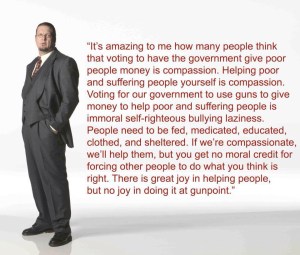
The part where Democrats go wrong is that they fail to understand that government is not a charitable organization, it is an agent of force. You cannot argue that putting a gun to someone’s head, and forcing them to give to a cause they do not support is moral. If the cause needs support, and is worthy of the assistance it asks for, it will gain support on its merits, not because glad-handing politicians decided it was worthy.

What Democrats are pushing for when asking for more government isn’t moral, it’s lazy and selfish. They have their causes that they wish to support, but instead of making a case in the marketplace of ideas as to why the rest of us should support it, they try to pass laws to force us to do so whether we like it or not. Does that really sound moral to you?

Penn Jillette
Penn Jillette

The argument that if they don’t, people won’t help has a lesson in there that they routinely fail to see. People don’t support it, because it’s often not a good idea. Just because someone’s intentions are well-meaning, doesn’t mean they are right.

I might want to help the doctor saving the life of a loved one, but any help I attempt to provide in an operating room would likely be less than helpful at best. I don’t know what I’m doing, and can help the most by staying out of the way, something government officials should understand, but the desire to do something always seems to overwhelm them.

Famous examples like Solyndra, where we invested $500 million taxpayer dollars with little knowledge of the solar industry, and lost it all. Or with General Motors, where we invested $49.5 billion that GM didn’t even want, only to lose $10.5 billion when all General Motors needed to do, according to ousted CEO Rick Wagoner, was to file bankruptcy, which they ended up doing anyway.

Rick Wagoner
Rick Wagoner

Both instances, Obama and his administration meant well, just as I would in the aforementioned operating room, but good intentions still yielded bad results.

The problem for many Republicans is that they are quick to paint Democrats as evil, or immoral in response to the Democratic attacks. Ultimately, they’re often just wrong, and we’d be smart to focus our message on the factual inaccuracies Democrats use to justify their agenda.

Name calling has never advanced society, and it never gives you the moral high-ground. Republicans and Libertarians alike, should acknowledge the altruistic intent of every Democrat-proposed item on their agenda, but then break down why they are bad ideas with logic and reason. People will respond to this better than bickering and insults.

Our government is designed to be a guarantor of rights, which it must do at the point of a gun. That is a morally sound thing to do when using an agent of force.

But deploying the might of government into free markets, free will, and the individual pursuit of happiness, is oppression. It isn’t oppression like we saw in the 1700’s under monarchies, or into the 1800’s with slavery, but it’s still forcing people to be subservient against their will. Much like government, oppression of any kind, should be minimized as much as reasonably possible and should never be portrayed as moral.

The fact is, both parties mean well, and should be portrayed as moral. We simply disagree on the methodology and implementation of how to best advance our nation. We on the right feel freedom accomplishes this best, Democrats believe government regulation does. Since the historical evidence is on the libertarian side of the argument, I will always contend we are effectively the most moral.

You are probably a libertarian if…

One of the struggles I believe libertarians face is convincing people who largely embrace libertarian principles to know and/or admit they are actually libertarians.

A good number of people I interact with state they are socially liberal, but fiscally conservative. I’m sure you’ve probably heard this. If you’ve ever said this yourself, you’re essentially a libertarian.

Yet many of these people are either not aware of what libertarianism really is, or just refuse to admit they’re a libertarian because of the unfair and inaccurate stereotype that libertarians are anarchistic drug addicts.

Einstein is quoted as saying, “Everything should be made as simple as possible, but not simpler.” Whether he actually said it or not, is questionable, but this is essentially the philosophy of libertarians regarding government. Most of us are not anarchists, we simply believe that government should be as simple as possible without resorting to anarchy.Don't Tread On Me

So with that in mind, I decided to put together a list of signs that might help you to understand whether or not you are indeed a Libertarian.

You’re probably a libertarian…

  • If you’ve ever driven without your seatbelt on, or ridden a motorcycle without a helmet, even though the law says you must, because, “dammit, it’s my head, and I’ll do what I damn well want with it.”
  • If you’ve ever noticed your neighbor who is on disability throwing his golf clubs in the car as you’re headed to work and thought to yourself, “Hey, something isn’t right here.”
  • If you think straight people trying to ban gay marriage makes about as much sense as you banning someone else from having a doughnut because you’re on a diet.
  • If you have ever questioned the logic of why a carmaker is required to put airbags on your car by law, which you are then allowed to turn legally turn off and never use.
  • If you’ve ever wondering how it’s legal to give sex away, but not OK to be compensated for sex.
  • If you’ve ever stated that Democrats and Republicans are both corrupt.
  • If you’ve ever gotten a ticket from a police officer in a situation where you were no danger to other motorists whatsoever and been mad about it.
  • If you’ve ever been upset because you went to buy liquor on Sundays and were restricted from doing so because of obvious religious underpinnings that should be clear violations of the 1st amendment, yet are allowed anyway.
  • If you’ve ever heard the phrase, “No victim—no crime” and thought, “Yeah, I’m down with that.”
  • If you’ve ever thought about opening your own business and were scared away due to the burden of regulations you were faced with and thought, “This shouldn’t be this complicated.”
  • If you’re a smoker and have been upset that an establishment wants to have a designated smoking area for people like you, but were advised they could not by law.
  • If you’re young, reasonably healthy, somewhat poor, and don’t really want to have to buy health care, but upset you are no longer given that choice.
  • If you have friends who smoke marijuana safely and without harming anyone and thought it’s basically nonsensical to throw someone like this in jail.
  • If you’ve ever heard your child’s school fired their favorite teacher in favor of the more tenured teacher and thought, “How dare they choose an older teacher over a better one when we’re talking about the future of my child.”
  • If you’ve ever received a traffic violation citation from a machine that took a picture of you and didn’t smile because you were on Candid Camera.
  • If you’ve ever witnessed a terminally ill person want to engage in assisted suicide, and were upset that government officials were intervening as if it’s any of their business.

These are but a few of my favorites I can come up with the top of my head, can you think of more? Tweet me at @LgclLibertarian, #MightBeLibertarian

Consenting Adults Amendment: How Columbus City Council Screwed The Little Guy

Gary Nolan (and THE Scrappy Doo)

Like many internet writers, I’m an amateur—I do this for the joy of spreading the liberty and rational thought message to any who will listen. If you’ve ever gotten the impression I’m rich, your hypothesis regarding my financial status, is indeed quite flawed.

Many on the left champion more regulation because they say such things protect and/or help the little guy, the underprivileged guy, the poor guy—that’s me!

So let’s see how this is working out for me so far.

In order to help lift myself out of financial distress, I ultimately need to either get promoted, find a new job, or obtain a second job—I’m ruling out the lottery due to statistical improbability. Of the three choices, the latter is the easiest and least risk-involved, so I endeavored to find additional ways to pad my pocketbook.

As I was watching an episode of The Independents on Fox Business, host Kennedy did a segment on Lyft, the peer-2-peer app based car service. It’s a very novel, yet simple, idea.Pinkout81-640x426[1]

  • You have a car and want to earn some extra cash.
  • You download the Lyft app and apply to be a driver
  • They do a quick background check to ensure you’re not one of Charles Manson’s kids.
  • Then a Lyft mentor comes out, shows you the ropes, inspects your vehicle, then gives you a big pink mustache to put on the front of your car signifying you’re a Lyft driver for users to easily identify
  • Once you’re ready, you launch the app, then signify you’re a driver awaiting a rider
  • Any riders needing a lift would launch the app and select a driver who is available and closest to them
  • You meet up, a ride is given, and upon completion, money is exchanged
  • The driver and rider then both rate each other on the experience. If either rates the other below three stars, they’ll never get matched again

Immediately I thought, this was for me. I have a very clean, well-maintained, low-mileage 2002 Honda Accord sedan that would be ideal.

2002 Honda Accord: According to Columbus City Council—death trap

So I installed the Lyft app, went on to the website, and signed up. I’m a personable guy, I love to talk to people, I can work when I want, and I don’t mind driving. Plus, I get to be self-employed again (I’m a previous small business owner), no jerk boss to deal with—it couldn’t be any more perfect, right? I was genuinely excited!

So Lyft contacted me, set me up with my mentor, but then an overreaching government hit me like a ton of bricks.

My 2002 Honda Accord is two years older than the 10-year-old or newer requirement a recently passed law by Columbus Ohio City Council requires, which meant that legally, I could not be a Lyft driver with my car; I’d need to buy a newer one. Generally speaking, if we had the money to buy newer cars, we likely wouldn’t be looking to drive for Lyft, right?

So these bureaucratic do-gooders, either guided by ignorant benevolence, or pressure from much-richer-than-I taxi company lobbyists (or both), who claim to be out for the little guy like me, took away this little guy’s right to go into business for myself in this manner.

Columbus City Council: AKA People Who Violated My Right To Earn A Living

I’m sure the Columbus City Council patted themselves on the back for their chicanery, touting out how they have protected would-be victims from someone with an unsafe automobile. But this assumes many things which cannot be deemed true with any certainty.

  • It assumes any car 10 years old or newer is safe. (False)
  • It assumes any car 11 years old or older is unsafe (False)
  • It assumes a would-be adult rider cannot make a reasonably intelligent decision about whether to get into a car and accept a ride from someone (Typically false)
  • It assumes that people who want to earn some extra money have the money to buy a newer car (Typically false)
  • It assumes Lyft mentors safety inspections aren’t good enough (Typically false). Remember, unlike Lyft,  government isn’t even inspecting your vehicle. Their regulation’s assumptions are solely based on the age of your car.

As I ponder the idea that I live in a free country where government exists solely to protect my rights, I am appalled that my city council, in a misguided effort to protect others, have harmed me with no legitimate justification—both me, and my car, are quite safe.

While I generally believe our Constitution’s framers did a pretty good job, if you’ve read my previous posts, you’ll recall I’m not afraid to propose constitutional amendments that I think would advance their principles of limited government, and deny power-hungry rights-infringers that which pleases them most.

The 1st Amendment
The 1st Amendment

That said, as a result of this incident, it got me thinking about a new amendment I wish legislators would adopt which would solve this problem and many like it—I’ll call it the “Consenting Adults” amendment.

The right for adults to engage in any agreement among themselves, barring any affected and unwitting third party, shall not be infringed.

It’s simple, and quite consistent with the Constitution’s intent as a limit on the how the government may deny your right to pursue happiness. Whether it be me providing a ride to someone for money; two or more people wanting to get married, regardless of their sex or preference; or any other act wherein consenting adults wish to engage. “We The People” should be able to do whatever we want to do, so long as we’re not hurting anyone else doing it. Libertarianism 101: No victim-no crime.

To be fair, I do understand our government usually acts with the best of intentions when they pass these laws. But sadly, many politicians neither have the intellectually capacity or knowledge to understand the ramifications of their actions to their full extent. Nor do they have the honor to admit when their actions have failed or had detrimental unintended consequences. Such instances should prompt them to repeal these regulations, but they rarely do.

They’re also sorely lacking in the understanding that everything they do, is ultimately done so, at the point of a gun. If such proposals were thought of in this manner, they would often be rejected.

Would you support cops showing up, guns drawn on me, screaming “Don’t you dare give that person a ride in your twelve-year-old death trap, or we’ll shoot!”? I sure hope not. But ultimately, if I defied this regulation long enough, that is precisely what would happen.

SWAT team: AKA People I'd eventually see if I used my 12 year old death trap to give people rides via Lyft
SWAT team: AKA People I’d eventually see if I used my 12-year-old death trap to give people rides via Lyft

Politicians should honestly understand that much of what people ask them to do is simply none of their business. Most of the time, when people say, “there ought to be a law,” they’re wrong. These days, our country is sadly free-ish at best thanks to such people. But if you vote for libertarian-minded politicians, we can correct that.

Is Evil A Passé term? An Atheist’s Thought Experiment.

Gary Nolan (and THE Scrappy Doo)

Lately, I’ve been reflecting on what it means to be an atheist. Since I wasn’t always one, how might I feel differently than someone who never had faith to begin with?

For instance, there are people who behave as though they hate their respective deity, then call themselves atheists. I’d argue those people are deists who hate themselves, yet blame their god for their own shortcomings instead of accepting personal responsibility for the way their lives are turning out.

zeus_1[1]
Mythological Greek God Zeus
In my mind, an atheist wouldn’t have any stronger feelings about God, Jesus, or Allah than they would about Zeus or Odin. To me, the only difference between mythology and religion is that the latter still has people who believe in it.

But one thing has curiously struck me lately; the concept of evil. Is this a passé term?

For those who are religious, evil is something put forth by the counterpart of their chosen deity. But I feel this term thwarts understanding of these acts by blaming a being like Satan instead of the perpetrator.

So let’s break down humans for a minute; or as we’re affectionately known in the biological community;  Animalia (Kingdom); Chordate (Phylum); Mammalia (Class); Primates (Order); Hominidae (Family); Homini (Tribe); Homo (Genus); H. sapiens (Species).

Regarding the kingdom classification of Animalia, that means that despite our own desire to feel special, we are ultimately just an animal in the animal kingdom. We are certainly the most intelligent, but there are many animals that are stronger, faster, or otherwise better adapted to their environment, as natural selection dictates.

So while we are special for our intellect, all animals have their own unique specialties, making us all special in different ways, or none of us particularly special at all; depending on how you want to look at it.

Homo-sapiens have evolved as well or better than any other species to life on Earth in many unique ways. For instance, because of our intellect, we’re the best at customizing our environment to suit our needs, instead of having to adapt like all the others. We build houses with air conditioning and heaters, after all.

We’re also intelligent enough to not only be excellent hunters, yet also quite adept at growing our own food. When’s the last time you saw an elephant planting a row of corn?

One trait that many overlook however, is our unparalleled linguistic skills. Because we are social animals, our advanced ability to communicate with others, whether it be face-to-face, or using technology such as the phone or internet, strengthens our society in ways other animals cannot achieve. Every time you ask for help and receive it, you’ve exemplified this.

Oddly enough, we’re the only animal smart enough to have observed and understood natural selection and the benefits it brings to life as a whole, yet we’re compassionate enough to try to prevent it by helping the weak among us instead of allowing them to succumb to whatever their inferior traits might be. If that’s not an ultimate display of commonly accepted morally benevolent societal behavior, I don’t know what is.

This can be seen in the way we help the disadvantaged through charity, medical care, etc. Or simply the endangered species list, where we actively work to preserve an animal that seems incapable of adapting to its environment as natural selection dictates it should.

stalin-hitler_1644235c[1]
Adolf Hitler and Josef Stalin
But back to the term “evil.” The term conjures up names like Adolf Hitler, Paul Pot, Saddam Hussein, Josef Stalin, et al., who are often touted out as examples, and it seems quite fitting on the face of it.

The reality is that if we define murder as the killing of an innocent life, the animal kingdom is full of mass murderers. Cheetahs are mass murderers of gazelles, but maybe we will give that a pass since they eat them to survive.

Lions however, will often kill cheetahs, not for consumption, but just to eliminate the competition for food. Not very sporting at all, if you ask me. So are they evil too? Of course not.

So what makes them different from human mass murderers? The fact that we are smarter, or that we understand the value of empathy and therefore can associate with the victim? In reality, it’s just that we are societal in ways that many other meat eaters are not.

The concept of morality is generally thought to be a religious one, where you are either with or against a particular dogma. Some people would argue that morals are universal, but this is a false premise. Whether it be gay rights, abortion, the death penalty, drugs, prostitution, gambling, etc., what is immoral to some is moral to others.

If we throw out the religious component, morality would generally describe behavior someone does for the good of society, immoral behaviors are to the detriment of it. While many deists would argue that without religion, there would be no morality, Professor of Psychology, Dr. Michael Shermer explains the evolutionary benefit of commonly held moral behaviors here. Evidence suggests we would be just as moral without religion.

When people think of natural selection, they often use the phrase “survival of the fittest,” which can be misleading. It conjures images of some unyielding beast who kills anything that gets in its way. But societal beings are actually “fitter.”

If a strong violent psychopath were going through the neighborhood killing people, he might be successful if everyone in the neighborhood were also a sociopath and failed to band together to combat him. But if the others unite, the psychopath would likely end up dead due to simple strength in numbers.

They wouldn’t do it for the thrill of killing as the psychopath does, but simply for the betterment of their group. Via the death penalty, war, self-defense, and vigilantism, we tend to weed out the violent psychopaths among us for our own mutual benefit.

Lethal Injection Table

Many like to think it’s because we’re exterminating evil, but if there is no deity or anti-deity, all we’re really doing is preserving our societal construct.

As for those we consider evil, they’re just psychopaths, pure and simple. People lacking empathy and the innate desire to contribute to the advancement of the human race through societal behavior.

When we think of them as evil, we feed their ego by giving them the impression that they’re somehow closer to a deity or otherwise superhuman. But if evolution has worked in our favor because we are societal, they are actually inferior—arguably, mentally handicapped beings.

As psychological research continues to advance our understanding of the human brain, there is hope we’ll find solutions to mental disorders like sociopathy and/or psychopathy. But in the meantime, it would be nice if we stop sensationalizing these people by calling them evil; they’re just genetically and behaviorally defective. Elevating their status to something superhuman by calling them evil, will only encourage their behavior.

Production vs Sales. Let’s redirect our focus for a stronger America

Gary Nolan (and THE Scrappy Doo)

Read any want ad section and you will notice one thing is abundantly clear. A predominance of the jobs available in the United States are in the field of sales & marketing. This phenomenon has always troubled me.

A salesperson is selling a product, but someone has to produce that product, a process that is surely more labor intensive than selling it. So how can it be that we always need more sales people? Because the production jobs are going away.

I’ll briefly point out that many sales positions are commissioned, so companies often over-hire because they don’t really have to pay salespeople unless they do well. They’re effectively throwing ten darts at once in hopes of hitting a bull’s-eye instead of putting the effort in to being a better dart thrower. It’s both lazy and ineffective. You often damage your brand more than improving your actual sales.

But while advertising is important, it should always play second fiddle to production, let me give an example.

If I were to offer you the car of your choice, cost-no-object, what would it be? All over the world, many of you would choose a Ferrari. Yet, have any of you ever seen a Ferrari television or magazine ad? Likely not.

2014 LaFerrari from Ferrari

Yet, millions of you would buy one tomorrow if you could afford it, despite never being faced with a single advertisement from them. Aside from their racing efforts and emails, Ferrari doesn’t really do much marketing. People wear Ferrari-logoed clothing and put up Ferrari posters, essentially marketing Ferrari for free. This is genius! You pay Ferrari for the privilege of marketing their stuff, instead of them paying someone to market it for them.

So how is it possible that one of the most desired and recognized objects on the planet does not need to be sold? Because it sells itself, just look at it!

A beautiful design, flawless engineering, a sound that is mechanically orgasmic, and a palpable passion ooze from these machines. This quick video, one of their few actual marketing efforts which will never air on TV, but has been shared (for free) at the time of this posting 5 million times, should illustrate my point.
The lesson here is pretty clear. Too often you see business owners thinking that their issues stem from poor salesmanship instead of poor craftsmanship.

There are certainly bad salespeople, and some turnover should be expected, but marketing in general seems to be where companies want to spend their money instead of research, development, and production. I see (and occasionally have worked for) companies who have incredibly outdated equipment, inefficient internal processes, and products of inferior quality that could be easily updated, but they’ve emptied their bank account on advertising instead.

We’ve all heard the story of The Goose that laid the Golden Egg, this is exactly what many companies are doing. Profit-margin is the holy grail these folks are after, but this is how they kill the goose.

A company with a great reputation will hunt for a more cheaply made product, often in China, and then hope through marketing they can continue holding on to their market share. But once you gut that goose, and people find out you used a respected name to market an inferior product; profit margins may remain high, but overall profits will start to plummet as people take their business elsewhere.

For instance, let’s look at Irwin tools. You may have never heard of Irwin, but you’ve certainly heard of Vise-Grips, and they’re the makers of them. Since 1921, they have been making these pliers that just about every person has in their “tool drawer” at home. Irwin Vise Grips have been a superior quality hand tool for nearly a century, but no more. Irwin moved them to China in recent years as they hunt for greater profit margin.

As a libertarian, I certainly want companies to have the freedom to build wherever they wish to, but that doesn’t mean I don’t think it’s stupid.

These companies are hoping most people won’t notice the loss in quality and continue paying a premium price, but consumers who use products are pretty good at noticing when a product’s quality has been diminished, and it’s insulting. Believe me, I notice the difference—the new Vise-Grips are clearly inferior.

So these days, I don’t mind buying a cheap $5 pair from the local Harbor Freight, because I know they’re probably the same plier at this point, and I’m not paying extra for the Irwin name if I’m not going to get the legendary Irwin quality.

They’re now just another cheap Chinese version no different from all the other copies out there, there’s a good chance they all come from the same factory—China doesn’t exactly believe in intellectual property. We are talking about a country that brazenly opened up an Apple Store that wasn’t actually affiliated with Apple in any way. So it’s not unlikely that the factory Irwin commissioned to make their pliers isn’t selling the exact same pliers to others, literally giving Irwin’s design away to someone Irwin didn’t sell it to.zhuhai-iphone-store[2]

I want to point out that there can be no doubt, with labor unions, overbearing regulations, the highest corporate tax rate on Earth, and the ever-increasing cost of living in the United States thanks to a poor economy, the costs of building in the U.S.A. are ruining our chances of keeping these jobs. Irwin is not completely to blame here.

But if the American people demanded our government ease regulations, get rid of the corporate tax rate (they can’t vote, so why should they be taxed?), and make the concept of manufacturing in the United States more viable again, maybe the want ads will be looking for more than just the next Ron Popeil, and real jobs and quality products will again be a part of the American economy.

Contrary to Popular Belief, We’re Not Racists

Gary Nolan (and THE Scrappy Doo)


The name “entitlements” always troubles me. I reject the notion that someone is “entitled” to the fruits of another’s labor.

When those of us on the right argue that welfare, food stamps, unemployment, and/or disability should be reduced in any way, let alone eradicated, we’re often branded as racists. The argument being that reducing these programs would unfairly hurt minorities because statistics show that minorities disproportionately make up those who utilize these programs.

So first, let’s talk about what it means to be a racist. It generally means that you hold someone in a different regard because of their skin color or ethnicity, and it’s generally used in the context of disrespect, but not always. On occasion, it is intended as a positive force.

For instance, the NAACP, a group with a noble mission, is still a racist organization. But it’s mission is to help “colored” (the C in NAACP) people, and it limits its assistance to only that group, discriminating against all others. It makes no effort to harm people outside their race, which distinguishes it from negatively racist hate-based groups such as the KKK or the Black Panthers.

NAACP-Logo[1]

That being said, I generally think racism on all fronts should not exist in a properly moral society. I would prefer these organizations favor groups like the financially underprivileged and leave race out of it. In 1909, when the NAACP launched their efforts, race issues were very different from today. Legislative racism was prevalent and allowed, and private racism wasn’t relegated to the very ignorant few as it is in the modern era.

But back to government programs. While I understand the numbers indicate that this would affect minorities at a greater level, I find the notion insulting that most on the right are attacking government handouts from a racist point of view. We are attacking these programs from a work-ethics and/or morality point of view.

We generally believe that people can and should earn their own way, regardless of their ethnicity, and should not expect society to finance their life. I’ve not seen anyone outside groups like the KKK argue to end entitlements for people of color only, so the argument it is racist is not buoyed by any real evidence.

Penn Jillette
Penn Jillette

If someone needs help, they should ask for it from their family or community, but they have no right to expect government to extort other American wage-earners at the point of an IRS agent’s gun. “We the people” should have the right to choose who gets our hard-earned money and how much of it.

People who use these programs are mostly capable of taking care of themselves—very few are severely disabled to a point where they can do nothing to earn a wage. While some are purely lazy, many who used to work but suffered an injury preventing them from doing their chosen profession just need to reeducate or retrain themselves in a new field. But why would they as long as government will give them free money? While I admit that it can be scary or difficult to make such a change, YOU are your own responsibility; if society didn’t harm you, then society does not owe you. MESC UNEMPLOYMENT2#67134

Many contend there’s no jobs to be had. Yet I’ve never seen a local newspaper want-ad with the header, “Sorry, no jobs this week.” The problem is that many simply refuse to take a job they don’t want or that they feel is beneath them. That’s a choice they should be allowed to make, but I don’t feel I should be expected to bankroll it.

They argue that most of the wages are too low, but the problem is just as easily due to costs of goods and services being too high from taxes needed to pay for these programs and other government waste.

But there’s another issue that I believe is very racist, and it’s not what’s perpetuated by us on the right. The left arguing that minorities need these programs. It essentially insinuates that minorities are inferior, less capable of fending for themselves, or that they’re uncompetitive in the job marketplace.

The only other theory is to argue that minorities are being held back by Caucasians, but this would mean that whites have secret “white-people” meetings where we conspire to halt the advancement of others, which of course is ludicrous and unequivocally racist in its own right.

Sadly, many have been conditioned by some unscrupulous community leaders to believe that the color of their skin hinders their advancement instead of instilling in them that they can succeed with hard work, a good attitude, intellect, and selfless dedication. We have plenty of minority successes in this country as a counter-argument to the idea that race is a road-block to success.

Democrats founded the KKK, and they were also the ones to fight vehemently against abolishing slavery—far too few even know this. Their hateful racism has merely been replaced with compassionate racism, but it’s still racism and it’s still wrong.

Martin Luther King Jr.

Martin Luther King Jr. had a dream that his children would be judged by the content of their character, not the color of their skin. He never argued they should get special treatment because of it. It’s one of the most elegant statements ever given regarding racism. He didn’t want a divided black vs. white nation, he wanted a united one of mutual respect where race didn’t matter.

Skin color is no different from hair color or eye color. These traits are  genetic variances within our species (homo-sapiens), brought on by geographically varied ancestries and natural selection. As such, they should be treated as descriptors or indications of heritage, not predeterminers of one’s intellect or ability.

Racism is slowly being eradicated as advancements in knowledge of biology grow, specifically DNA research, which disprove the idea that minorities are somehow a sub-species, a theory widely held not much more than a century ago.

Tiger Woods
Tiger Woods

But also, racism ends as heritages intermingle and produce mixed offspring. Barack Obama and Tiger Woods are but two shining examples of mixed-ethnicity people who’ve went on to achieve greatness, and this group is growing rapidly.

I have little doubt that “pure-breeds” as some might call them are a dying breed, and I think this is not only a good thing, but part of our evolutionary process as natural selection chooses the best traits from all races to effectively build a better man.

As our ability to travel to faraway lands becomes easier, facilitating cultural intermingling, I suspect we will evolve into one big race somewhere in between in the centuries to come—a beautiful concept in my opinion.

So how do we end racism? It will die a slow quiet death with education and evolution all on its own, the evidence clearly indicates as much. Race-baiters with megaphones calling other people racists only foster bigotry by dividing us on the issue of race, accomplishing the opposite of the cause they profess to fight for. We are not the racists—they are.