Ever heard of intergovernmental immunity? I sure as hell hadn’t.
During the formation of the United States, state’s rights were a big fucking deal to the founding members. They were wary to create some “all-powerful” federal government—that ish would be too much like the motherfuckers they just shot and killed in order to form our new nation.
That said, they also understood that certain things needed to be controlled by the federal government over the states.
For instance, the Bill of Rights was initially thought of as a limit only on the federal government, but eventually SCOTUS heard Gitlow v. New York (1925).
Some socialist asshole named Gitlow was arrested in New York for passing out commie propaganda suggesting people should overthrow the government. He was arrested under a New York law banning such speech.
SCOTUS, after hearing the case, ruled in favor of Gitlow—the Constitution’s enumerated rights are not rights at all, if the states can violate the fuck out of them. So after that, case law mandated that the rights in the constitution applied to all levels of government, not just federal.
In that decision, SCOTUS was addressing the right to free speech via the first amendment, but it laid the precedent that the states have to abide by the Constitution’s restraints. All the states agreed to this shit—they can’t just back out of it later.
But this isn’t the only time the federal government exerts power of the states. There’s also intergovernmental immunity—which is much older.
Back in 1819, SCOTUS heard McCulloch v. Maryland. McCullough worked for a federal bank. Maryland wanted to tax said bank. McCullough told them to fuck off and die. The case made it to SCOTUS, and legendary chief Justice John Marshall opined that the states cannot tax or regulate property of the federal government, and voila! Intergovernmental immunity was born.
Chief Justice John Marshall
The federal government can allow the states to tax or regulate them, in certain areas, but only if the federal government says it’s cool. We’ll get to that in a minute.
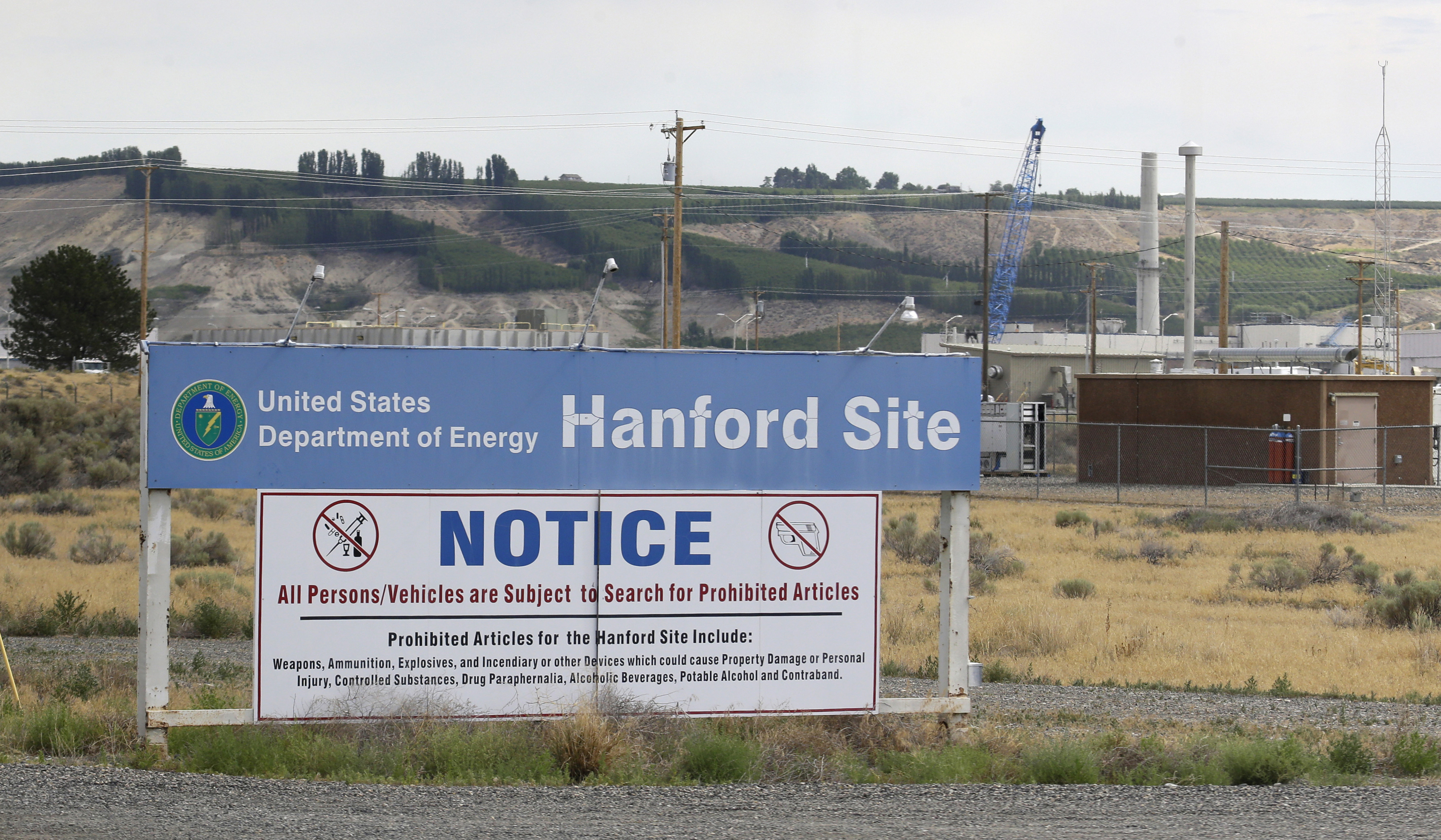
This case revolves around intergovernmental immunity, because the state of Washington has this now-closed nuclear power plant called the Hanford Site. It was built in 1943 as part of the Manhattan Project. It was the first plutonium reactor in the fucking world—’Murica, bitches! Some of the plutonium produced at that site was the fuel used in the Nagasaki bomb.
Back in 1989, they decided that this plant was old, tired, outdated, and ready to be put out to pasture. So since that shit is no longer operational, someone has the duty to erase that mother fucker off the face of the Earth, and all it’s radioactive essence along with it.
That somebody is the federal government, via the U.S. Department of Energy.
The Hanford Site
Now let’s talk about Worker’s Compensation. You know, that government “insurance” program by which, if you’re hurt in the workplace, the government pays out cash money to you?
Well, there isn’t a federal worker’s comp program—that’s usually handled by the states. So, in 1936, the federal government passed 40 U.S.C. § 3172.
Remember when I said the federal government could give the states some power over them if they wanted? This statute gave the states the power to narrowly regulate federal workers on federal property which exists in that state via that state’s worker’s comp program.
Too many times, because of intergovernmental immunity, federal workers were forced to sue the federal government to get paid for on-the-job injuries, so congress passed this law to help.
This saved requiring the lazy fucks in the federal government to pass their own version of such a program.
We know worker’s comp is about injuries that occur at work, such as falling off a ladder and breaking a fucking leg, or something. That’s pretty easy to identify as a workplace hazard and incident.
What’s not so fucking easy, is attributing diseases like cancer, which may be caused by radiation leakage from a defunct nuclear power plant, to a workplace like the Hanford Site. It’s pretty much impossible to prove that someone’s cancer is not just a random cancer they contracted, even if odds suggest it probably is related to handling nuclear waste.
But worker’s comp requires that the claimant can prove the fucking harm was caused by the workplace. So this is a pain in the ass for these people trying to clean up this nuclear site.
As you can imagine, they’re basically real-life Homer Simpsons, working in a pretty hazardous environment. When accidents happen, people will likely get sick and die. Hell, some of the protections they use, may even be insufficient, leading to problems they thought they were protected from.
At the Hanford Site, the federal government was paying claims just fine, until 2018, when Washington changed the rules with H.B. 1723, making it easier for workers to claim workplace injuries there.
Generally, if safety protocols are meticulously followed, barring some fucking equipment failure, these workers should be adequately protected. But Washington noted that protocols often weren’t followed, which then might lead to increased risk.
If workers put their own dumb asses at risk by avoiding safety protocols, it’s hard to blame the workplace for such illnesses. They’re a victim of their own defective idiotic brain—such claims usually aren’t covered.
But Washington was like, “you government assholes aren’t doing a good job monitoring these safety protocols, so we don’t really know if these fuckwits are to blame for their own issues. It could be you lazy fucks, instead.”
So basically, Washington’s rule change went from requiring proof all safety protocols were followed and they got sick anyway, to “if they got sick from a disease that could be caused by exposure, we’ll assume they’re owed compensation. The monitoring of safety protocols is pretty fucking weak at times, and we can’t really determine who’s at fault.”
Even more odd, the law specifically only modified that for the Hartford Site workers. That’s odd, because other people in the state, working for the federal government, the state, or private companies, could be working with similar risks, and subject to the same harms, but for them, they don’t get that presumption of work-caused disease.
Between when SCOTUS agreed to hear this shit, and it was actually heard however, Washington amended the rule with S.B. 5890, which now covers anyone in the state working with radioactive shit.
So the Federal government was like, “Hold on a fucking minute. We were all Kool and the Gang with this shi before, but now it’s getting expensive AF.
It might seem like the federal government wouldn’t care if it covered non-federal workers, as they’re being paid by the state, and thus aren’t on the hook for these additionally-covered workers.
This is where it gets interesting.
Before the latest rule change, the federal government was suing because they felt the state was unfairly discriminating for federal workers. Now that they are applying the rules to everyone, it’s questionable if Washington mooted this case—they’re no longer discriminating in the way the federal government complained.
The federal government is skeptical the latest rule will be retroactive, which Washington says it would be. So the federal government is like, “You assholes didn’t moot shit. We’re still on the hook for these old motherfuckers, and we don’t believe you when you say you’ll apply it to non-federal workers retroactively.
So anyway, that’s the nuts and bolts of this case. Now, let’s check in on the oral arguments…
First up for Petitioners, the good ole USA, is Department of Justice Deputy Solicitor General, Malcolm Stewart.
He opened by pointing out that the changes they made to the law, have not been proven to be to the benefit of the United States, and as such, didn’t moot their fucking claim.
U.S. Deputy Solicitor General Malcolm Stewart
He points out that every other worker on the site, such as state or private workers, are under different rules, and as such, that’s pretty unfair to the United States.
Justice Kagan asked, “if they had passed this new law before you filed for certiori to have us hear it, would you still have filed?”
He agreed, it wouldn’t have been the same argument, but they’d still have filed to ask the court to vacate the lower court’s decision on this, which they lost. But, he also pointed out that he wanted the court to provide clarification on the scope of the 1936 federal law, 3172 mentioned above.
Justice Roberts seemed confused by the statute, and asked Stewart, if the facility were owned by the state, would these workers be covered by state worker’s compensation laws?
I think at the heart of the question Justice Roberts is asking, since the law Washington wrote about these federal workers only applied to them, could they also apply it to the workers if it were a state facility?
Counsel Stewart was like, “Sure, but they didn’t.” He points out that the HB1723 law only applies to Hanford Site workers, which all work for the federal government. So even if the state could apply those rules to other state facilities, the law as written doesn’t allow it. It specifically just calls out the Hanford site.
His beef is that the federal government is being discriminated against other workers doing similar work in Washington, and that’s some bullshit, in his professional opinion. They argued this point, a lot. I mean, a LOT.
Going back to the rule that the federal government has to agree to allow the states to tax or regulate them, which they do here, his argument is that they didn’t agree to be discriminated against. If the rules were the same for everyone else, they wouldn’t fucking be here. But the state, knowing that the federal government has some deep pockets, made rules specifically for the Hanford Site peeps, knowing the state or its business, wouldn’t have to pay it, only Big Daddy Fed would.
Next up is SCOTUS newbie, Tera Heintz.
She opened by arguing that while she thinks they win on the merits, it’s fucking irrelevant because it’s moot. They rescinded and replaced the law that was on the books when SCOTUS agreed to hear this shit, so if they still have a new problem, they need to submit a new case and go through the proper channels again.
Tera Heintz of Morgan, Lewis & Bockius LLP
We’ve seen this tactic before, in a New York State Rifle Association case, when states know they’re out of line, but refuse to budge until SCOTUS agrees to take the case, then all of a sudden they’re like, “Our bad, dawg. We’ll change it.”
While it’s possible some states just coincidentally see the light, and admit the errors of their ways, this seems skeezy at best.
She was like, “their complaint is asking you to invalidate a law on constitutional grounds which no longer even fucking exists. She added, even if they win, what victory can you give them? Nothing, I tell you. NOTHING! The relief they sought when they failed, has already been granted.”
This may seem like a fair argument, as the law was rescinded. But this tactic, is again kinda skeezy. Because the new law replacing it, is offensive to the other side in a slightly different way, and they fucking know it. They effectively admit the other side had a point, but instead of just fixing the error, they try to achieve it by another means, and hope that SCOTUS is so stupid as to let that shit fly.
She goes on to point out that claims filed under the old law, are what the other side is worried about, and those claims will be retroactively amended to the new law. But as the other side argued before, there’s no guarantee this is true, and the law is not written with language that suggests it must be applied retroactively. So they don’t trust this shit further than they can throw it.
Remember, that the new law is supposed to make it so that all workers, federal or not, working with retroactive materials, can now get this presumption that their cancers and shit were because of this exposure to hazardous materials.
Associate Justice Clarence Thomas
Justice Thomas wanted to know, “what if people who benefitted under the old law, want their case updated to the new one?” He’s basically asking, what if their condition changed, and they need more assistance. Maybe the new law doesn’t help them as the old one did, so they want assistance under the old law, where they got help.
Heintz argued that workers who were awarded assistance under the old law would simply refile under the new law if they need new assistance. For pending claims, the new law is retroactive and would be applied to them. Any closed claims under the old law, would need refiled under the new one.
It’s worth noting, they’re here in SCOTUS as an appeal of a Washington Supreme Court (SCOW) ruling. Once SCOTUS makes its decision, it will go back to SCOW.
So Justice Roberts is like, “You’re asking us to assume that SCOW will rule this law to be applied retroactively, right?”
She agreed, stating that that’s how they always come down on laws like this. No reason to think they’ll come down differently here.
But Justice Roberts was like, “You know, for us to moot a case, we need some certainty, and courts are kinda unpredictable.”
She surprisingly said she understood, acknowledging justice Roberts may have a point.
Chief Justice John Roberts
She pointed out though, that the opposition are being rather speculative. They don’t come to court today with any claim of harm or damages, nor do they seek any remedy for them.
They’re asking the court to prevent future damages they fear may occur. But we’re telling you they won’t, and we have good reason to argue as much.
Justice Kagan, being skeptical that she had overcome the high bar SCOTUS has for mooting the case (basically knowing how SCOW will rule), she asked, “Do you have any precedent where we mooted a case just based on previous similar ruling from a lower court, and thus assumptions about how they’d come down on a case we’re considering?”
She didn’t seem to have any cases to cite, but argued that the court could do it if they want.
Justice Gorsuch, jumping on Kagan’s question was like, “By what authority would we just vacate the lower court’s decision, if it’s not moot?”
Counsel Heintz again, surprisingly admitted she didn’t have an answer for that. Justice Gorsuch chuckled and said he didn’t either, and they moved on.
Justice Stephen “Crazy Hypothetical” Breyer, who’d apparently been working on this hypothetical for days, was like, “OK, the old law was about a geographical area, specifically, the Hanford site, and people who worked there, who just happened to be all federal workers.
The new law says it applies to any structure and its lands.
Now imagine, some people who work on the river cleaning out muskrat nests. (Yes, he really said this)
These muskrats pick up some of this radioactive waste, and transport it to their nests. The people cleaning those nests are now exposed to danger, but they’re not near any “structure and its land.”
So what about those workers? You say the new law is very specific, but I’m betting the law doesn’t say a fucking thing about muskrats and their nests. So, I say, it isn’t clear.
What do you say to that?”
She was like, “First of all, you need to stop hitting acid before you come into the courtroom. Secondly, you’d review their case solely on the text of the new law. “
But justice Breyer was like, “But imagine these people filed fourteen claims under the old law, and they won the first thirteen under the old law, but 14 isn’t decided yet. Now, the federal government wants their money back on the first 13, and they want the worker to lose on claim 14, even though the precedent was decided in the first 13 that they won. What say you?”
She was like, “Claim 14 is independent. The 13 previous have no effect on the pending 14th claim, which can only consider the new law’s text.”
Justice Alito then asked, “If this old law is so dead, why do you care if we invalidate it?”
Associate Justice Samuel Alito
Her response seemed to suggest that she was simply trying to save the justices some time. Not sure I buy that argument.
I think the concern for them is that if SCOTUS issues a broad ruling, it could fuck up their new law, too. But if they moot the case, then nothing changes for them.
Justice Alito then asked if the 1936 waiver law allows the state to single out a particular federal facility by name?
She agreed that it could, and that in fact, when the 1936 waiver was enacted, states were already doing that. So this is why she thinks the oppositions argument is invalid.
It’s also worth noting, that this seems to only apply to workers contracted by the federal government. Federal workers are covered by the Federal Employee Compensation Act (FECA). She wants to be able to discriminate against these workers who are specifically, not employees of the federal government, just simply paid and contracted by them.
You might have thought that Justice Stephen “Crazy Hypotheticals” Breyer had worked so hard on his muskrat hypo, that he was exhausted. But he was not.
Associate Justice Stephen Breyer
He then jumped in with this:
I mean, that is exactly the question that is bothering me.
I mean, one day in the legislature a group of federal employees from Hanford show up and they say: You know, it’s tough being a federal employee.
People in the state make much more money.
We have more dangerous jobs.
And the state laws generally are pretty fair to their workers, but try working for the federal government.
This is supposed to strike a chord of agreement. So they say: Now you can’t do much for us because you’re a state legislature, but I’ll tell you one thing you can do.
What you could do for you is you give us, if we’re hurt, and define hurt very broadly, please, so that if we’re even hurt a little bit, we get millions. Now we’ve got to watch that number but, really, it’s high.
And you know the wonderful thing? If you make private employers pay this in the State of Washington, they are voters, so you have to worry about them. And if the government pays for it in the state, well, that’s a problem, you’re going to have to raise taxes.
But do you know who’s paying for this one? The feds.
The feds will pay, the taxpayers in the other states.
So let’s go and really hit the ceiling and we’ll really pay a lot of money and we won’t have to pay for it. Okay.
I know projects like that.
I won’t say which they are, but there we are. Now, to me, did I think Congress intended that? Hmm.
It’s going to take quite a lot of doing before I think they wanted that result.
Now that’s that’s where I am.
So what do you think?
Counsel Heintz responded by pointing out that if congress doesn’t like it, they can always amend the waiver—that’s their right. It’s a broad check against the abuses Justice Breyer outlined in his hypothetical.
Justice Kagan, not interested in hypotheticals like Breyer, glommed on to his line of questioning, though. She asked:
Ms. Heintz, I think the question was really a question of, like, you know, maybe you’re right about the text, but why would Congress have done that? I mean, we can’t really believe that that’s what Congress meant to do. And if you take all the other statutes which you gave us and you said, look, the text is different, and you’re right, the text is different. But, at the same time, we know that Congress has a kind of modus operandi with respect to this, and it basically always says whatever you do elsewhere you can do for facilities like Hanford. It doesn’t say, you know, whatever you could dream of doing elsewhere but actually wouldn’t you could do to federal facilities. And I think that that’s what Justice Breyer is asking.
Like, what sensible Congress would have written the statute the way you say it ought to be read?
Associate Justice Elena Kagan
Counsel Heintz was like, “The federal contractors participated in the political process when the waiver was written. So congress was aware of their concerns and where the shit might go when they wrote the waiver.
Sure, maybe congress didn’t expect us to go THIS far, but they already knew there were other rules like this, that singled out specific facilities.
She also points out that the Hanford site is the riskiest environment in the country to work in. So they surely also knew that special rules might be needed for this fucking place.
Justice Barrett question if the 1936 waiver’s language seemed to be aimed at regulatory agencies, not the state legislature.
Meaning, does the waiver apply to the state passing laws, or only to the regulatory agencies in the state passing regulations? If it’s the latter, then that assumes there’s already a law on the books creating an agency and giving them the power to regulate this.
She seemed to be hinting at the idea that the waiver was granted based on statutes that already existed, and the waiver was responding to them. So if there were new laws passed, would that potentially invalidate the waiver, and require a new waiver to be passed before they could do this?
They agreed, that sounds crazy. But Justice Barrett was essentially arguing that the waiver is directed towards the regulatory agency, not the legislature. But it’s the legislature who enacted the new statute.
Counsel Heintz argued that the waiver did not specifically distinguish between laws and regulations, and as such, the waiver should apply to the new law.
In a unanimous opinion, authored by Justice Breyer, counsel Wentz was unimpressive in her arguments, and the state law is invalidated. When the federal government waived immunity, it certainly didn’t anticipate that the states would bend them over and fuck them in the ass in ways it wouldn’t dream of doing, if the state or local businesses were paying for it.
Hear oral arguments or read about the case here at Oyez or at SCOTUSBlog.
We all remember that there were some warfare activities in Iraq, right? So because of all that, there were munitions scattered about the place everywhere, and that shit needed cleaned up.
So The Parsons Corporation were given a $60M government contract to find those munitions, and discard of them properly, back in 2006.
In the contract, Parsons had to provide adequate security for their employees, and they subcontracted that duty to a company called ArmorGroup, despite the fact that Cochise Consultancy (the petitioner here) had submitted a competitive bid.
As it turns out, this piece of shit for the Army Corps of Engineers named Wayne Shaw, had taken bribes, forged documents, threatened people, and shit like that to ensure Cochise got the bid over ArmorGroup, and eventually, his shady ass got the subcontract shifted to Cochise.
Once Cochise started, they were getting $1M more a month than ArmorGroup would have. Eventually, that shady dickhead Shaw got rotated away from Iraq, and Parsons put the contract out for bid again, eventually giving the bid back to ArmorGroup.
A Parson’s employee, Billy Joe Hunt, was involved in the corrupt scheme between Cochise and Parsons, and eventually in 2010, the FBI came knocking on his door, and he was quick to fess up, landing his ass in federal prison for ten months.
In order to encourage whistle blowers to blow some fucking whistles, the government allows for something called qui tam lawsuits under the False Claim Acts. It’s basically where a private person can sue a private party for defrauding the government, and then get 30% of the reward for doing it. As you can imagine, it encourages private people to report these scumbags, when they can get a reward for doing it.
So Hunt decided to go after Cochise and Parsons in 2013 to try to make some money. He was in federal prison for ten months, and was probably broke AF. So he saw an opportunity, and went for it.
But, unfortunately for Hunt, it was deemed past the statute of limitations by the time the FBI came after him, and he served his time. It had been seven years since the violations occurred, and of course Hunt knew about it all along.
The statute of limitations required it had to either be within six years of the violation, or three years after a government official knew about it, and the seven years exceeded both.
So a district court dismissed Hunt’s claim, but then a US Court of appeals disagreed, reversed, and sent it back, saying that Hunt was a Parson’s employee, and not a government official, therefore, the three year statute hadn’t been violated yet. The government had only recently found out, and they didn’t bother to intervene.
So as usual, two courts don’t agree, and SCOTUS here we come. Cochise of course didn’t like the Appeals Court ruling, so they sued to try to enforce the Statute of Limitations exclusion given by the lower court.
So SCOTUS were asked to resolve the idea that Hunt was not to be considered an acceptable person to “know about it” and start the clock on the three year statute of limitations.
SCOTUS told Cochise to go pound sand up their ass. Unanimous decision for Hunt. He wasn’t a government official, and acted within three years of a government official knowing about the fraud. Now fuck off and pay him you dirty fucks.
On any given day, we are bombarded with news media, film stars, and sometimes just random citizens who champion the idea of government doing more to solve all the world’s woes. Those of us on the side of liberty think these folks are misguided and/or ignorant, but the question has always troubled me as to why two people, often of similar intellect, can come to two drastically different conclusions about the role of government.
I pride myself on embracing empathy. I try to imagine what it is like to think the way my ideological opponents think; it helps to break down any claims of theirs I consider erroneous, if I first understand them. While sometimes I get frustrated to no end with the semi-socialist mantra, I give them credit for simply wanting no person left behind. There is a beautiful altruism in the idea that people should always help other people in need.
So why can’t I come on board with them?
Socialism has been tried many times in history; we have four nations in the world today that practice it as official policy. China, Lao, North Korea, and Cuba. As near as I can tell, living conditions in these nations, by no account whatsoever, can be considered even remotely as nice as what we have in America or most other capitalist nations.
Russia, a former communist nation with similar land mass and natural resources to America collapsed under communist rule while trying to compete with us. We hardly batted an eye vying with them for economic might.
Even comparing same cultures, look no further than Hong Kong versus the motherland China. Where capitalist Hong Kong natives live largely free, make good wages, and enjoy a strong economy; the Chinese struggle to keep workers from just killing themselves.
Suicide Prevention Nets at Foxconn factory
Altruistic or not, history has shown complete socialism, as official policy, doesn’t have any successful examples (from the perspective of the citizenry) to choose from. So being someone who tries to approach everything with logic, why would I champion something so historically laden with failure?
But if someone eschews history, and simply believes that somehow the only reason a government controlled economy has always failed is because they haven’t been the one running it, that person may be stuck in an ideological Alcatraz.
For those who are willing to consider a different viewpoint however, I wish to ask you to empathize with me. I’m going to give you an exercise to try to understand how I think of government, then pick any government policy you condone and apply this simple test.
First, I want you to remember one thing:
Everything government does, it does so at the point of a gun—sometimes just implied, but the threat is always real.
I know that may seem like hyperbole, but I assure you it’s not. The IRS will show up with guns on the doorsteps of those who simply refuse to pay taxes. If you fail to comply with a government demand (they don’t make requests) every step of the way, as the situation escalates, government will not simply say, “OK,” and walk away; the ultimate conclusion will either be you or a government official getting shot and killed.
So when I consider any law, the first thing I imagine is whether I would be willing to put my own gun on that person to make them do what the law being proposed is asked.
For instance, I do not use recreational drugs—I think doing so is an illogical act and they simply do not interest me. But if my neighbor were next door smoking a joint, would I be compelled to walk over there, put a gun to his head, and tell him stop immediately or I’ll shoot?
Of course not.
Yet every one of you who argue to keep marijuana illegal are asking the government to ultimately do exactly that in your name. Government is an extension of you in this country, so if you’re not comfortable doing it yourself, you’re being lazy and hypocritical asking government to do it.
Conversely, if my neighbor were next door molesting a child, would I be compelled to go over and tell him to stop at the point of my gun? Honestly, I’m not so sure I’d even pause to ask him to stop. I’d probably go straight to “kill” mode. Therefore, I’m very comfortable asking government to enforce such a law.
I am firmly convinced that those of you who will not acquiesce to calling yourself a libertarian have never applied this simple principle to every single law you’ve considered a good idea.
But that’s sticking your head in the sand, because you cannot remove “being compelled by lethal force” from the equation of legislation.
Would the average Democrat put a gun to Bill Gates head and demand he pay a welfare mom who refuses to work, despite being physically able to, a chunk of the salary he worked so hard to attain?
Would the average environmentalist put a gun to the CEO of General Motors head and demand his vehicles get 30 mpg or you’ll splatter his brains all over the wall?
Would the average Republican put a gun to the head of a gay couple and tell them they had better not try to marry one another?
I’d like to think none would. But unlike me, they wrongly never take the time to think of considering the government in the proper way I proposed.
Libertarian Party Logo
So I ask all of you, think about a law either proposed or on the books that you condone. Then imagine putting a gun to the head of the would-be violator and honestly ask yourself if you still feel the same.
If you do, I would like to think that for many of you, I can now warmly welcome you into realm of libertarianism. We’re glad to have you.
Have you ever had one of those common misconceptions you’re constantly prone to correct?
People often state that America is a democracy, yet it’s not—America is a republic because we have a constitution. In a democracy, the majority always rules, but in a republic, the majority only rules when they do not violate a constitution. The purpose? To protect minorities from the whims of the majority.
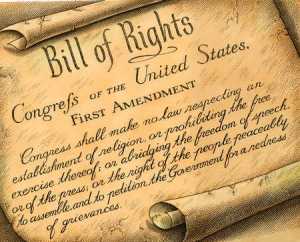
The 1st Amendment
A great quote from an unknown source, often falsely attributed to Benjamin Franklin is that a Democracy is two wolves and a lamb voting on what’s for lunch. A republic is an armed lamb contesting the vote. Who knows who actually wrote this, but it’s elegant in its accuracy and simplicity.
I find the distinction of a democracy versus a republic odd for Democrats, because they go to great lengths to paint themselves as the party who supports the needs of minorities, but democracy being the heart of their name is the polar opposite.
In theory, being a Republican means you believe in the idea of a constitution—a protector for the rights of everyone, including minorities. Whether that minority is someone of a different race, sex, age, religion, or economic status. Something Republicans of late often struggle with too as they pass legislation which grows government contrary to their core values.
On a side note, the name Libertarian of course is fairly obvious and still very appropriate—we’re solely about liberty. Some are pure anarchists, some are just government minimalists, but the basic mantra of limited government is always the same.
Libertarian Party Logo
Republican and Democrat nomenclature is largely moot these days—Democrats aren’t running on a platform of abolishing the constitution, nor are Republicans running on the platform of establishing a constitution since we already have one.
But, as I think about their respective policies, it is often the Democrats who wish to push through popular legislation regardless of whether it seems to jive with the Constitution or not, leaving Republicans as the one of the two more often standing with our founding document when battling against a populist agenda.
If you look at many social policies to help the poor, they help the majority (those who aren’t rich) at the expense of the minority (those who are rich). Something more charitable wealthy folks like Warren Buffet and Bill Gates may not mind, but others who believe that they can help the people and the economy better by investing themselves, instead of giving their money to a largely wasteful government, find infuriating.
Americans still largely believe socialism and communism are wrong. So politicians proposing laws that are socialistic in nature have had little choice but to rebrand them. They can’t publicly acknowledge many of their policies are socialism, the people would have none of that. But if you call it “Fair share” taxation, and appeal to the class envy of the masses, you can get them to believe that legislative-lemon is legal-lemonade.
But wouldn’t it be nice if we had honesty in politics? If the policies a prospective politician is proposing are so good, shouldn’t they want to be honest about them and let them stand on their merits? As a proper skeptic, the first red flag any voter should recognize is when a politician refuses to go into the nuts & bolts of their proposals. It’s a sure sign there’s something in there they don’t want you to see.
Senator Rand Paul (R)
If you look at politicians like Gary Johnson, Justin Amash, Rand & Ron Paul, they have made a name for themselves telling the people what they need to hear, not what they want to hear.
Their message of, “Give me the power so I can then take it away from myself and the rest of government” is a refreshing sentiment that seems to be gaining ground with the populace in the wake of the recent government scandal smörgåsbord, although I may just be optimistic.
In the coming years, it will be interesting to see if Republicans choose a libertarian leaning candidate like Rand Paul, will the Libertarian Party unite with them to defeat the authoritarian leaning left, or will they continue to fight each other while socialists continue to work with Democrats instead of splitting off like the Libertarian Party did with the Republicans?
I believe the era of big government Republicans is over. As America continues to evolve away from the strict religious dogma of eras past, embrace science in a way that methodically deconstructs most vice laws for the ineffectual farce that they so often are, and become more libertine in their views about sexual orientations and preferences, the future of the Republican Party is best served by becoming more libertarian.
While I understand these core religious beliefs are important to them; they must understand that these are policies better pushed for on a personal level instead of a legislative one. Our forefathers never intended for government to police individual morality; it was designed to protect our rights from another who would threaten them.
Congressman Justin Amash (R)
Our forefathers thought liberty was worth fighting for and dying for. Yet most Americans and politicians seem to overlook that public workers, soldiers, and politicians swear to defend the constitution, not the government.
But either way, the Democrats lost their battle in 1787 when we adopted a Constitution, yet they still won’t let go of the name—it is kind of sad. Then again, they might have an uphill battle if they decide to go with a more accurate “Socialist Party, ” so I guess I can’t blame them.
For many, an interest in politics, who our leaders are, and which political side we’ll choose to stand on is sparked by single events. For me, as a pre-teen adolescent, it was the Iran hostage situation. I could not fathom how one of the world’s two superpowers was allowing a little 3rd world country to hold our people hostage. It was troubling, and I detested Jimmy Carter for not sorting it out. To be fair to Carter; being so young, I was blissfully ignorant of the behind the scenes actions that were being attempted—all I saw was the big picture.
Carter Era Gas Shortage Sign
The long lines at gas pumps, thanks to Carter’s poor handling of OPEC, were hurting adults trying to make a living as well, but as a kid, I simply didn’t understand economic issues yet, so it didn’t really affect me like the Iran hostage situation. As we all know, Ronald Reagan took office, and our hostages came home. From then on, I was a Reaganite.
One of the things that upset me this past election was the notion that the economy was still so horrible because of what Obama inherited. While we all mostly agree he did inherit a poor economy, four years later, is it really an acceptable excuse?
As Reagan took office, he inherited a misery index of 20.76. It was the highest recorded misery index in history going back to that statistic’s inception in 1948—it hasn’t been to a higher level since either. Carter may have been a nice man and a brilliant scientist, but as a president, he failed miserably at maintaining America’s economic strength, much less growing it.
By comparison, Barack Obama inherited a misery index of 9.65. Less than half of Carter’s benchmark. While I agree G.W. Bush’s handling of the economy at the end was poor, it was a far cry from the disaster Carter presided over.
So approaching the “Inherited a poor economy” argument, let’s see how Reagan and Obama handled what they inherited:
After four years under Reagan, the misery index improved from the aforementioned 20.76 to 11.81—a significant improvement. After four years of Obama, it went from 9.65 to a slightly worse 10.15. Reagan wins this battle; one point for the Gipper.
But let’s delve further. If we look at GDP numbers, at the end of the Carter administration, dividing our total GDP by our population, we have approximately $11,433 per person in 1979. After 1983, that number improved to $15,171; an improvement of 25%.
Now let’s look at Obama. In 2008, the average GDP per capita was $47,363. At the end of 2012, that number grew to $49,494; an improvement of 4.3%. Reagan wins again; two points for the Gipper.
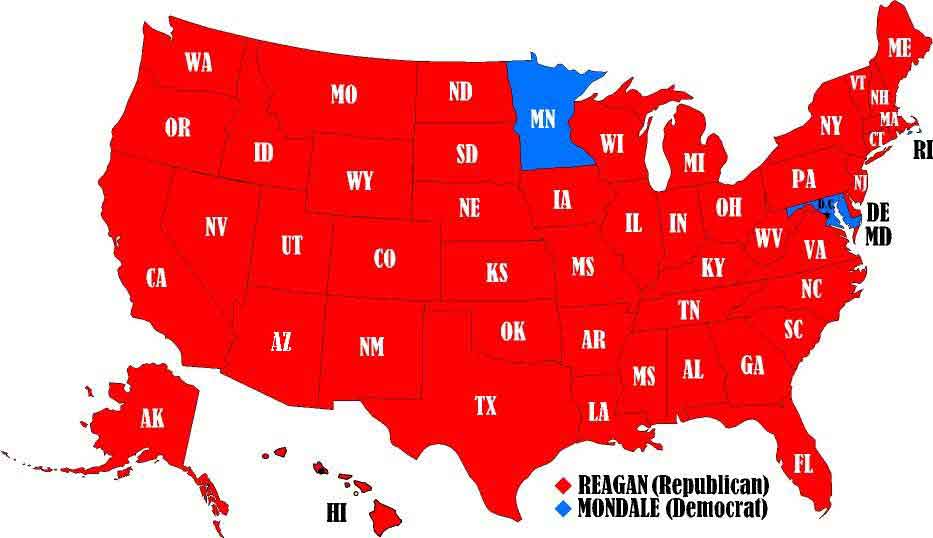
1984 Election Results
All that being said, one of the fairest tests of a president in a democratically-elected contest is how he is judged by the people he governs during a reelection. After four years of Reagan, he resoundingly beat Walter Mondale 49 to 1 states—Minnesota the lone stand out. He won 525 electoral votes compared to 13 for Mondale, and a popular vote of 58.8% vs 40.6% (54,455,472 to 37,577,352 votes). This means that a Republican actually won the left-wing bastions of California and New York! It was the greatest election defeat in history.
Barack Obama against Mitt Romney on the other hand was 26 to 24 states; 332 to 206 electoral votes; 51.1% to 47.2% with 65,910,437 votes to 60,932,795. We’ll call that an easy Reagan victory as well—three to nil; the Gipper.
Ronald Reagan
It was a long time ago, but when questioned about the state of the economy, I don’t remember Reagan blaming Carter his complete first term; he was too busy making his case for the future. He lowered the top-tier tax rate from 70% to 28%, gave people their money back, and just as planned, the economy took off like a rocket. So well in fact, that we reduced the world’s superpower population by half as Russia crumbled while attempting to compete. It was capitalism versus communism; capitalism won.
So why am I promoting Ronald Reagan if I’m a libertarian? Because not only do I believe that the GOP should be the libertarian party, I believe Ronald Reagan was my generation’s closest thing to a libertarian president, and this excerpt from a 1975 interview with Reason Magazine should illustrate why:
If you analyze it I believe the very heart and soul of conservatism is libertarianism. I think conservatism is really a misnomer just as liberalism is a misnomer for the liberals–if we were back in the days of the Revolution, so-called conservatives today would be the Liberals and the liberals would be the Tories. The basis of conservatism is a desire for less government interference or less centralized authority or more individual freedom and this is a pretty general description also of what libertarianism is.
Now, I can’t say that I will agree with all the things that the present group who call themselves Libertarians in the sense of a party say, because I think that like in any political movement there are shades, and there are libertarians who are almost over at the point of wanting no government at all or anarchy. I believe there are legitimate government functions. There is a legitimate need in an orderly society for some government to maintain freedom or we will have tyranny by individuals. The strongest man on the block will run the neighborhood. We have government to ensure that we don’t each one of us have to carry a club to defend ourselves. But again, I stand on my statement that I think that libertarianism and conservatism are traveling the same path.
One of the constant knocks against Reagan by libertarians and liberals was his massive spending on defense—a criticism he fairly leveled at himself. But people seem to lose sight of the fact that for all of Reagan’s spending on defense, every succeeding president has put more troops in harm’s way than Reagan did. Contrary to belief, he avoided conflicts as well as any president could.
What he did do however, was ensure that America was deemed to be so powerful, that any nation endeavoring to threaten us would understand it would be assured destruction. And with the exception of Russia, it wouldn’t be mutual. He referred to it as peace through strength.
When America was founded, there were many superpowers—we weren’t yet even one of them. But by the end of 1988, in no small part thanks to Reagan, we were the only one left standing, and remain as the only one still today.
If you lead by example, others will follow. America was a leader 200+ years ago in adopting a principle of liberty, and as a result of our success, there are free nations all over the world who followed our lead; including the monarchies we rebelled against so many years ago. Sadly, they may never give us credit for inspiring them, but true greatness doesn’t need acknowledgement, it’s content in the knowledge it is great.
Socialism: an interesting concept. Depending on who you are, your reasons for supporting it may vary.
Let’s start first with the basic concept which is inherently altruistic in nature. The idea that we should all pull together in an ultimate show of social equality—no winners or losers.
The people who have never lived under socialist rule who describe themselves as socialists, or their less extreme quasi-socialists who simply believe equal opportunity should be synonymous with equal result (We’ll call them quocialists), see socialism as a means of helping the less fortunate.
I find Hollywood ironic—they are composed of America’s most outspoken quocialists. However, think back to every movie where the plot line was a government that tried to create a socialistic utopia. 1984 and others all had one common thread: utopias suck and a government that tries to create one is inherently evil. There are hundreds of movies based on this concept, yet the hero is always someone yearning for freedom who leads a rebellion to fight the power. Government is never the benevolent protagonist.
So are Hollywood writers smart, yet actors blissfully ignorant?
Maybe.
If so, actors are either dupes or hypocrites. They take roles that reflect that big government is evil, while promoting it as the answer to everyone’s problems off the silver screen.
So then why do quocialists continue to pound the drum of more government? If you’re ignorant of history, and want to be loved by everyone, you fight to take away the bread crumbs from the rich and assume that will be enough to feed the poor.
The problem with this, is that they’re not taking just the bread crumbs—that’s never enough. They’re trying to take three or more courses of a five-course meal. Plus, they aren’t doing all of the giving, they’re forcing others to do it.
The reason I say they are ignorant is because we have many real-world examples of socialism to learn from. I cannot recall one socialist nation whose people don’t live in squalor. Hollywood writes these movies—even they can’t make it seem awesome. History shows it leads to deplorable economies; yet these folks, mired in ideology so thick they can no longer see through it, promote something that anyone with a modicum of knowledge has seen, never works to the benefit of the people.
So let’s throw out full-blown socialism for the half-hearted version our president routinely proposes; you know, the one where he says he loves business, but conveniently leaves out the “so I can tax them to hell and back” part.
Apparently these folks again are ignoring that no government has ever taxed itself into prosperity, and conversely ignoring that as a country embraces free markets and liberty, it thrives.
Look at Hong Kong vs China as a prime example. As the people of mainland China jump to their death from the Foxconn plant because conditions are so bad; a mere boat ride away, Hong Kong is a massively growing economy where people thrive and prosper making nearly 2-1/2 times as much per capita. Similar culture and people, just communism vs capitalism.
Suicide Prevention Nets at Foxconn factory
Compare the number of people fleeing socialist nations for America versus the number of Americans fleeing to go live in a socialist nation—then try to make your best case for socialism.
The problem is that Hollywood literally lives in a land of make-believe; where if something can be written, through imagination and companies like Industrial Light & Magic, it can be turned into an on-screen reality. When you live with a mantra that anything is possible, you start to believe that anything really is possible; such as making sure no one is left behind. The intentions are good. But much like science-fiction, it’s always lacking in real science that actually works.
Now to look at other paradigms, let’s talk about the people who live under socialist rule.
We know that people living under socialism often are dying to get out. Why do we know this? Because they are literally dying to get out. If you’ve not yet been disarmed, you become a rebel, fight the power, and likely die a martyr. If you have been disarmed; cutting and running is the soup du jour, with dreams of asylum yet nightmares of a watery grave on your mind.
Some are exactly what socialist rulers hope they would be: loyal servants of the state. They’ve been ingrained with the notion that serving your country is the most noble cause imaginable just as we’ve been ingrained that freedom is an unalienable right. If every person were born without a sense of individualism and a desire to want more, this socialism fad might just work. Too bad that’s not in the nature of mankind. Even the most loyal patriot drives 60 mph in a 55 mph zone. We just want to be free!
Many stay and take advantage of the hard work of others. They are beaten down, convinced there’s no reason for hard work (in their world there isn’t), and just do what they can to stay off the radar while working as little as possible and living off of the state.
I don’t know about you, but I’m not interested in being any one of those people.
The last group I want to emphasize the most: socialist leaders. From Adolf Hitler, Kim Jong Il, Fidel Castro et al., they all have one thing in common. They expect everyone to pull their “fair share” and work together as a unified state. Name me one socialist leader however who doesn’t own several mansions, diamond encrusted Mercedes Benzes, and servants to wash their family jewels—yes, those jewels.
I’ll believe real-world socialism isn’t evil hypocrisy when I see one socialist leader that lives on the same income as the people they govern.
The quocialists of America continue to assert that income disparity here in America is bad, but in China you have a couple of billionaires thanks to government corruption, then the other 99% who are lucky if they’re making a fifth of what we do here. Maybe American quocialists ought to take notice that while the real socialists build the iPhone and iPad, it’s those of us who live under capitalism that can actually afford to own one.
There are thousands of people in the United States that make far more money than the presidential salary our current POTUS rakes in. but that would rarely be tolerated under socialist rule?
So for Americans, socialism in any form is just a means for them to convince you they want what is best for you. Some are altruistic, but most are doing it to feel good about themselves. For people under socialism, they’re miserable, live in conditions I wouldn’t subject my dog to, or they die on a boat or a revolution dying to escape. Can you cite examples of anyone dying while trying to flee America or any other free country?
For socialist leaders, they have no intention of giving the people anything other than what is needed to convince the people not to revolt—not a penny more. To them, the food provided is merely fuel for the workhorses of their economy. Promises of primary needs are merely done for self-preservation of the socialist ruler, not the benefit of the people. Like Hollywood, they want to be worshiped and loved, but just can’t be bothered to do any actual work to earn that worship and love.
So are socialist leaders evil? All the socialist leaders I know of are.
Are Hollywood quocialists evil? No, They’re just altruistic, but lazy and ignorant.
Are people who live under socialist rule evil? No, they’re victims.
Now that Psy is making news again for singing lyrics that advocate killing US soldiers many years ago, I’ve decided this might be a good lesson in proper skepticism. People are often quick to jump to conclusions about someone based on one tidbit of information, but that’s just not a good way to be. Too often you end up jumping to wrong conclusions, or leaving yourself vulnerable to attack because you ignored other important evidence.
For instance, if I told you there was a man long ago who was upset by the fact that cars were only available to the rich, and commissioned a car company to build affordable cars that the average person could buy, you’d think that sounds like a good person.
If you read my post called The Beetle is dead, and government killed it, you’d know that person was Adolf Hitler. So hopefully you understand the importance of gathering all of the facts before judgement is passed.
I don’t presume to know what’s in anyone’s heart, and neither should you. But one of the first things that concerned me on this is something that happens often when people judge musicians. They assume that the lyrics have meaning to the artist. When Andrew Kevin Walker wrote the movie Se7en, no one asserted he was advocating killing all sinners in brutal fashion. Why? Because it was a fictional movie. Phil Collins’ famous song “In the air tonight” is often mistakenly assumed to be written because Phil witnessed someone committing a violent act. In reality, he has repeatedly stated that it was pure fiction.
So when judging a musician based on some lyrics they wrote, first you must stop and ask was this just a work of fiction or were they truly advocating this sentiment. Based on Psy’s own statements, he was upset about American soldiers who killed two Korean nationals, and were acquitted of any wrong doing. He was highly upset, and as a result, spewed some pretty hateful things. So this was not a work of fiction, he actually meant it.
So then I think about what motivated him to say it and how would I feel if the roles were reversed. If Koreans soldiers killed two Americans and were acquitted, would I be mad? Probably. Would I say hateful things? Well, I’m a proper skeptic, so I’d do the research and not jump to conclusions, but if I were an impulsive, young, dumb, musician prone to spouting off through my music, maybe I would.
So then I ask myself; is he someone who has never really come to know America? People in other countries are often anti-American, and spread a lot of lies, hyperbole, misinformation, and half-truths about the good things we actually do around the world. Musicians sometimes live in a pro-anarchy bubble of friends who love to demonize any government as well. However, Psy spent 4 years here in America prior to writing these hateful lyrics, so he has certainly had an opportunity to come to know America, and should have known better.
So then I ask myself, does he still believe this? Well, he did issue an apology. So as not to leave out any context, here it is in its entirety:
As a proud South Korean who was educated in the United States and lived there for a very significant part of my life, I understand the sacrifices American servicemen and women have made to protect freedom and democracy in my country and around the world. The song I was featured in — from eight years ago — was part of a deeply emotional reaction to the war in Iraq and the killing of two innocent Korean civilians that was part of the overall antiwar sentiment shared by others around the world at that time… While I’m grateful for the freedom to express one’s self I’ve learned there are limits to what language is appropriate and I’m deeply sorry for how these lyrics could be interpreted. I will forever be sorry for any pain I have caused anyone by those words.
I have been honored to perform in front of American soldiers in recent months — including an appearance on the Jay Leno show specifically for them — and I hope they and all Americans can accept my apology… While it’s important we express our opinions, I deeply regret the inflammatory and inappropriate language I used to do so. In my music I try to give people a release, a reason to smile. I have learned that though music, our universal language we can all come together as a culture of humanity and I hope that you will accept my apology.
So after reading this, do I believe his apology? As I look at it, I have a couple of problems with it. A proper apology doesn’t try to justify the behavior in any way, it just says, “I’m sorry.” But here, he does seem to make excuses for why he acted the way he did. He also says, “…how these lyrics could be interpreted.” Here are some excerpts:
Kill those fucking Yankees who have been torturing Iraqi captives and those who ordered them to torture.
And
Kill [the Yankees’] daughters, mothers, daughters-in-law and fathers / Kill them all slowly and painfully.
I don’t know about you, but to me there was little ambiguity there in what he said. I do believe I read they were lyrics from a song by someone else that he was just repeating. But, I don’t see how it was open to interpretation, either way. So again, it seems like he was trying to downplay the severity of the things he said instead of just properly apologizing for them.
So then the last thing I would ask, is if his apology is motivated by anything other than remorse? Well, he is trying to sell CD’s after all. Being universally hated by the most powerful economy in the world isn’t exactly a brilliant business strategy for a musician looking to achieve international fame. So he has a motive other than regret for his apology that cannot be ignored.
So what is my skeptical analysis?
I’d say he probably doesn’t feel the anti-American hate he did back then these days based on his words and actions as of late, but I doubt he’s truly sorry he said those things either. He’s probably just embarrassed. I suspect he has hate for those soldiers that killed his countrymen, but understands that America is the only reason there even is a free South Korea in the first place.
Can a person change? Well, I used to say I was Republican who thought Libertarians were crazy, and now I’m a Libertarian. I used to be a Christian but now I’m agnostic/atheist. So yes, people can change.
Is it possible Psy went from being an America hater to an America lover? Of course!
Does he a really want to kill Americans? I doubt it.
Was he prone to make emotional, hateful, and idiotic statements back then? Probably.
So I would accept his apology at face value, but I wouldn’t assume him to be pro-America either. America has been pretty good to his career as of late, so that may have changed in light of his new success here.
I do know this, I listened to Gangnam Style once just to see what all of the fuss was about, and after doing so, I realize that I cannot unhear it, I’m eternally scarred, and I want my 5 minutes back. Only a monster could write something so hideous.
log·i·cal: capable of reasoning or of using reason in an orderly cogent fashion lib·er·tar·i·an: an advocate of the doctrine of free will; a person who upholds the principles of individual liberty especially of thought and action












![Bad-boys-bad-boys-watcha-gunna-do-courtesy-freepatriot.org_[1]](https://logicallibertarian.com/wp-content/uploads/2013/10/bad-boys-bad-boys-watcha-gunna-do-courtesy-freepatriot-org_1.jpg?w=300)








![hollywood-sign[1]](https://logicallibertarian.com/wp-content/uploads/2013/01/hollywood-sign1.jpg?w=300)

![85204d1147826246-diamond-encrusted-mercedes-benz-sl-diamond-2[1]](https://logicallibertarian.com/wp-content/uploads/2013/01/85204d1147826246-diamond-encrusted-mercedes-benz-sl-diamond-21.jpg?w=300)




 The Logical Libertarian™