In another health care snooze fest, SCOTUS is looking at HHS and their shenanigans regarding how they reimburse certain hospitals for drugs through the Medicare Part B program.
The situation is this. You all know hospitals have to give some patients drugs, right? Well, some hospitals, known as 340B hospitals, apparently get their drugs at ultra-low prices. As a result, HHS was like, “Why the fuck are we paying you full price for drugs that you’re buying on the cheap? This is bullshit. We ain’t doin’ this no more.”
HHS also tried to say, “These are our rules to enforce, so this shit isn’t even up for judicial review.” They cited a previous precedent, used often in judicial review, from Chevron U.S.A. v. Natural Res. Def. Council. This precedent basically said that courts can’t just make up their own rules on how a regulation should work. If the regulating body (HHS in this case) has a “reasonable” interpretation of the regulation, and congress specifically didn’t say they should do something different, it’s their regulation to interpret it, and the courts should stay the fuck out of it. This is partly why they think it’s not up for judicial review.
But the 340Bs were like, “Fuck you, we use that money to help people, we’re not getting rich over here. Plus, you can’t just change the rules willy-nilly however the fuck you want. You’ve at least got to do some research first, and set your reimbursement to a number that shows you know what the fuck this shit actually costs.”
Counsel for HHS was like, “Hey, these cost surveys are a lot of work, and the government accounting office so much as told us not to do so many surveys. So we’re just doing what congress told us. Not to mention, many of these hospitals accepted the rate we gave them as perfectly fucking fine. So I don’t see the problem here, buddy.”
After deliberation, SCOTUS was like, let’s address the idea that this shit isn’t up for judicial review. We’re the Supreme Fucking Court. We’re like a regular court, but with sour cream added. We will decide what we can review, thanks. Chevron is a precedent we set. So we could fuck Chevron right in the ass, just like we did with Roe v. Wade if we want, you randy punks. But even if we leave Chevron alone, someone still has to rule on “reasonable interpretation” of the statute. Who do you think that is? That’s right. It’s us, mother fucker. So sit the fuck down with this, “Not open for judicial review” shit.
After that, they had to decide if the rule was reasonable, to which all nine justices were like, “HHS, are you fuckwads on crack? You couldn’t even be bothered to put together an Excel spreadsheet with pricing info and shit? You just cut the price by throwing darts at a dartboard? You know that’s fucking stupid, right? You give us no choice but to side with the AMA you dumb fucks.”
And with that, the HHS were told to go back to the drawing board, and if they want to cut pricing, put together a fucking pricing survey to back up their reasoning for the prices they put forward.
Hear oral arguments and read about the case at the links below.
With this case, its level of complication is only surpassed by it’s level of boringness. I’ve read it multiple times, and have basically determined that it’s just a prime example of how when government writes a law, they only make things overcomplicated and inefficient.
Basically, the gyst is this. Medicare and Medicaid pay hospitals for treating patients. The amount they pay, is a set amount for a set procedure. So if you have to get your taint amputated because you have ass cancer, they might pay $10,000, no matter where you get that shit done.
That being said, there are hospitals, knows as Disproportionate Share Hospitals (DSH). These hospitals exist to help underprivileged Americans get care they might not otherwise be able to afford to get at other care facilities. As such, these hospitals are broke AF, and need money to help cover these extra expenses. DSHs get higher payments, since their patients are poor, and often in worse health, needing more treatment, as a result of their financial situation.
The Health and Human Services agency, has an algorithm to calculate how much to pay these DSHs., which basically looks at their Social Security Insurance (SSI) benefits, time spent in the hospital, and whether Medicare and/or Medicaid pay for it.
They have two separate algorithms for Medicare and Medicaid, to try to catch everyone using one benefit or the other, but then special rules to make sure if a person uses Medicare and Medicaid, they aren’t counted twice.
This is where it gets laughably complicated. The issue is regarding the phrases “entitled to” and “eligible for.” In the English language, they certainly mean two different things. The first means, it’s yours unless a reason is presented it should not be. The latter means it could be yours, if reasons are presented it should be.
But, HHS, apparently unaware of the English language, treated them as essentially the same. Both phrases represented patients whose bills were paid my either Medicare or Medicaid. But then, an appellate court, looking at the phrase “eligible for” came in and was like, “We don’t give a fuck if Medicare or Medicaid paid their bills, if they’re eligible for either Medicare or Medicaid, then they’re to be counted.” This new definition, broadened the “eligible for” phrase, which now makes the two phrases in question mean something different.
So then, HHS was like, “Well fuck you, appellate court. We think they’re the same. So if you’re going to redefine “eligible for” while just redefine “entitled to” to mean the same thing, using your new and broader definition.
So now, SCOTUS must decide, if HHS overstepped its bounds, broadening these definitions of the statute (as opposed to congress rewriting the law, I’m guessing), which would result in billions more taxpayer dollars finding their way to DHS locations around the country.
In a 5:4 decision authored by Justice Kagan, and joined by Justices Thomas, Breyer, Sotomayor, and Barrett, SCOTUS ruled HHS fucking nailed it. That it doesn’t matter if those agencies paid for the care, if the people were covered by these programs, they count, and HHS is well within their scope of authority to interpret the rule that way. As such, these people can be included in the algorithm, whether Medicare paid for their shit or not.
If I understand this right, and fuck me if I don’t, because this shit is confusing. Since there’s only so much money to be paid out, by expanding the number of people covered in the algorithm, it means the available money is divided up and doled out to more hospitals, thus reducing the amount DSHs will get over regular hospitals.
Justice Kavanaugh wrote the dissent, with Roberts, Alito, and Gorsuch joining him. They looked at the statute itself and felt that if Medicare doesn’t pay for the care they received by statute, the patient and DHS aren’t “entitled to” get Medicare to pay for it by adding them into their algorithm anyway.
Hear oral arguments and read about the case at Oyez here, and SCOTUS Blog here.
A well regulated Militia, being necessary to the security of a free State, the right of the people to keep and bear Arms, shall not be infringed.
United States Constitution, Bill of Rights, 2nd amendment.
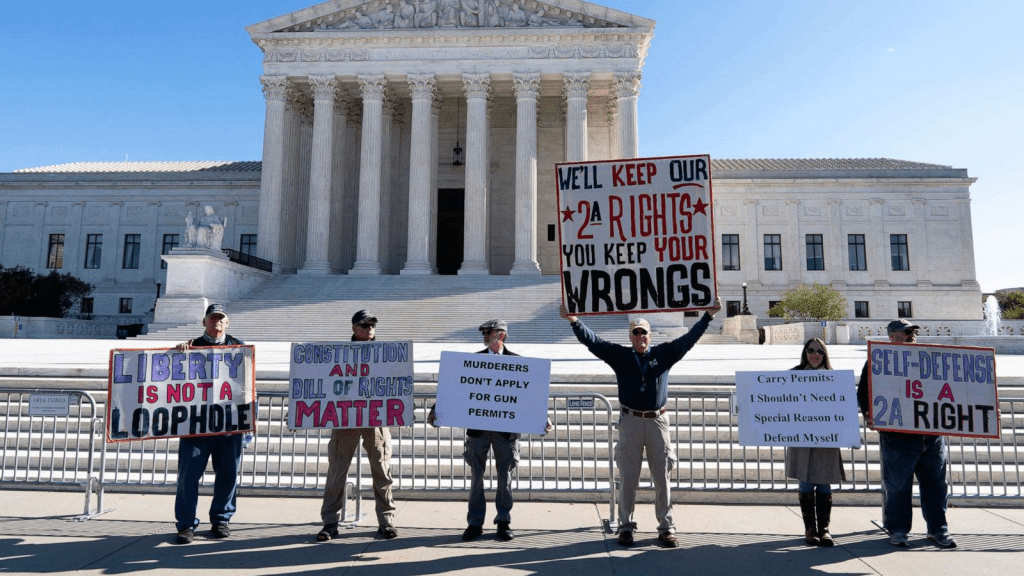
While the rest of the country seems intensely focus on whether Roe v. Wade is overturned, a good number of us are pretty interested in how this one goes.
The People’s Republic of New York, the most statist state that ever stated, is under the scrutiny of SCOTUS again, thanks to the New York State Rifle Association (NYSRA), and their crusade against New York’s tyrannical positions on guns.
The latest kerfuffle is over permits to carry. You see, New York knows they can’t ban guns outright, but they have done everything in their power to make sure you can’t actually wield it.
One of these rules is that in order to carry a gun on your person in New York, you must apply for a permit, and show cause for getting one, such as someone has been threatening you, or you’re in some high-risk job.
This seems totally fair, right? Criminals are always courteous enough to give you a heads up that they’re coming for you, so you can apply for such a permit, buy a gun, and be prepared.
Counsel for NYSRA opened by saying, “Carrying a firearm outside the home is a fundamental constitutional right. It is not some extraordinary action that requires an extraordinary demonstration of need.”
We’re of course biased here at Logical Libertarian towards the freedom to own and carry a gun, but few other rights, if any, allow the state to make you prove your desire to exercise that right. This is highly “atypical” as Counsel Paul Clement put it. The bill of rights specifically says, “to keep and bear arms,” but NY’s law effectively makes “bearing” a privilege the state grants you, not a right.
For instance, you don’t have to go to the Mayor and get a permit to tell your local conseltwerp to eat a bag of dicks, and then be required to supply a load of evidence to suggest said counseltwerp has a demonstrable need to eat that bag of dicks.
Justices Barrett, Roberts, Alito, and Kagen all pressed NYSRA’s counsel on the “sensitive places” allowances. This is the idea that the majority of justices agreed in previous decisions, the government has a right to refuse carrying in places like schools, government buildings, etc. So they were testing the idea of whether NY is just basically declaring the entirety of a city or district, can be deemed a “sensitive place.” The crux of the argument being, when is it OK to declare a place a sensitive place, versus when is the place to broad to be declared as much.
One thing to note, in the sensitive place issue, people still have the right to carry in general, and even if they have a permit, they can’t carry in a sensitive place, so it seems a little disingenuous to debate. The law in question forces people to get a permit to carry in general. The sensitive places restricts anyone other than law enforcement from carrying in that particular place. While they’re related, they are not the same.
Counsel for NYSRA stated succinctly:
At the end of the day, I think what it means to give somebody a constitutional right is that they don’t have to satisfy a government official that they have a really good need to exercise it or they face atypical risks.
~Paul Clement
Counsel Clement went on to point out that while they accept the “sensitive places” limits, and even limits on who can carry, such as criminals and people with mental illness, their side opposes the “atypical” stance NY has adopted. Meaning, that NY is essentially saying a typical person may not carry, only a person who’s atypical, such as someone at elevated risk, is the problem. It can’t be a right, if one has to be unique to exercise it.
One issue that also comes up, is tradition. SCOTUS like to make sure laws are adjudicated consistently, so people who were perfectly OK one day, aren’t criminals the next. Change should come gradually, and not sweeping and fast.
They’ll look at old law, sometimes even English law adopted prior to the Constitution, but which the Constitution got it’s basis from. Sotomayor wanted to cite traditional laws restricting weapons, which states have adopted, many of which American law is inspired by.
She stated:
The one thing that I’ve looked at in this history is the plethora of regimes that states pick, and that starts in English law, through the colonies, through post-Constitution, to post-Civil War, to the 19th Century, to even now, those 43 states that you’re talking about, most of them didn’t give unrestricted rights to carry in one form or another until recent times. Before recent times, there were so many different regulations.
What it appears to me is that the history tradition of carrying weapons is that states get a lot of deference on this.
And the one deference that you haven’t addressed is the question presented is what’s the law with respect to concealed weapons. In 1315, the British Parliament specifically banned the carrying of concealed arms.
In colonial America, at least four, if not five, states restricted concealed arms. After the Civil War, there were many, many more states, some include it in their constitution, that you can have a right to arms but not concealed. You can go to Alabama, Georgia, and Louisiana, which are now more open—more free in granting the right to carry guns, but they prohibited through their history concealed weapons, the carrying of concealed weapons.
It seems to me that if we’re looking at that history and tradition with respect to concealed arms that there is not the same requirement that there is in the home. One of the things Heller pointed to was there were few regulations that prohibited the carrying or the keeping of arms in homes. But that’s not true with respect to the regulations about keeping of arms outside of homes. Putting aside the prohibitions, regulations on sensitive places, regulations on the types of people, it seems to me that I don’t know how I get past all that history
~Justice Sotomayor
But justice Kavanaugh, speaking with Clement reiterated that rights start with the Constitution’s text, not tradition or other laws. So basically, Sotomayor’s argument was stupid, and she should shut the fuck up with that noise.
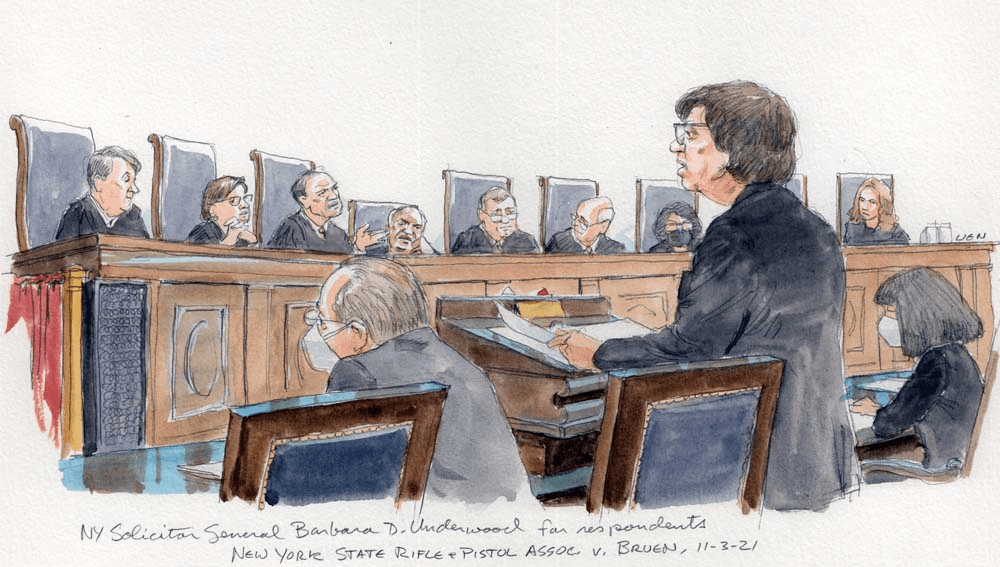
As counsel Underwood for the state of NY came to make her shitty arguments, Justice Roberts hit a home run with this question:
Now Heller relied on the right to defense as a basis for its reading of the Second Amendment, or that was its reading. Now I would think that arises in more populated areas.
If you’re out in the woods, presumably, it’s pretty unlikely that you’re going to run into someone who’s going to rob you on the street.
On the other hand, there are places in a densely populated city where it’s more likely that that’s where you’re going to need a gun for self-defense and, you know, however many policemen are assigned, that, you know, there are high-crime areas. And it seems to me that what you’re saying is that’s probably the last place that someone’s going to get a permit to carry a gun. How is that, regardless of what we think of the policy of that, how is that consistent with Heller’s reasoning that the reason the Second Amendment applies a direct personal right is for self-defense?
~Chief Justice Roberts
Counsel Underwood argued:
Well, and the other thing is that these regulations are all an effort to accommodate the right, to recognize and respect the right of self-defense while regulating it to protect the public safety.
And in areas where people are packed densely together, as the questioning that just happened displays, the risks of harm from people who are packed shoulder to shoulder, all having guns, are much more acute.
~Barbara Underwood
Justice Roberts, realizing this argument was weak, countered with:
What if it’s one of these crime waves, whether it’s a celebrated spate of murders carried out by a particular person, I don’t know who that is—you know, the Son of Sam or somebody else? Is that a good reason to—a atypical reason? Is that a justification? Some random person is going around shooting people.
I’d like to have a firearm even though I didn’t feel the need for one before?
~Chief Justice Roberts
Justice Alito, not to shy away from this line of questioning, pushed Underwood further by asking:
Could I explore what that means for ordinary law-abiding citizens who feel they need to carry a firearm for self-defense? So I want you to think about people like this, people who work late at night in Manhattan, it might be somebody who cleans offices, it might be a doorman at an apartment, it might be a nurse or an orderly, it might be somebody who washes dishes. None of these people has a criminal record.
They’re all law-abiding citizens.
They get off work around midnight, maybe even after midnight.
They have to commute home by subway, maybe by bus.
When they arrive at the subway station or the bus stop, they have to walk some distance through a high-crime area, and they apply for a license, and they say: Look, nobody has said I am going to mug you next Thursday.
However, there have been a lot of muggings in this area, and I am scared to death. They do not get licenses, is that right?
How is that consistent with the core right to self-defense, which is protected by the Second Amendment?
~Justice Alito
Counsel Underwood’s arguments in response again were that basically, a lot of people crowded together with guns, is inherently an unsafe situation, and thus why NY should have the right to prevent such a situation. An argument not supported by any evidence, but commonly argued as justification for restricting gun rights.
Justice Alito really went after her in this exchange:
Samuel A. Alito, Jr.
There are — there are a lot of armed people on the streets of New York and in the subways late at night right now, aren’t there?
Barbara D. Underwood
I don’t know that there are a lot of armed people.
Samuel A. Alito, Jr.
No?
Barbara D. Underwood
I think there are people —
Samuel A. Alito, Jr.
How many — how many —
Barbara D. Underwood
— there are people with illegal guns if that’s what you’re —
Samuel A. Alito, Jr.
Yeah, that’s what I’m talking about.
Barbara D. Underwood
— referring to. Yeah.
Samuel A. Alito, Jr.
How many illegal guns were seized by the — by the New York Police Department last year? Do you — do you have any idea?
Barbara D. Underwood
I don’t have that number, but I’m sure there’s a — it’s a substantial number.
Samuel A. Alito, Jr.
But the people — all — all these people with illegal guns, they’re on the subway —
Barbara D. Underwood
I don’t — I don’t —
Samuel A. Alito, Jr.
— they’re walking around the streets, but the ordinary hard-working, law-abiding people I mentioned, no, they can’t be armed?
Barbara D. Underwood
Well, I think the subways, when there are problems on the subways, are protected by the — the — the transit police, is what happens, because the idea of proliferating arms on the subway is precisely, I think, what terrifies a great many people. The other point is that proliferating guns in a populated area where there is law enforcement jeopardizes law enforcement because, when they come, they now can’t tell who’s shooting, and the — the — the — the shooting proliferates and accelerates.
And, in the end, that’s why there’s a substantial law enforcement interest in not having widespread carrying of guns in densely —
As you can see, NY’s laws are common among anti-gun legislators, that the people should rely on government to protect them, as she points out the transit police. While it may be a compelling argument to people who don’t like guns, it’s antithetical to the principles this country is founded on.
Justice Kavanaugh, took issue with her underlying premise that the state can and should be able to restrict guns in densely populated areas because that’s inherently dangerous, arguing:
Has that happened in those states? I mean, can you make a comparative judgment? Because it seems like before you impose more restrictions on individual citizens and infringe their constitutional rights based on this theory, you should have to show, well, in those other states that have shall issue regimes, actually, there is a lot more accidents, crime.
And I don’t see any real evidence of that.
~Justice Kavanaugh
He clearly felt her justification was based on dubious, if not an entirely fabricated premise. While she responded with generalities that she seemed to thing we should just accept as true, no data was provided.
The United States (The Biden Administration and their merry band of assholes) had an amici also argue, but again, Justice Roberts wasn’t having any of his bullshit. He fired this salvo:
John G. Roberts, Jr.
I mean, what is the appropriate analysis? I mean, you sort of — we — we, I think, generally don’t reinvent the wheel.
I mean, the first thing I would look to in answering this question is not the Statute of Northampton, it’s Heller, and Heller has gone through all this stuff and, obviously, in a somewhat different context, although that’s part of the debate, self-defense at home.
You know, this is different. But I still think that you have to begin with — with Heller and its recognition that the Second Amendment, you know, it — it has its own limitations, but it is to be interpreted the same way you’d interpret other provisions of the Constitution. And I wonder what your best answer is to the point that Mr. Clement makes in his brief, which is that, for example, if you’re asserting a claim to confront the witnesses against you under the Constitution, you don’t have to say I’ve got a special reason, this is why I think it’s important to my — my defense. The Constitution gives you that right. And if someone’s going to take it away from you, they have to justify it.
You don’t have to say when you’re looking for a permit to speak on a street corner or whatever that, you know, your speech is particularly important. So why do you have to show in this case, convince somebody, that you’re entitled to exercise your Second Amendment right?
Brian H. Fletcher
So let me start with the general question and then get to that specific point for Mr. Clement. As to the general question about Heller, we agree completely that the Court ought to apply the method from Heller, which we, like I think all the parties, take to be look to the text, history, and tradition of the Second Amendment right, and we’re applying that now to a somewhat different issue with the benefit of somewhat broader materials. Now, as to the question about why you have to have a showing of need, I think the problem with Mr. Clement’s formulation is that it assumes the conclusion. If you had a right, the Second Amendment conferred a right to carry around a weapon for possible self-defense just because an individual wants to have one available, then, obviously, you couldn’t take away that right or make it contingent upon a discretionary determination. But the whole question is whether the Second Amendment right to keep and bear arms confers that right to have a pistol with you for self-defense even absent a showing of demonstrated need.
John G. Roberts, Jr.
Well, I’m not sure that’s right.
I mean, you would — regardless of what the right is, it would be surprising to have it depend upon a permit system.
You can say that the right is limited in a particular way, just as First Amendment rights are limited, but the idea that you need a license to exercise the right, I think, is unusual in the context of the Bill of Rights.
A district court and the Second Circuit in New York, being sympathetic to New York’s tyrannical scheme dismissed NYSRA’s claims, but luckily for New Yorkers, SCOTUS think those courts are basically idiots.
In a 6:3 split partisan decision, where Breyer, Kagan, and Sotomayor dissented, arguing that states should have the necessary powers to reduce gun violence, even if it involves violating fundamental rights, Justice Thomas laid down the law. New York State’s law violates the 14th amendment (the one that guarantees equal protection and shit), denying some people their second amendment rights. He rightly points out, as was argued, no other right has this burden, so why is the second amendment special? Justice Alito added that a right is a right, whether you intend to lower murders by gun is fucking irrelevant.
Roberts and Kavanaugh agreed, but pointed out that background checks, mental health checks, and other checks to make sure someone is the type of person we agree shouldn’t carry are fine, but that has a foundation in that it’s a right until you prove you’re not someone who should be allowed to exercise that right, where as what NY did, was say you don’t have the right, until you prove you need it, and this shit just ain’t OK.
Hear oral arguments and/or read about the case here.
Do you have a corporate retirement plan, like a 401k or company stock purchase plan? Well then, this case is for you!
Northwestern University has two plans, an employee match plan, where they throw in cash to match the employee’s contribution, and a Voluntary Savings plan the University doesn’t throw any scratch in.
At issue is the Employee Retirement Income Security Act (ERISA). Employees of Northwestern, led by busybody extraordinaire April Hughes argue that the people managing those funds for Northwestern suck like the vacuum of space at what they do. Performance is weak as balls, and the fees they charge are high.
Hughes and company are like, “Someone needs to make a fucking law to hold these incompetent fucks to a certain standard. We’re losing our asses here.”
But traditionally, the courts have found that as long as people have other options, this is a free-market issue, and y’all need to invest elsewhere if you’re unhappy.
ERISA dictates the people managing this shit operate with “care, skill, prudence, and diligence [of] a prudent man [sic].” One of the complaints against them, is that they offered retail plans with high fees, when the same fucking plan in wholesale version with lower fees was available to them. Plus, they also complain that because they wanted to offer a gazillion fucking options, managing all that shit increased the fees to do so.
Isn’t it ironic that all these fuckwads at a prestigious university are the ones pushing radical left-wing ideology, complaining about greedy corporations, and yet they can’t even manage their own fucking retirement plan without bitching and moaning that their own experts don’t know what they’re fucking doing?
Northwestern is basically like, “This is ridiculous. We’re educated people. How dare you question us, punks!” They argue that in order to lose, Hughes and company have to prove intent to do a shit job. Did they know they were making poor investments, or paying exorbitant fees, and were like, “Fuck ’em, we don’t care. We’re doing this bad shit over here instead.”
A district court, and then the seventh circuit on appeal sided with Northwestern, stating it’s basically a free market issue, and they could have invested elsewhere.
However, in a unanimous decision where Justice Barrett couldn’t be bothered, SCOTUS sided with Hughes, telling the seventh circuit that they’re fucking idiots. Yes of course, they could have gone elsewhere, but ERISA is a law, and these idiots at Northwestern are in violation of it. Their investment skills suck ass, and their fees are ridiculous for such shitty ass work, which therefore means, they aren’t operating with “care, skill, prudence, and diligence” as the law demands.
Hear oral arguments and/or read about the case here.
Reagan National Advertising and their co-petitioners Lamar Advantage Outdoor own some billboards and shit. On these billboards, they display commercial and non-commercial messages alike.
In the city of Austin, they have a rule that differentiates whether a sign is permitted based on whether the sign is connected to the property it happens to sit on. Like, let’s say there was a billboard for McDonalds, but it’s on McDonald’s property—that’s AOK. But if there’s just some rando billboard not on McDonald’s property, yet it is advertising McDonald’s, well, it’s a fucking eyesore. Take that shit down—or in this case, if it’s not already up, you can’t put it up.
Reagan had some old style signs they wanted to convert to the new digital signs which can change messages routinely, much easier than the old wallpaper style shit we’re so used to.
Austin’s rule though, was that no new signs could be put up on a property that wasn’t the property of the people advertising on the sign, which these digital signs would violate. Old signs built and put up before the regulation were grandfathered in, though. So that meant this was an odd situation. He wanted to convert the signs, not put up new ones. Although to be fair, the conversion is effectively a new sign.
So Reagan was like, “Woah, you assholes. This violates my first amendment freedom of speech. If the people who own this business want the sign up, and we have a buyer to put messages on the sign, a rule that stifles us just because the buyer doesn’t own the property is some grade A bullshit. If the area is zoned for the sign, and the sign isn’t indecent, it fucking goes up.”
Austin was like, “We’re just trying to prevent our beautiful and weird city from a million fucking signs littering the landscape, and making it look like a shithole.”
But Reagan was like, “We already had these signs up, assholes. We’re just converting them.”
Part of the complaint here is also that, if the ruling is about whether the sign’s message is related to the premises it sits on, means that some overpaid assholes in the Austin courts will effectively have to read every fucking sign application, and become a “Supreme Board of Sign Review” as justice Kagan actually called it in a previous case, “Reed v. Town of Gilbert,” which ruled a town could not make different rules based on the messages temporary signs conveyed.
So the city was like, “You really don’t want to read every fucking sign, do you? Just give us our judgement, and let us have our ruling.”
In opening arguments, counsel for Austin explained their position pretty well.
Michael R. Dreeben
This case involves a fundamental question about the meaning of content-based regulation under the First Amendment.
The Fifth Circuit interpreted this Court’s decision in Reed to mean that any time that an officer must read a sign to apply the law, the law is content-based. That holding is wrong and should be reversed.
A law is content-based on its face when the text of the law singles out specific subject matter for differential treatment.
The law in Reed did that by distinguishing ideological, political, and directional signs. A rule regulating off-premises advertising does not.
The off-premises rule is an empty vessel that applies to all subjects and topics.
It turns on the relationship of a sign to its location, not the content of its message. The Fifth Circuit’s rigid rule does not further First Amendment values.
Austin’s law does not skew the marketplace for speech or suppress any ideas.
But the Fifth Circuit’s rule would have untenable effects.
Many ordinances can be applied only by looking at what a sign says.
Temporary event signs are a perfect example.
Strict scrutiny of such laws is unwarranted. Now Respondent offers a new theory, arguing that any sign code provision tied to the function or purpose of speech is content-based on its face.
But many neutral laws are tied to function.
Sign regulation is inherently functional.
Signs function to present information.
And the regulation of solicitation is based on the function of soliciting. So long as these rules are even-handed, they are facially content-neutral. First Amendment review still applies, but the right standard is intermediate, not strict, scrutiny.
Because the Fifth Circuit applied the wrong standard, its judgment should be reversed. I welcome the Court’s questions.
Once it was Austin’s turn, their lead counsel opened with this rebuttal.
Kannon K. Shanmugam
The City of Austin denied Respondents’ application to convert its existing signs to digital signs, and it did so on the ground that the signs advertised off-premises activities. Under this Court’s decision in Reed, Austin’s distinction between signs advertising on-premises and off-premises activities is content-based. That distinction turns on the subject matter, function, and purpose of the content of the messages on the signs, and it has the effect of prioritizing certain messages from certain speakers and limiting, if not prohibiting, others. The fact that Austin’s regulation does not prohibit speech on an entire subject and that the application of the regulation depends on a factor in addition to the sign’s content does not render it content-neutral.
A district court felt the city of Austin had indeed made a decent argument, as they don’t want to deal with this shit day after day after day, and ruled in their favor. But the 5th circuit was like, “Maybe y’all aren’t familiar with the first amendment, so let us help you. The fact that you’re saying what is on the sign matters, means its content-based, and thus…well…first amendment. Overturned, bitches!”
In a 6:3 apolitical ruling however, SCOTUS sided with Austin. They ruled that they weren’t limiting content in their ruling, which would be a violation of free speech. Instead, this was merely limiting where you could put a fucking sign or not, based on whether what the sign was advertising, was related to the property it was on. Essentially saying a business has a right to put up a sign on their property, but fuck those billboard assholes who want to put signs up everywhere, that shit is hideous.
Justices Thomas, Barrett, and Gorsuch dissented, arguing that this rule from previous case “Reed” is being misinterpreted. At first, it was purely about content. Now you assholes are making it about some new standard that can be fudged about however courts see fit. What the fuck was wrong with “content-based” in a very literal sense? We can’t even…with you assholes.
Hear oral arguments and read about the case at the links below.
In a case where counsel for the petitioner appeared to be high AF (He seemed confused and talked slow through almost everything), self-important entitled deaf and legally blind woman, Jane Cummings went to Premier Rehab, a Texas rehab clinic that receives federal funds, looking for assistance with her fucked up back. Because she can’t hear shit, and can barely see shit, she asked them to provide an American Sign Language (ASL) interpreter for her.
I’m curious how she’s using an ASL person, if she’s also legally blind, but I guess maybe she just wears some thick ass glasses or something. Either way, mother nature dealt her a pretty shitty hand, I’ll give her that.
Premier was like, “Hey, we’re happy to help, but we can’t just eat the cost of an interpreter like this, and we don’t have enough deaf customers to justify such an expense. You can lip read, write notes, or hire an interpreter yourself to bring to the sessions, but otherwise, you can take your Bernie Sanders entitled bullshit right the fuck out of here.”
So Cummings took her business elsewhere like a spoiled brat, but she said the new place she went to sucked balls, and didn’t really help her. Presumably because they wasted all their money on an ASL interpreter, and not a good physiotherapist. So now she’s back to being mad at Premier, since they’re good at what they do, but wouldn’t give her the interpreter she wanted.
Cummings being a persistent, self-important entitled piece of shit, wasn’t done yet though. She sued Premier under the Americans with Disabilities Act (AWDA), The Rehabilitation Act, and the Affordable Care Act, as well as citing Texas Human Resources Code. Hell hath no fury like a deaf, self-important, entitled woman scorned, apparently.
A district court heard her complaint, and argued her damages were bullshit. She was maybe a little humiliated, frustrated, and upset, but for fuck’s sake, you can’t fucking sue over that. In America we have a right to be assholes, and you getting your feelings hurt isn’t cause for damages. You have no right to demand a company hire someone special just to serve you, because you have a condition. Stop being such a self-important entitled piece of shit.
She then rolled up on the fifth circuit, telling them the district court had been mean to her, but they also told her to eat a bag of dicks.
So now at SCOTUS, they’re charged with determining if emotional distress is cause for compensation under these myriad of acts designed to protect those with disabilities. The fact that Premier receives federal funding is at issue, since such recipients, under the law, may not discriminate based on disability. Although, I’d argue there’s a difference between discrimination, and not hiring a special person just for you. One is an order not to do something, the other is an order to do something.
Think of it like rights. The right to free speech, religion, bear arms, etc., orders government not to infringe upon them. No one has to do anything, or incur any expense for those rights to be preserved. But when people argue health care is a right, that’s forcing people to do something—, it does cost money, and force people to do work, and therefore is not a fucking right.
In a partisan 6:3 split, SCOTUS ruled that Cummings was being a self-important and entitled piece of shit. Emotional distress isn’t cause for compensatory damages, as she didn’t lose any fucking money in the situation—her feelings were hurt. But for fuck’s sake, the fact that this is even a case is gross. How dare she feel that a company must hire or contract an employee specifically to serve her. Essentially she’s arguing if they might go out of business, that’s fine by her, as long as she gets her help first.
Any empathy I feel for her disability was lost when I read the premise of this case. Fuck her and every self-important entitled piece of shit like her.
The left justices however, were of the opinion, that such discrimination laws, when violated, would cause emotional distress first and foremost, and therefore, logic dictates that such issues should be compensated. Bestill their bleeding hearts. Clearly, they have no clue what it takes to run a business, and instead would just run it into the ground in the name of wokeness.
You know that shit that comes out of your paycheck every time called Social Security? Well, it’s available to people living in all fifty states, Washington DC, and for some odd reason, the Northern Mariana Islands, which the US owns.
For some reason, they apparently didn’t give a flying fuck about Puerto Rico, because those motherfuckers don’t get a damn thing.
Jose Luis Vaello-Madero, a Puerto Rican dude, found his way to New York back in 1985, and presumably, started paying into Social Security plan. In 2012, he got sick as balls, and couldn’t work anymore. As such, he started receiving his SSI benefits, which again, he would have paid into.
In 2013, he went back to Puerto Rico to help care for his wife, who was also experiencing health problems, while continuing to receive his SSI benefits.
The greedy pricks in our federal government eventually found out he was living in excluded Puerto Rico, and were all like, “Slow your roll, dude. Why are you collecting benefits when you’re living in Puerto Rico? Not cool man, not cool. Also, we found out you moved there years ago. So guess what, you’ve gotta pay all that shit back you received while you were living in Puerto Rico. Capiche?”
Jose, was like, “Wait a fucking minute, I paid into this program, you merry band of cunts. This is my fucking money. Also, have you ever read the fucking fifth amendment that says I deserve equal protection under the law? Well, the whole idea you exclude us Puerto Ricans, who belong to your asshole country, violates that. So I’m suing YOU motherfucker! Also, how the fuck did the Marianas negotiate benefits, but somehow Guam, Puerto Rico, and others were left out? You just hate people who speak Spanish, don’t you?”
Justice Sotomayor, seemed pretty inclined to agree with Jose. She questioned:
Sonia Sotomayor
All right.
So let’s look at the plus of that.
This program is fully funded by the federal government, fully administered by the federal government.
There’s no cost to Puerto Rico.
There’s no cost to any state.
And so I don’t understand what the different relationship with Puerto Rico has to do with this program because there’s no cost to the government. It’s not as if it could take this federal money, Puerto Rico, and distribute it in some other way or put this money to use in some other way because the money’s going directly to the people, not to the government.
So I don’t see how that can be a plus with respect to the self-governance of Puerto Rico.
Call me crazy, but when I look at my paycheck, Social Security is one tax taken from my paycheck, federal taxes are completely separate. So Sotomayor’s question makes zero sense to me, since it WOULD in fact cost the govt, since Puerto Rican’s don’t currently pay into the system. It’s as if she doesn’t understand they’re not currently taxed for that.
But maybe she’s just like, “let the pay in like everyone else, and get their fucking benefits.”
A district court, and the 1st Circuit Appellate court were both like, “Jose, you clever son of a bitch. We think you make a good fucking argument.” But the United states, not quick to let go of money they can potentially steal, we’re like, “Fuck you lower-court clowns, we’ll take this shit all the way to SCOTUS.”
In an 8:1 decision, where only Justice Sotomayor dissented, SCOTUS ruled for the United States, deciding Jose’s argument wasn’t so clever after all. They argued that because Puerto Ricans don’t pay into the system, they have no right to expect benefits down the road.
If a Puerto Rican makes their way to the 50 states, and pay into the system, they can receive benefits back out of it. But as soon as they leave, and go to Puerto Rico, Timbuktu, or bumfuck Egypt, benefits end there.
Sotomayor dissented, calling all her cohorts, and the congressional twats who wrote this rule, some racist assholes.
Hear oral arguments and/or read about the case below.
log·i·cal: capable of reasoning or of using reason in an orderly cogent fashion lib·er·tar·i·an: an advocate of the doctrine of free will; a person who upholds the principles of individual liberty especially of thought and action









 The Logical Libertarian™