As you may know, during the Spanish-American War, the United States busted Spain’s ass, and took Guam for their troubles. In 1950, they gave Guam power to rule themselves, while still remaining a territory of the United States.
In 1940, the US needed a place to dump military waste, like old ammo and even some hazardous chemical warfare shit like DDT and Agent Orange, using that dump through both the Korean and Vietnam wars.
It wasn’t a great dump, though, and it leaked that shit into the Pacific Ocean, prompting the EPA to declare it a serious priority to address in 1983 after passing the Comprehensive Environmental Response, Compensation and Liability Act (CERCLA). CERCLA was designed to deal with hazardous wastes at dump sites.
Five years later, the government said the Navy was the major asshole causing all of this, but because Guam ruled itself, the EPA told Guam to come up with a solution.
But Guam was like, “You assholes admit the Navy caused this, and we don’t rule the fucking Navy, you do. So the Navy should figure this shit out and clean it up. Why the fuck would we be on the hook for this?”
in 2011 a district court appointed some fucktwit who closed Ordot, the dump in question, and estimated it’d be like $160M to clean that mess up.
At one point during questioning of Guam’s counsel Garre, Justice Sotomayor went into full disrespect mode, interrupting counsel before he could answer most of the questions posed to him, and even at the end when he was trying to answer, cutting him off with a rather terse “Counsel, please!” I believe she was out of time, but still, it was incredibly unbecoming.
However, she must’ve had a change of heart, because her along with the other eight justices sided with Guam. They can sue the federal government to clean that shit up. CERCLA clearly has language for liability, and the Navy is clearly liable. Enough said.
We all know the People’s Republic of California love to rule with an iron fist, right? Well, federal regulations require charities to disclose a list of their major donors, to help protect those donor’s interests, in case those charities are doing some shady shit.
Well, California, believing themselves to be better than the federal government are requiring companies give them donor names and addresses as well. Here’s the rub.
California has had breeches of these lists, and leaked that info to the public. So for instance, if some dude has a hard on for Jesus, and donates to an anti-abortion group, Californians outs that motherfucker as an “anti women’s rights” person, when they had no desire to have their position publicly outed. While we here at Logical Libertarian are pro-choice, we consider a pro-life stance a fair belief to have, and that belief has nothing to do with women’s rights, it has everything to do with giving basic human rights to a human life that merely hasn’t exited the womb yet.
No one who’s pro choice is out there pushing to take away women’s rights in any other way. This is merely a misleading tactic to get people to join their side.
So charity Americans for Prosperity (AFP) and their peers are arguing this is a violation of their first amendment rights to freely associate, because it might deter them from otherwise donating to their cause.
They hear California’s argument that it’s to help prevent charities fraud, but they’re like, California never even uses that information to do that, all they do is fucking leak it when they don’t like people. Not to mention, the IRS already has that info.
In the words of the defense:
Because the attorney general has failed to take measures to adequately protect the Schedule B forms, some donors will consider the Attorney General’s scheme and reasonably conclude that the risks of disclosure are too great.
The group cited that California employees themselves, posted over 1800 of these forms on a public website, just to out donors they disliked.
California contends, this doesn’t directly prevent anyone from freely associating, so they’re calling bullshit. If people believe in a charity, they can donate to it all they want, we just want to know about it, and we may tell the world about it because we’re assholes.
So throughout the case, the terms strict scrutiny and exacting scrutiny have been bandied about. The petitioner’s want a strict scrutiny ruling. Which seems to mean that if the state wants this info, it has to go about getting it in the least intrusive way possible, and this isn’t it.
However, the state is arguing that an exacting scrutiny standard should be applied, and because this law doesn’t actually have a component to prevent free association, the petitioner’s argument is bullshit. They’re not associating because they’re afraid of being publicly outed, not because the state is preventing it. So it’s not EXACTLY preventing free association.
A handful of whiny twats in congress for the DNC asked Justice Barrett to recuse herself, since Americans for Prosperity donated heavily to help ensure she was confirmed to the supreme court. She was unimpressed with their argument, and did in fact participate. She’s nominated for life, after all, so there’s no power they hold over her, and she has no reason to side against what she thinks is right. This is likely an attempt at Democrats to both get more information for Commie Cali, and to attack Barrett for her Christianity again, as they did when she was confirmed.
We here at Logical Libertarian are also atheist, but we find these attacks on her religion equally disgusting as misrepresenting anti-abortion arguments.
Anyway, back to the case. California’s argument is that they need this info to investigate charities fraud. But the petitioner is like, “That’s some fucking bullshit. They never use this info for that. They never investigate charities fraud proactively, to where they’d need this info on hand. They only fucking investigate when there’s an actual accusation of fraud or some shit, in which case, they send an audit letter, or subpoena the info. So there’s no need to have this shit ahead of time.
Gorsuch, going after California, pushed on the right to privacy issue specifically, asking if the first amendment’s right to peaceably assemble also assumes some level of privacy, to which she responded it did. So then Gorsuch asked her to draw a distinction between California charities disclosed up front, and say some company being forced to send their company Christmas card list, to see if they’re friends with anyone government cares about, or who they’ve dated in the past so they try to compile data on who people end up marrying?
Counsel danced around this, in saying that if the people in question had a fear of reprisal, they could certainly argue that as a reason why not to disclose such info. But notice that this flips the script, and argues that government has a right to demand it, and it can only be thwarted if the people cite a reason why, as opposed to the people have a right not to disclose it, until government proves it has a compelling interest that supersedes their right to privacy. And this is why it’s Communist California, and not a state which gives a fuck about rights in any meaningful way.
Gorsuch however, interrupted her and said, “assume there’s no reprisal whatsoever.”
Here response:
Aimee A. Feinberg
I think that would be very difficult because, in that situation, there would be a significant burden on intimate association.
There would very likely be a significant burden resulting from public dissemination of that kind of information. And, as a result, the government would have to come forward with a commensurately strong justification, and it wouldn’t be clear to me in that context what that interest would be.
Call me crazy, but she ultimately just made the argument for the petitioner’s.
In a 6:3 partisan decision, liberty won out. The conservatives protected the 1st amendment rights of charitable donors against the commie assholes in California. The dissenters argued that this is a pretty creative interpretation of the first amendment, and opens the door to other shaky 1A arguments. But you know what, fuck those assholes. California was out of line, and I don’t mind saying it.
You all remember the days when the Affordable Care Act was challenged in SCOTUS, and Chief Justice Roberts argued that the penalty was a tax, and therefore constitutional, right?
Well since then, Republicans, unable to repeal Obamacare outright, made the penalty zero. So now that the penalty is zero, Republicans are now arguing it’s no longer a tax, and therefore the individual mandate is an unconstitutional mandate, and the law should be repealed entirely.
The ACA supporters will argue that the mandate is severable, meaning SCOTUS could remove the mandate clause and leave the rest of the law in tact. But Republicans are like, “That’s how the fucking law was paid for. So you can’t fucking sever it.”
So basically SCOTUS is being asked to re-review this case in light of this new change.
With regards to severing the law, Congress reduced the tax to zero, but didn’t repeal the law. If they had the power to do one, they had the power to do the other. So the argument is then made that it must be severable, because if congress wanted the law to be repealed, they’d have repealed it, not reduced the tax to zero.
But the argument to that, is that congress didn’t have the votes or support for a full repeal, but by removing the tax, they’re hoping SCOTUS will nullify it, effectively trying to make SCOTUS the “bad guy” in all this shit.
At one point, Justice Kavanaugh asked:
Brett M. Kavanaugh
Are you aware of any other examples in the U.S. Code at least where Congress has enacted a true mandate, not something hortatory, but a true mandate with no penalties?
Essentially questioning the validity of such a law knowing there’s no other instance where congress forces you to buy something. Social Security is forced retirement income, but you don’t go out and buy it, government just takes it as a tax.
The reason this is Texas v. California, is because Texas challenged the law, and California and other states are defending it.
In a 7:2 decision, where Alito and Gorsuch dissented, SCOTUS ruled in favor of California. Texas may not sue California over this bullshit. Texas hasn’t shown in any way how they were harmed by California and company, and therefore they have no grounds to be suing here.
Scumbag cop Nathan Van Buren was “friends” with another scumbag, Andrew Albo. Albo liked the ladies. Especially the ones he paid to have sex with him. Van Buren decided to shake Albo down, and asked him for $15k to cover his son’s medical bills.
Here’s the rub, Van Buren’s son was perfectly healthy, and it was clearly just a shake down.
Albo, not the dullest knife in the drawer, recorded the conversation, and took it to the FBI who decided to set up a sting. They had Albo ask Van Buren to look up a woman he wanted to hire as a prostitute, to make sure she wasn’t a cop. Van Buren did so, and boom! Busted his ass.
So now he’s charged with wire fraud, using law enforcement databases for unlawful purposes. Van Buren’s argument is that he was authorized to use that database, and therefore it wasn’t fraud. So now SCOTUS has to decide whether using a database you’re authorized to use, but using it in a manner the job doesn’t provide for, constitutes wire fraud under the Computer Fraud and Abuse Act, which prohibits anyone who “exceeds authorized access” on a computer, specifically it defines that as “to access a computer with authorization and to use such access to obtain or alter information in the computer that the accessor is not entitled so to obtain or alter.”
Counsel for Van Buren launched the opening salvo by arguing:
The CFAA is an anti-hacking statute. It prohibits obtaining information from a computer without authorization.
And to ensure comprehensive coverage, the statute also prohibits “exceeding authorized access.” As Judge Kozinski put it, this ensures that the statute covers not just outside but also inside hackers. In this case, however, the government seeks to transform the supplemental prong of the CFAA into an entirely different prohibition.
In the government’s view, this prong covers obtaining any information via computer that the accessor is not entitled “under the circumstances” to obtain. It is no overstatement to say that this construction would brand most Americans criminals on a daily basis.
The scenarios are practically limitless, but a few examples will suffice.
Imagine a secretary whose employee handbook says that her e-mail or Zoom account may be used only for business purposes.
Or consider a person using a dating website where users may not include false information on their profile to obtain information about potential mates.
Or think of a law student who is issued a log — log-in credentials for Westlaw or Lexis for educational use only. If the government is right, then a computer user who disregards any of these stated use restrictions commits a federal crime.
He makes a pretty valid point. And it seems odd that there isn’t just a specific law to prevent government officials who have access to our private information, from obtaining that for any non-business related use, and sharing it, or something like that. Seems like they know it’s wrong, but just don’t have a proper law to charge him with.
Neil Gorsuch thinking likeme asked,
Neil Gorsuch
And then, on the reverse parade of horribles we’ve heard from the other side, I guess I’m struggling to imagine how — how long that parade would be given the abundance of criminal laws available. So, if this one didn’t cover that kind of conduct, but there were troublesome forms of it, like your client’s behavior in this case, misusing a police database, I assume there are ample state laws available that criminalize a lot of that conduct.
Am I mistaken?
Jeffrey L. Fisher
No.
In fact, this case comes from Georgia, and Georgia itself has a statute about — about hacking or otherwise misusing computer information.
The government, as we point out in our — in our reply brief, the government gave a few hypotheticals in its brief, and almost every one of them is already addressed by some other provision of the — even the U.S. Code, let alone state law. And — and even — remember, my client himself has already lost his job and has other forms of punishment that have already been brought to bear.
In a 6:3 non-partisan decision, SCOTUS ruled for Van Buren. He’d have had to obtain info he was not authorized to have in order to have committed a crime. Sure, this was some personal and troubling bullshit, but it’s info he otherwise had access to. So while it’s kinda immoral, it isn’t illegal. If they don’t like it, they need to pass laws specifically to prevent it.
We’ve all heard the expression there’s two sides to every story. It implies that one side is the truth, and the other side is lying. While that can be true, it can also be that both sides are right, and are both just leaving out crucial factors. It could be that neither side is right, and the truth is something else entirely. It could be that one side is right, and the other believes they’re right, but are simply mistaken. And most commonly, it could be a matter of opinion, and there simply isn’t a right or wrong in the first place.
The point of skepticism, is to be able to consume information in such a way that you are least likely to be deceived, or make bad assumptions. Thus leading to more intelligent decisions, and typically better outcomes for you. Let’s look at some examples.
In April of 2019, it was reported in several news outlets that just eating one slice of bacon can increase your risk of colorectal cancer by 20%. You can see one instance of this report from CNN here. CNN was not dishonest in this reporting, that data is true.
But when you click the actual study, and apply a little skepticism (and some math), you might look at it a little differently.
There were 475,581 participants in the study, and a mere 2609 case of cancer reported among all participants. So if one group is 20% higher than the other, that means it’s approximately 45.4/54.6 split (45.4/54.6 = 120.2%, or 20% more).
54.6% of 2,609 = 1,425 (0.29% of the total group)
45.4% of 2609 = 1,184 (0.24% of the total group)
So while 1,425 is indeed 20% more than 1184, out of the total group or people observed (475,581) a mere 0.55% contracted colorectal cancer. A total of 241 more were the bacon eaters, or a mere 0.05% overall increase (0.29% vs 0.24%).
An almost entirely insignificant 0.05% or 241 out of 475,581 people doesn’t sound nearly as scary as 20%, does it? But scary sells news media, and journalists are rarely scientists.
This problem isn’t entirely about science, because you can apply these same skills to a myriad of things you’ll read or see in the media.
Imagine a news story we’ll call statement A with a headline that reads, “Woman courageously does all that is needed to put food on the plate for her child.”
Female Shoplifter
But then imagine a different news outlet runs a different headline we’ll call Statement B that reads, “Woman fired for drinking while at work, stole unhealthy snacks and booze from a grocery store.”
Statement A makes her sound like a hero, but Statement B tells a very different story. Both can be 100% true, but the context changes how you feel about the story entirely.
The point of all this are to make you think about any news story you read, and maybe think about changing the way you consume information. So here’s a couple of ideas on how to improve how you consume information.
Avoid click-bait headlines from sources you’ve never heard of, or that you know are openly biased. You know they’re all almost entirely bullshit. So why waste your time on them? The good ones will link to credibly sources, and you should click on those to read the whole story, if you do go down that road. But in general, if people stop clicking on clickbait, the people doing it will respond to the lack of demand for it, by ceasing to make it.
Read the article and not just the headline. Even reputable sources have resorted to click-bait headlines just so you’ll read their stories over the nonsense from non-reputable sites. You’re missing a lot of context and nuance if you don’t read the story. Not to mention, you look silly when you add your own comment that clearly shows you didn’t read the article.
Any story that says something like, “The such-and-such that such-and-such doesn’t want you to know” or “Person A destroys person B” is bullshit. All of it. Like every single one of them.” Stop sharing that nonsense. Seriously.
If you see a story and it seems pretty amazing, but you aren’t seeing it on reputable sources, I assure you, some podunk website did not scoop Reuters or AP. It’s bullshit that they didn’t vet properly, or worse, that they just made up.
Check a second source. This one is huge. If you see a story on a site that’s kinda reputable but not great, look for it on a site like Reuters or AP. If you confirm from multiple reputable sources, then it’s probably true. But if it’s multiple sources with the same bias, you should probably still avoid it.
Think about what’s being said in the story, and could there possibly be another way of looking at it. For instance, if I told you France gets 75% of its energy from nuclear, where the United States only gets 20%, you could easily assume that France is a leader in nuclear energy compared to the United States. But if I told you France has 58 nuclear power facilities whereas the United States has 98, you’d think the US is the leader. Both are true, but both tell a different story. So it pays to dig into the data when you can, and form your own opinion based on all the information.
Nuclear Power Plant Emits Only Water Vapor
Hopefully this helps you think about how to consume news differently, and prevents you from being that embarrassing friend on social media always sharing bullshit articles everyone but you seems to know isn’t true. You’ll thank me later. 🙂
A well-regulated militia, being necessary to the security of a free state, the right of the people to keep and bear arms, shall not be infringed. ~ 2nd Amendment to the US Constitution.
Nothing seems to evoke more passion from either side of the political aisle than the 2nd amendment to the U.S. Constitution. People on the Individual-Right side of the fence often cite the “shall not be infringed” clause, but those who wish to limit or eliminate the individual right to bear arms often cite the “well-regulated militia” clause.
Former ACLU Leader and Mathematics Professor Ira Glasser
The anti-individual-right argument being that the framers meant for Americans to be able to form militias to protect the people or the country, and those militias would need to be armed. This sentiment has been echoed by such noteworthy Civil Rights leaders as former ACLU head and mathematics professor Ira Glasser, which he discussed at length during the March 2nd, 2018 Comedy Cellar podcast. (click to listen)
NYC Comedy Cellar
Side Note: Don’t be fooled that the podcast is from the Comedy Cellar. Owner Noam Dworman is quite fond of discussing politics, and is incredibly thoughtful, fair, and insightful on the subject.
Oddly, the person who got it right (IMO), contradicting Ira Glasser, was Noam’s co-host, comedian Dan Naturman, who often describes himself as left-leaning. Dan does possess a law degree from Fordham University, and Noam studied law at the University of Pennsylvania, making them the only people trained in law involved in the discussion, not Glasser.
While Noam Dworman tends to seem centerist, he understandably felt the need to defer to Glasser’s judgement, since his work with the ACLU would seem to assert Glasser would be the more knowledgeable person in the room—but on this issue, he just wasn’t.
Comedian Dan NaturmanThe argument the anti-individual-right group presents seems pretty sound on the face of it, but there are several flaws with this line of thinking, making it unarguably incorrect.
But let’s break down the flaws of these arguments one by one.
THE CONTRADICTION
The first issue is that it is entirely contradictory with the rest of the Bill of Rights.
The Bill of Rights was drafted, not as a set of laws for the people to heed, but instead, limits set on government as to how government may restrict the people’s individual rights.
The Bill of Rights Institute writes:
The first 10 amendments to the Constitution make up the Bill of Rights. James Madison wrote the amendments, which list specific prohibitions on governmental power, in response to calls from several states for greater constitutional protection for individual liberties.
So if the 2nd Amendment was drafted to allow the establishment of militias, and was not meant as an individual right, it would be inconsistent with the other nine amendments.
Our founding fathers believed you have inalienable rights by virtue of existing, and they cannot be taken from you. They don’t come from government at all—the founders of our country were very clear on that when they wrote the Declaration of Independence.
The Bill of Rights places limits on what government may do, not establishes the formation of government entities. Those things are laid out in the first portion of the Constitution. But it also is written with the intention that the power comes from the people, not government.
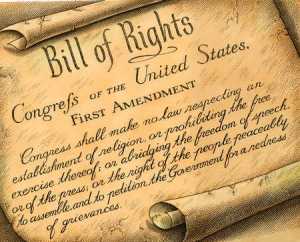
The 1st Amendment
For instance, our first amendment states “Congress shall make no law respecting an establishment of religion…” versus something like “You are free to practice any religion of your choosing.”
This pattern is consistent throughout the Bill Of Rights, and while most see both those phrases as essentially the same, there’s an incredibly important distinction. As the Bill of Rights are written, the people have the power and are imposing a limit on the government’s ability to limit their religious freedom. In the second theoretical example, it implies government has the power and is granting religious rights to the people.
So now that we understand the Bill of Rights (it’s in the name, for Pete’s sake) establishes rights of the people, not of government, and thus contradicts the idea that the 2nd amendment was meant to help local militias to form, let’s move on to issue #2.
THE MEANING OF THE WORD MILITIA
The meaning behind the word “militia” in the second amendment.
If we assume the term “militia” refers to local military and police, which are government entities after all; the people arguing the 2nd amendment was set up to allow local governments to establish militias comprised of the people believe our forefathers wrote an amendment that says that government cannot infringe on government’s rights to bear arms. This is not only inconsistent to the rest of the Bill of Rights, which guarantee individual rights, but its redundancy is nonsensical. If government cannot infringe on government’s rights to carry guns, then there would be no reason to even mention it in the first place.
The militia clause does refer to government, but not just local governments, it means any government. It wasn’t a right of the militia, it was a limit on it. This will make more sense as we move on to the next issues.
THE MEANING OF THE WORD REGULATED
The third important issue people get wrong with this, is believing “well-regulated” is synonymous with “well-organized.”
The last issue with the anti-individual-right argument is what it argues is being protected. The incorrect argument is that it’s protecting a country (state) which is free. But the reality is it is protecting freedom itself, ensuring the state remain free. You’d have to deny nearly all of America’s founding history to believe that freedom wasn’t at the core of everything the founding fathers did. Freedom was always more important in their minds. Far more important than the state.
ANOTHER WAY TO WRITE IT
With all that in mind, let me reword the amendment in the way it was intended using language that is maybe more understandable in today’s vernacular.
In order for the people of the United States to remain free, the militia shall be kept under control by the people of the United States who have the right to keep and bear arms.
This is precisely how the amendment was intended, and the only interpretation of it which cannot be easily challenged.
They knew government will always be prone to becoming bloated and oppressive. And while a government can pass a million laws, those laws have no teeth if there is no militia to enforce them. So in order to keep that government, specifically its enforcement wing (the militia) well-regulated, the people should be armed as well. This way, the government (and militia) always have some level of fear from the people. It’s the only reason to use the word “regulated” that makes sense.
The United States Supreme Court in 2008 with District of Columbia v. Heller held it is an individual right saying the following:
This opinion, being current precedent, effectively settles the argument for now.
IS THIS IDEA OF THE GOVERNMENT FEARING THE PEOPLE EVEN REALISTIC NOW?
Since the United States Military is infinitely more powerful than its armed citizens, many argue the point becomes moot, since we “the people” couldn’t possibly fight them. Which in a narrow scope might seem accurate, but again, if you apply a little skepticism, it isn’t.
But, they’re still given orders by an elected government. When the military kills the citizens, it usually isn’t well-received by the people who voted for them, threatening their re-electability.
It’s also important to remember ours is a voluntary military comprised of the people, and thus aren’t likely to murder their brothers and sisters for no good cause.
So why do gun control advocates believe this is what the 2nd amendment implies? It’s likely a simple case of confirmation bias—a phenomenon whereby someone attempting to prove something they hope to be true/false, eschew interpretations that conflict with their bias and/or accept suspect data that supports their bias, due to an inner desire to substantiate their argument.
We are all prone to do this, and with the exception of devout skeptics like myself, we’ll rarely even know we’re doing it, nor act to correct it.
Their lives were forever changed because of gun violence, so it’s quite reasonable to assume they would advocate limiting our right to bear arms. And when people have been forever affected by senseless gun violence, it behooves all of us to respect their trepidation in respect to lax gun laws. We haven’t walked a mile in their shoes.
But apologies to those who wish to limit our rights to bear arms, and believe the “militia” clause supports your argument. If you want to argue against gun rights, using the “militia” argument, it just isn’t consistent with the rest of the Constitution, and you’re unfortunately misinterpreting the clause.
A large majority of Hollywood believe Trump is basically satan, and many black athletes have taken a knee during the national anthem because they believe the police are too quick to shoot a young black man.
Gwyneth Paltrow/Chris Martin and Family
When they have these opinions, being someone who is used to being in the spotlight, they rarely shy away from sharing their feelings on any given subject—using their bully pulpit to encourage others to follow their lead.
There are a few important facets to these expressions of beliefs that I feel are worth discussion.
First things first. They have a right to an opinion, and they should share such an opinion if they’re passionate about it. They should be shown respect for speaking out on something that’s important to them. Their success means that if it is a cause worth fighting for, they can shine a light on a subject that us non-famous people simply don’t have the ability to do.
I’ve seen the Twitterverse often have regular people telling athletes with an opinion on politics to “Just shut up and play (insert their respective sport here)”, or people tell British physics Professor Brian Cox, who’s quite vocal about Brexit, to “just stick to science.”
Professor Brian Cox
I understand why people might feel this way, since such famous people are not famous for politics, and thus not presumed to be experts on the subject. But politics isn’t science, it’s entirely driven by subjectivity. Meaning one person’s opinion is just as valid as another. And as a libertarian, anyone who speaks truth to power (even if I think they’re misinformed on what is truthful) is still doing something noble.
By all means, make the effort to correct them if you think they’re wrong on the facts, but people should do so respectfully, and applaud anyone with a voice for speaking out.
Colin Kaepernick started a movement to call out when officers shoot unarmed black men, and little repercussions occur as a result, something we should all be bothered by when it happens. We can quibble over whether some of the shootings he rallied against were justified, some may have very well been, but it does happen nonetheless, and we shouldn’t excuse it.
But all that being said, people should understand that being famous doesn’t make you an expert and thus adds no additional credibility to their argument, versus your neighbor who may be espousing the same opinion, (unless they’re an expert in the field.)
So while we should not discourage them from speaking out with things like, “just shut up and play your sport” or something like that, please bear in mind that you shouldn’t be blindly following them either. You shouldn’t assume they’re in command of the facts, and that the information they provide is truthful. The only thing you could presume to be true, is that their heart is in the right place, and they mean well.
Just about every issue is way more complicated than any non-expert understands. So listen to what people say, but apply your own skepticism, and if you care about the issue, take the time to look up credible sources on the issue, forming your opinions based on them. Doing something, or believing in something because a famous person told you to, is irresponsible at best.
log·i·cal: capable of reasoning or of using reason in an orderly cogent fashion lib·er·tar·i·an: an advocate of the doctrine of free will; a person who upholds the principles of individual liberty especially of thought and action



![29zZnh0j[1]](https://logicallibertarian.com/wp-content/uploads/2014/10/29zznh0j1-e1562001256653.jpeg)
![No_gun[1]](https://logicallibertarian.com/wp-content/uploads/2012/12/no_gun1.jpg?w=300)


 The Logical Libertarian™