Tag Archives: logical libertarian

I never tell a lie, and I’m never wrong. Let’s have some legal reform!

Gary Nolan (and THE Scrappy Doo)

As we all know, politicians are often known for two things: lying and the inability to admit when they are wrong. If you want to see a prime example of both in one instance, look no further than this example from the chairperson of the DNCDebbie Wasserman-Shultz (DWS).

Lying and the inability to admit fault are traits that are generally considered immoral, and are upsetting to the populace these people are elected to serve, but what’s the real reason behind it?

Let’s first discuss the lying which can be either malicious or altruistic.

I’ll give you examples:

  • Malicious: I did not have sexual relations with that woman, Monica Lewinsky ~ Bill Clinton
  • Altruistic: No honey, that dress does not make you look fat ~ Every husband in history

An easy way to tell the difference is to understand who is being protected by the lie. If it’s the liar, then there’s a good chance it’s malicious.

So are all lies that roll off a politicians tongue malicious? Of course not. But, we all understand how malicious lies come about and agree they are wrong, so let’s focus on the altruistic ones instead.

What’s the one type of altruistic lie that’s good? Every time someone called the government because they saw a UFO and were told, “We’ll look into it” when in reality they knew it was the latest super-secret plane the government was testing and weren’t at liberty to discuss—I’m OK with that. The B-2 Stealth Bomber alone is estimated to be responsible for hundreds of reported UFO sightings before the curtain was lifted on it.

B-2 Stealth Bomber
B-2 Stealth Bomber

There is no way for the government to tell Americans their secrets without telling our enemies too. So some things simply must be kept out of the public knowledge base.

With politicians however, most of their altruistic lies are born out of arrogance. Many think voters can’t understand their superior knowledge or intellect well enough to support their ideas. So they lie to get elected, then proceed with their original agenda because “they know better.”

For instance, many on the left lie about the origins of their proposed social engineering policies, calling them anything but socialism, because they know people in America aren’t very fond of the socialist doctrine, even though these politicians honestly believe socialism can be good.

Many on the right lie about their intent to cut government assistance because they know telling people they intend on putting the kibosh to their government aid will be seen as cruel and heartless, when they truly believe it will help promote self-reliance and actually help those it’s expected to hurt.

I would argue that if these policies are good, they will stand on their merits. An intelligent person should be able to explain their position in such a way that reasonably smart people will understand. If socialism or capitalism are good, just make the best case as to why, and let us decide.

It’s hard to paint politicians as completely immoral here, they legitimately think they are doing what is best. But I find the hubris for them to assume they are more intelligent than me, the person they are nominated to serve, distinctly offensive.

Moving on from the lies, let’s discuss the inability to admit wrongdoing.

Although DWS has a degree in political science, not law, she does serve in Congress with a few hundred other law makers, many of whom do have a legal background; our president too.

I’m not attempting to disparage lawyers, it’s a noble profession. But it is common practice for them to vehemently avoid any admission of wrongdoing or offer any apology for a wrongful act. This practice has sadly become part of our fabric, and it affects all of us morally and financially.

Scales of Justice
Scales of Justice

In our current legal system, an apology is admissible evidence against you, so we have been conditioned to never admit wrong-doing. Lack of personal responsibility is everywhere these days, and I think it’s in no small part to our legal system’s exploitation of apologies.

As you saw DSW pirouette around the issue like she was on Dancing With The Stars (They do share the same initials after all), it became clear she knew she had lied, but was adamant about not admitting it.

What can we do about these two issues? While we will never be able to stop people from lying, we can do something about the admission of guilt issue by changing our current legal system.

If we look at health care, many doctors who know they erred when giving treatment will often refuse to give an apology at the insistence of their legal team, due to its evidential liability. Interestingly enough though, a 2001 University of Michigan program showed that while the liability may increase, the number of actual lawsuits decrease as patients are far more apt to accept an apology as restitution than most lawyers give them credit for.

This study shows that we humans care more about personal responsibility than money, and we are capable of forgiveness if it’s simply asked for. So, I have a simple proposal to make a meaningful reform to our legal system.

Introduce legislation that provides certain indemnities to a person when they accept fault. If a person admits their error, apologizes, and/or makes a sincere attempt at restitution prior to legal action being taken against them, (ruling out criminal activity), they should be immune from additional punitive damages in civil court over and above their actual fiscal liability for the damages inflicted.

This one simple change to our legal system could not only introduce a better moral code in our society by encouraging people to accept responsibility, but imagine the dramatic lowering in prices of goods and services, as insurance premiums and general business operating costs drop due to a lower or complete lack of settlement costs.

There you have it, I have improved our sense of morality and helped our economy with a few strokes of my keyboard, and that’s no lie!

The Self-Imposed Death Penalty

Gary Nolan (and THE Scrappy Doo)

After the unforeseen suicide of Ariel Castro, a man who plead guilty to avoid the death penalty in the first place, the Ohio chapter of the ACLU has asked for a full investigation. I have one simple question—why?

In America we have an incessant need to prevent people from killing themselves. Whether it be someone who is depressed, terminally ill, or in prison for a heinous act, we behave as though it is our duty to stop them from ending their own life. But let’s review these three scenarios.

If I had a loved one who was depressed, I would do everything in my power to talk them off the proverbial ledge, and I would want the police to try to convince them otherwise as well; if they were called to the scene anyway. But would I want police arresting them for a failed attempt? Not on your life!

Imagine you were terminally ill with no chance of getting better, on a morphine drip just so you could eke out another few months, and burning through whatever inheritance you had intended to give to your children. Then imagine you finally come to the conclusion that the life ahead of you is only going to get worse, so you just want to end it. Seriously, close your eyes and imagine it. Now imagine some politician telling you that you may not by penalty of law? Now, honestly say you wouldn’t be furious. How dare some bureaucrat insist that you suffer because suicide is immoral in their eyes.

Dr. Jack Kevorkian understood this, and did his best to help those in pain to the most painless end possible, and he was put in prison for it where he eventually died. Every juror, the judge, and the prosecutor should be ashamed at the disgusting perversion of a trial outcome that took this man’s freedom from him when all he did was help people achieve peace.

Dr. Jack Kevorkian
Dr. Jack Kevorkian

In a free society, no one has the right to dictate to another that they must choose to live—it violates the core concept of freedom—that you own your own body. Yet we so often do exactly that. While I suspect that much of this comes from our heritage as a largely Christian nation who consider suicide a mortal sin, legislating religious dogma violates our Constitution and the freedom of those not encumbered with such beliefs.

Moving on to the Ariel Castro situation, the ACLU, an organization I should be in lock-step with based on their name, continues to show that they’re not about civil rights, but instead about contradicting and interfering with any American government agency. Being a constitutional libertarian versus an anarchist one, I believe our government has a place in this country, it’s to protect the rights of others. But unlike many, I also know our forefathers had another duty in mind that was explicitly implied, but never written: they have a duty to stay the hell out of our way.

If Ariel Castro had been attacked by other inmates, the ACLU would be right to want an investigation; prisons most protect prisoners. But if the ACLU had any concern to actually protect civil rights, they’d agree with me that if Ariel Castro wanted to die, we should simply let him. It’s the ultimate civil right.

Analyzing the actions of offenders who have given themselves the death penalty, I can’t see how we as a society have a problem with it. If they feel they did something wrong and wish to atone for it; good for them—it’s their final act of decency.

If they want to protect society because they know that they are prone to do it  again pending a release or escape; again—good for them.

If they simply don’t want to suffer in prison; maybe not good for them, but good for the rest of us. They have assured that society need never fear them in the future.

Part of me wishes to point out the savings to the taxpayer, but fiscal issues should not play into matters of life and death, however I have an idea I’ll get to in a minute.ACLU_oh[1]

Many have said that Castro took the easy way out as opposed to suffering in prison. While I agree; I don’t care. Prison was not meant for the suffering of offenders, we do have a cruel-and-unusual-punishment clause in the Constitution, after all. It was meant to protect society by detaining people who might infringe on the rights of others. By killing themselves, such offenders merely guarantee a safety to society that prisons attempt to accomplish through incarceration.

We all know I’m prone to some blue sky thinking, so what I propose is the exact opposite. If a prisoner wants to die, let them ask to see the warden and volunteer for a lethal injection. Make them wait a period of time such as 24 hours to change their mind, but if that’s what they want, then I say thanks for protecting society from any future bad acts as well as thanks for saving us taxpayers the approximately $28,000 a year we spend to incarcerate them. If we take it one step further, we could even offer a financial incentive to do the right thing. prisoner[1]

For instance, a 30-year-old prisoner is sentenced and decides to self impose the death penalty. The average life expectancy of a prisoner is approximately 78 years old. So 48 years times $28,000 is $1,344,000. If we took half of that money and paid it out in installments to the victim’s families, it would truly be the last decent act of a violent offender, and still save the taxpayers a decent sum of money.

Either way, I think the majority of America, like me, shed no tears for violent offenders who decide to end their own lives. While we are a republic, not a democracy, the Constitution doesn’t forbid it either. So in such situations the majority rules; maybe it’s time the majority decides to make a rule and insist the government let people end their own lives if they want, and leave it up to loved ones to convince them otherwise. But the days of prison having a suicide watch need to end.

Capital Punishment Poll

Capital punishment is an issue that often crosses party lines. What’s your opinion?

A Good Police Officer Is A Humble Police Officer

Gary Nolan (and THE Scrappy Doo)

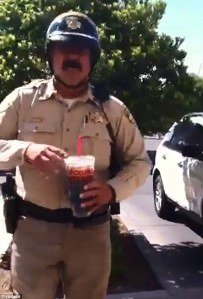
I have a great respect for police officers. Like soldiers, they selflessly put their lives on the line for my safety. But a good police officer is a humble one. They understand that they are not above the law—they are there to serve and protect the citizenry. When a humble and respectable person is wrong, they admit it. More importantly, when they’re wrong, and a 12-year-old kid asks for their badge number, they give it up and show dignity and honor for the job they are charged with. This Las Vegas police officer however, has traded such dignity and honor for a sense of entitlement and a god-complex.US_Park_Police_badge[1]

He did something illegal by parking his motorcycle where a motorcycle shouldn’t be parked unless he had been chasing someone, or doing other official police business that required an emergency parking job. As it turns out, he was getting food/drink and he got called out on his illegal parking by young Jeremy Drew, a kid with a pretty good sense of justice.

If this officer had a shred of dignity, he would have looked at Jeremy and said something like, “You know, you’re right. My sincerest apologies. I was wrong to park here. Here’s my badge number, and if you feel a duty to report me, then by all means, you should do so.” Would the officer had been so kind had I parked my motorcycle there while I got lunch?

Las Vegas PD Officer In Question

Then that officer should seriously reflect on why he became a cop in the first place, and whether he’s serious about defending the Constitution and local laws—therefore not violating them himself. He then should either resign if he doesn’t have the honor to do the job properly anymore, or change his way of thinking and behaving if he does.

Many police get upset when we citizens show little respect for them. To those officers I say this: don’t do actions that are disrespectful, hypocritical, arrogant, or plain illegal, and you won’t usually get disrespected. The corrupt among you, the indifferent among you, and the good officers who do nothing about the bad ones, serve as the main reason respect for the badge is waning.

We all know bad cops are bad, but that’s simply not the whole issue. I understand the idea of the police “brotherhood,” but if one of your fellow officer’s is out of line and you accept it, allow it, and/or condone it, you’re indifference might as well be an endorsement. If it is a crime for a person watching a murder to do nothing (depraved indifference), then you as police officers should also do something to stop your fellow officers when they do wrong as well.

The honor for the badge should be far more important than the honor for the random person behind it. If they don’t respond apologetically and remorsefully—showing clear signs such behavior will cease, then maybe a discussion with superiors or internal affairs is in order.

While most police officers are good, the ones that are doing illegal and/or inexcusable acts are rarely dealt with when their offense is only a misdemeanor like above, and this tolerance of bad behavior is exactly why America has shifted from a country that heralded Andy Griffith to a country that embraces the “F*** the police” mantra so prevalent in pop culture these days.

In another instance, on May 26th, 2012, a Portland Maine law student who remained unnamed by choice, was carrying a sidearm, as is his Constitutional right. A resident with what appears to be little understanding of the rights to carry a sidearm, decided to call the police and report the innocent open-carrier. Officers were dispatched to the scene. See the story here:

Again, an officer was in the wrong, and reacted incorrectly once confronted by a citizen who was in the right. Here’s what should have transpired but didn’t.

  • An officer should have never been dispatched. The person who called the police should have been advised by the dispatcher that carrying a weapon is a legal act and that they cannot dispatch an officer unless it appears there is an illegal act happening.
  • The officer merely did his duty in responding, but he was incorrect in his interpretation of the law. I can forgive an officer for not being in command of the laws like a lawyer—a law degree takes a lot longer to attain than your typical police academy certification. But if someone is telling you the law, and they seem to know what they’re talking about, especially when you don’t, then stop acting like you do. The law student was right, which means the officer was either purposefully being incorrect, or just wasn’t certain and thought he knew the law. Either way, arguing with someone when you don’t know you’re right is pure arrogance. What would have been so hard about saying, “You may be correct, let me check with my superior” or “You’re right sir, my mistake” once corrected by the law student.

There are a litany of videos of police officers abusing their power, these are merely two. The military and police are somewhat similar, yet where the military is revered for its respect and honor, the police are too often not. The one glaring difference between the two is labor unions—soldiers aren’t unionized. When union entitlement mentalities take over a workforce, the workers rarely fear for losing their job. Someone with little fear of getting fired, isn’t so compelled to do the right thing—in government, this is a recipe for abuse.

When legislators, police, and other government employees violate the law, the penalties imposed are usually far less severe than what John Q Public might endure if he committed the same offense. This is fundamentally wrong in a country where “We the people” give power to the government.

Instead, government officials should be penalized more severely. I didn’t take an oath to defend the Constitution, but they did—they know better. If we can’t trust them, who can we trust? And if we can’t trust them, “We the people” who actually have the power according to our Constitution, might as well get rid of them. Would you hire an employee if you thought they would steal from you?

Barney Fife and Andy Griffith from The Andy Griffith Show

We voters must vote to rid our government of organized labor so that we can better hold the rule-breakers accountable. But police must start to care about the honor of their profession and police themselves as stringently is they police us. Doing so will yield top quality public servants. Until then, we get the Barney Fifes and/or Joseph Miedzianowskis instead of the Andy Griffiths and Elliot Nesses. We deserve better.

Would you mind electrocuting this person real quick? Why People Support Overtaxation.

Gary Nolan (and THE Scrappy Doo)

In July of 1961, Yale University psychiatrist Stanley Milgram began an experiment that ended with shocking results—literally! It is now simply known as the Milgram Experiment—his most famous work.

Stanley Milgram
Stanley Milgram

Milgram was troubled with the excuses provided by Nazis in the wake of World War II for the atrocities they had committed. Obviously, they engaged in overly heinous acts toward their fellow man, so horrid in nature it makes one wonder how Hitler got his followers to do them. Yet their responses to the question of why were often the same; they were just following orders.

Milgram was skeptical that people would do something at the direction of an authority figure that they would not in good conscience do on their own. He devised an experiment whereby he would instruct participants to shock other participants they would never meet who were located behind a wall. The shocker was real but was unaware that the shockee was an actor. This actor would fain pain by screaming in agony, and the intent was to see if the shocker would continue to shock the shockee solely because an authority figure told them to, regardless of how dangerous or painful it seemed to be for the person on the other side.

The video below shows what happened. If you’ve never heard of this experiment before, check it out. It is certainly a fascinating study into the human psyche with very surprising results. His experiment showed people were willing to do horrific things to one another if an authority figure told them it was OK to do so, confirming the idea that many Nazis were indeed telling the truth about their motives.

As I think about this experiment, I can’t help but draw what I believe is a very exact parallel to modern-day tax policies.

There were potentially a number of reasons Obama and many Democrats scored victories in the last election, but there can be no doubt that class envy was one of the common motivating factors. The “tax the rich” mantra was a winning campaign strategy, but let’s think about it deeper.

Bill Gates
Bill Gates

Imagine I put a random democrat-voter currently receiving or requesting government assistance in front of Bill Gates or Warren Buffett and asked them to perform one simple task: look Bill or Warren in the eye and explain fairly and logically why you think they owe you something. I suspect most of them would be speechless and embarrassed, I know I would. But then again, I have a conscience and I am a libertarian.

Some may be brazen enough to look Gates and Buffett in the eye and argue that they’re simply too rich and have no right to all that money, but most would know there’s no rational argument to present and would simply accept that any effort to make such an argument would show that they were the ones being greedy by demanding what someone else had worked for, Bill and Warren are merely wanting to control what they’ve earned after all.

I specify “control” versus “keep” because they often donate a lot of their earnings to charities. But, when they give their money away, they choose instead of government choosing for them, who gets what they worked so hard for, and risked so much to obtain.

However, if voters can hide behind the wall of government just like Milgram’s participants hid behind a wall, and an authority figure like a politician tells them it’s OK to harm the wealthiest among us, the Milgram Experiment mentality takes over and people who wouldn’t have the gumption to demand the earnings of someone else in person all of a sudden wave the “tax the rich” banner like it’s part of their religion. If Obama says it’s OK, it must be, right?

What’s the solution? I don’t rightly know. But the first step in fixing a problem is understanding it. I don’t know that too many people have applied Milgram’s findings to politics, but there is no doubt in my mind that this an “apples to apples” comparison. The answer to how we get people to begin to grasp the concept that they are cowardly asking government to do something they would likely never have the hubris to ask for themselves is elusive, and likely always will be.

Contrary To Popular Belief, Laws And Police Rarely Prevent Crime

Gary Nolan (and THE Scrappy Doo)

What are laws actually for? If you’re thinking to prevent crime, think again. While I don’t support anarchy, if there’s no laws to be broken, there’s no crime, right?

The legislature writes laws to set a standard for law-abiding citizens to know what will and won’t land them in jail. It’s the best way to ensure fairness in prosecution.

Some legislators may believe that would-be murderers would pause and think, “I want to kill this person, but Nancy Pelosi says that’s wrong,” but I think most reasonable people know this is simply not true.

Nancy Pelosi (D - California)
Nancy Pelosi (D – California)

Taking it further and speaking in absolutes; a law cannot stop a crime—criminal acts are physical actions. In order to stop a moving object, you need another physical object to interfere. Isaac’s Laws of Motion, remember? But a law is just words on a page and cannot technically prevent anything. A police officer could, but we’ll get to that in a moment.

Let me give an example of why this nuance of defining standards is important and what happens when it’s done wrong.

In 1995, after the repeal of the national 55 mph speed limit, Montana passed a daytime “reasonable and prudent” law. In what could be one of the most glorious acts of libertarianism ever enacted, the state entrusted the people of Montana to determine for themselves a safe speed to travel under the conditions at any given time. To many people’s surprise, studies showed that letting people drive as fast as they wanted actually reduced highway fatalities. They got to where they were going faster too.

Montana Reasonable and Prudent Speed "Limit" Sign
Montana Reasonable and Prudent Speed “Limit” Sign

Then on March 10th, 1996, at a brisk 85 mph, along came Rudy Stanko and his Camaro, when Kenneth Breidenbach, a Montana Highway Patrol officer pulled him over, citing him for unsafe driving in relation to speed. See the legal arguments here.

Stanko was initially convicted, but “Reasonable and prudent” wasn’t properly written, making Stanko the victim of bad law.

Stanko’s attorneys appealed, stating that the “reasonable and prudent” statute was constitutionally vague—they were right. The judge agreed that a person cannot be cited for not driving reasonably and prudently unless the state first defines reasonable and prudent, which it hadn’t. As such, Stanko had no way of knowing if he was doing something that would earn him a ticket, and thus no way to avoid doing it.

Although I hated to see the Montanabahn go, we cannot allow police officers and courts to arbitrarily decide why one person doing 85 is OK, and the other is not. Why? Officer Ken or Justice Joe, for instance, could cite their cheating ex-girlfriends at will for something they let everyone else get away with—I assume you get the point.

As a libertarian (and a Corvette owner), I of course hoped that Montana would have attempted to define reasonable and prudent, which I concede may have been monumentally difficult, but instead, they reverted back to an actual speed limit of 75 mph, and this great bastion of libertarianism died a sad yet preventable death.

So now that I’ve illustrated the purpose of laws and what a good law does, to be fair, I should point out that some laws may serve as a deterrent. However, crimes of a violent nature are also usually crimes of passion, which are usually only preventable with a weapon, not a law.

So do police prevent crime?

Think about all the times you might call the police. More often than not, they are called because either a crime is in progress or has been committed. Also, when police pull someone over, they are doing so because a traffic law has been broken, not because you were about to run a red light—which was clearly still yellow—dammit.

In both instances, the crime is investigated and/or prosecuted, not prevented. It is a very rare occasion you would call the police before a crime is perpetrated and the police would intervene to stop the act before it was able to be carried out. EC689123235C04BEBFE698A4CC_h231_w308_m5_caksoayGp[1]

Again to be fair though, as evidenced by high rates of recidivism, when police arrest someone who committed one crime, they are often preventing the next one on that felon’s “to-do” list.

To all police officers, if you’re one of the many honorable and law-abiding people putting your life at risk for me on a daily basis, I appreciate you immensely—as we all should. So please don’t assume I’m criticizing your sacrifices.

But I believe preventing crime is ultimately a duty of the people. This is one of the many reasons why we have the 2nd amendment and why we all should be more apt to take advantage of it. We should encourage citizen-based crime prevention options, and stand your ground legislation should be nationwide. If a criminal knew most of the neighborhood was armed and would gladly shoot them without repercussion, the innate sense of self-preservation might just override the desire to steal your car stereo—it is not worth dying for.

As far as the police go, I firmly believe that as a nation we should have far less police officers in favor of more police detectives. I don’t blame the officers themselves, they’re just doing a job, but too often the police serve as a means of income for the community via traffic enforcement instead of preventing and solving crime, and this isn’t in the people’s best interests.

So how do we prevent crime then? As you may have imagined, I have some suggestions. Here’s but a few:

  1. Stop writing unneeded laws: I won’t go deep into the drug debate here, but it is a perfect example. Most violent drug-related crimes occur because recreational drugs are illegal. This idea was proven beyond any doubt during alcohol prohibition and its subsequent repeal approximately 80 years ago. Deep within our nature exists a truism: if you encroach on mankind’s freedom, we will lash out—sometimes quite violently. Don’t believe me, tell your kid not to do something, see what happens.YourSpeed
  2. Reign in entitlements: As long as we’re paying welfare mothers to have welfare babies that serve more as a source of income than an outlet for an abundance of motherly love, we’re going to have children who grow up with little to no sense of morality. If I feel I’m entitled to your car, I’ll likely just take it? However, if we force people to sink or swim, we’ll have a lot more people who develop a good work ethic. People who work for things appreciate them and don’t feel compelled to take what others worked for due to another innate quality in most humans—empathy.
  3. Improve education: Get rid of teacher’s unions, public schools, etc., and have proper free market education. If free markets can make a better car, and I think Russia vs. America proved this, then it can build a better school too. Studies have shown private schools routinely outperform their public counterparts. One look at any prison shows that most of the people in there can’t even spell incarceration. Sure there are genius criminal minds, but contrary to Hollywood hype, they’re not as common as you would think. A smarter society is usually a more peaceful one, whereas most criminals are idiots.
  4. Improve the economy: Some criminals are psychopaths, but some criminals are just desperate. Psychopaths will commit crimes as long as they are free, but with a strong economy, you at least reduce the crimes of desperation.

Ultimately we need to adopt a “No victim, no crime” policy then restore our country’s greatness such that people don’t feel the need to do bad things to survive. but the answer is almost never more laws and more police.

Lethal Force Poll

In the wake of the Zimmerman verdict, the use of lethal force and when it is appropriate is a subject of great controversy. With that in mind, when do you believe lethal force is justified?