The Myth of the Wasted Vote

I was a pretty ardent supporter of Senator Rand Paul for president, stating that he’s the only Republican Party candidate I would have voted for in the upcoming election. Since he’s no longer running, my support has shifted to Gary Johnson of the Libertarian Party, but will generally support whomever of the three remaining LP nominees wins their party.

Senator Rand Paul (R)

On Twitter, I campaigned hard to any of my Republican voting followers that Senator Paul is their only candidate who can get libertarian votes, and even some Democrat votes, because his positions of liberty often span party lines. As such, I felt this strategy was their best path to the White House.

Was he polling well? No. But, this was mostly due to lack of name recognition versus the issues. More importantly, though, it’s important to understand that most Republicans will vote Republican irregardless of the specific candidate, so they would certainly follow Rand. Once he was the only person on the debate stage against a Democratic nominee, I felt he would easily win on the issues.

This might seem like I’m asking Republicans to pick my candidate instead of their own, which is counter to what I’m suggesting in this post in the first place, but the reality is that I always preferred Gary Johnson.

In supporting Rand however, I was offering what I would consider a highly favorable compromise. But the rest of the Republican voting block didn’t seem interested in such a compromise, and turned this into a negotiation where both sides agreed there simply was no deal to be made.

While I believe the remaining Republicans are slightly better than Democratic offerings, I refuse to vote for any Republican on the sole premise that it’s imperative to beat the Democrats at any cost.

The most common disagreement we have with the GOP, is that we largely disagree with their consistent efforts to subversively legislate Christian values, while skirting 1st amendment objections by simply not specifically mentioning god in such legislation.

For instance, if you look at Ted Cruz’s website, he has an “Issues” section where he specifically talks about fighting for religious liberty.

Texas Senator Ted Cruz (R)

But one look at this page, it is clear that this is actually not about religious liberty, but instead, a Christian crusade of sorts.

While it might look like religious liberty to Christians, almost every issue is about fighting for Christians specifically with no protections offered to other religions nor atheists.

Let’s look at his 11th bullet reads as follows:

“Successfully defended the words “under God” in the Texas Pledge of Allegiance and Texas schools’ moment of silence law in federal district court.”

Not only is this NOT promoting religious freedom, he’s specifically promoting government imposing a religious reference in a government sanctioned pledge—the absolute polar opposite of religious liberty.

It’s this kind of hypocrisy, and misunderstanding of the Constitution from a lawyer who should clearly understand it better than most, that makes Ted Cruz come off as disingenuous, ignorant, and wrong.

While this is on Ted Cruz’s website, these Christian based ideals, are echoed by almost all Republican candidates, including Donald Trump.

Donald Trump (R)

While I have no war with religion, I don’t want to live in a country where I have to fear my leaders forcing me to be more Christian either.

Do I consider “Under God” a big issue? Not in the least.

I’m bothered that Ted Cruz considers it big enough to put on his website as one of his credentials, and under the banner of religious freedom.

More importantly though, I’d like to think he’d fight for my rights as an atheist if a Christian legislator attempts to violate them by legislating religious ideology. Based on this page of his website however, I genuinely don’t believe he would.

So what about the wasted vote?

Many Republicans have lashed out at me, arguing that people like me are giving Democrats the win if we vote Libertarian, and that we’re wasting our vote on someone who won’t win.

At first thought, it does make some sense. A majority of libertarians would choose a Republican over a Democrat if those are their only two choices, but this is a short-sighted view on their part, and frankly somewhat arrogant and presumptuous to assume I’d prefer them. More importantly, it’s counter to my own best interests in the long term.

Former Governer Gary Johnson - Libertarian nominee for President
Former Governor Gary Johnson – Libertarian nominee for President

The first and most important point I’d like to make is this. My vote is mine. No one has any right to it, and no one has any right to dictate to me who I should vote for. So if you’re a Republican who wants to attack me for voting libertarian, you’re out of line.

Second: Your vote is your way to influence change in government. It’s not just about winning, it’s about letting people know that while they may have a majority, that majority is potentially in jeopardy if they lose some support. That growing their support will require them to give more deference towards our ideals too.

But the more important point to understand about the wasted vote myth, is that if I continue to go along with the (not Rand Paul) Republican nominee, I’m supporting a system I don’t agree with. Voting for someone who won’t win isn’t a wasted vote, voting for someone I don’t want to be president is.

Because if I want libertarianism to grow, the only way I can do that is to vote for libertarian candidates and issues. Voting for Republicans will only reinforce the current Republican agenda with no deference to my own. In other words, what argument could one possibly make to believe libertarianism would grow if no one votes libertarian? So the only way I can waste my vote is by not voting for those who promote the ideals which I support.

If I vote libertarian, and Republicans do lose, this puts Republicans in a position of self-reflection as to why they lost, and how they can grow their party.

Libertarian Party
Libertarian Party

Many Republicans are quite libertarian in their views already, so it’s not that big of a leap, and I hope they consider it more seriously. They’ll hopefully recognize that the way to grow their party, is to be more libertarian on the issues. When you look at the issues that people part with the GOP on in the first place, you’ll find it’s the issues that libertarians and Democrats agree, and when people lash out at Democrats, it’s usually the policies where libertarians and Republicans agree.

I’d argue there’s a lesson in that for both the major parties, hopefully one or both of them figure it out soon.

Who Can You Trust? A Guide To Questioning The Media

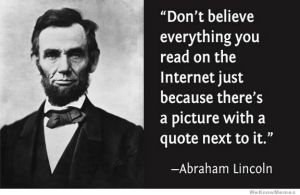
The internet is full of numerous people making claims. Whether it be memes with pictures of famous people saying something they clearly didn’t say, or quotes from famous people who actually did say it.

Abraham Lincoln Weighing In On the Internet

Point #1 I’d like to make is that a famous person isn’t more credible than any other person, unless said famous person is actually educated in the field of the claim being made. (Think Professor of Physics Brian Cox speaking on the subject of physics or science in general for instance).

Professor Brian Cox
Professor Brian Cox

Before we start, for purposes of this post, it’s important to define opinions, beliefs, and facts, as I believe they are mutually exclusive.

  • Opinion – A statement that has no right nor wrong answer.
  • Belief – A statement that does have a right or wrong answer, but that isn’t substantiated by evidence to know said right and wrong answers.
  • Fact – A statement that does have a right or wrong answer, and is supported wholly by evidence making it a demonstrable truth.

To give an example of these three, let’s look at someone who chooses a vegan diet.

If a person doesn’t want to be someone who exploits animals, or simply doesn’t like the taste; that is a matter of opinion and they should never be questioned on their choice, as there’s no evidence one can put forth to prove them wrong.

However, if they go vegan because they argue it’s healthier, that is a matter-of-fact statement. If they have no evidence supporting it, it’s merely a belief.

To make it fact, they would first have to define “healthy.” It could mean disease free, not obese, longevity of life, low cholesterol…the list is endless. From there, one would have to do or cite a controlled study comparing veganism to omnivorous or carnivorous diets, and prove it to be true. As such, such matter-of-fact statements, unlike matters of opinion, are indeed open to being questioned.

Now that we’ve covered those points, let’s kick this off with some simple thoughts to keep in mind when you read something on the internet, or see an advertisement on TV.

  • A claim sans evidence should be deemed as nothing more than an opinion or belief.
  • A claim sans evidence from an expert, is only an expert opinion or belief.
  • While an unsubstantiated expert opinion should be trusted more than an unsubstantiated non-expert opinion, neither should be deemed as fact.

Exploring the above three points; they often come into play when viewing a celebrity or expert-endorsed advertisement. They often make claims that you feel potentially make sense. But if you practice some critical thinking, you’ll soon notice that they can’t, don’t, or won’t cite any tests, studies, or evidence-based facts to back up their claim.

When watching a science-looking TV program, it’s important to understand that a proper expert would say “I don’t know” until they have actually seen or performed a study and gathered real evidence; not speculate profusely, presenting it as fact. (Think Ancient Aliens, Ghost Hunters, etc.)

Why do some experts speculate like this? Because science is a LOT of work! It involves loads of money, and a myriad of education and testing that can take years or even decades to complete. Not to mention, it also requires something to actually test. How can someone be an expert on Bigfoot if they don’t have an actual Bigfoot to observe and test, right?

Speculation however is easy; you just start talking.

So what are a couple of tell-tale signs you should look for when you see someone making a claim that you suspect might be less than trustworthy?

  • Is it an advertisement? If so, it’s biased, and should be ignored almost unilaterally. On a credibility scale, from zero being pure bullsh*t, and ten being “Take it to the bank;” advertisements are a zero. A celebrity endorsement likely ranks no more than a one, and an expert endorsement maybe a two. Why do endorsements add any value at all if they’re just being paid to say whatever their told to say? Because their credibility is on the line, so you’d like to think they care as much about their credibility as you do yours. But that being said, Dr. Oz proved this is still not that trustworthy.

    Dr. Mehmet Oz
    Dr. Mehmet Oz
  • If the advertisement cites an independent study, look up the study. If it’s legitimately independent, that sends it way up the credibility scale, and such companies should be commended for doing so. Although to be fair, if the independent study hadn’t been favorable, it would not have been in the ad, so it’s still partially comfirmation-biased as you’ll likely not hear any negative portions the study might have reported.
  • If it’s not an advertisement, does it actually give you evidence-based answers versus speculation? These pseudo-science shows, like the aforementioned alien, cryptozoology, or ghost shows are famous for presenting themselves as science, but being anything but. They bring dubious experts on who ask provocative questions, but then never follow it up with evidence-based answers. It makes them seem smart, but most of the time, it’s ridiculous nonsense with big words.

Why is this important? Ignorance is bliss, after all. Right?

If you were building a home, would you cut a framing board at what appears to be six feet to you (Not science)? Or would you measure the board (Science)?

People spouting unsubstantiated nonsense as if it is fact are some of the most dangerous people on the planet. They convince people who don’t know any better, to act on their claims as if they’re fact. Sometimes to grave consequences. Think Steve Jobs being duped to treat his cancer with “alternative,” instead of actual medicine. Such false medicinal advice may have cost him his life; a claim that cannot be proven since we don’t have two different Steve Jobs (one who took a doctors advice versus one who didn’t) to test, as the linked article points out.

At this point, I’m sure you are wondering who exactly you CAN trust. Assuming you don’t know how to, or have the means to carry out a proper controlled study, or do actual research yourself, I’ve prepared a makeshift credibility scale to help you suss out the chaff.

Scientific Journals, such as The Journal of the American Medical Association (JAMA), the New England Journal of Medicine, the Journal of Science, The Journal Nature, etc., are the most credible science sources you will find.  They report controlled and peer-reviewed studies only. They don’t take money to print studies. And they even print retractions if a new peer brings information to light that falsifies a previous claim.

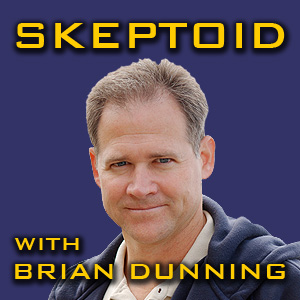
Websites like Snopes, Skeptoid, or Science Based Medicine are largely devoted to debunking false claims, and do a great job of bringing just well-researched facts sans opinion. I would trust them nearly as much as scientific journals.

Skeptoid's Brian Dunning
Skeptoid’s Brian Dunning

So what about non-scientific information like politics, human interest stories, etc.?

Unbiased news sources are a very credible venue. Reuters and the Associated Press are two of the most commonly cited news sources by other commercial news outlets, and this speaks to their credibility. They don’t do opinion, so when you read an article from them, it may be somewhat less interesting, but that’s because it’s just the facts.Fox News

News sites with opinion, like MSNBC, CNN, Fox News, ABC News, CBS News, The New York Times, Wall Street Journal, and more are still fairly credible, despite being laden with opinion—this is mostly due to their market share.

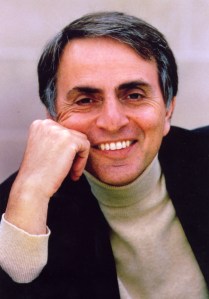
Carl Sagan once said, “If it can be destroyed by the truth, it deserves to be destroyed by the truth.” If these mainstream outlets were consistently delivering false information, or didn’t make an effort to present both sides of an argument, this is exactly what the market would do to them.

Carl Sagan
Carl Sagan

While their ideological counterparts hate such news sources, independent minded people generally understand that while they’re biased, they at least validate sources and make an effort to be accurate and fair. It’s not perfect, but it’s at least reasonably credible.

Openly biased news sources like Drudge Report or The Daily Kos still have a market to answer to, and often break accurate information first due to their aggressive desire to defeat their ideological opponents. But I would avoid citing them as fact, because their information is suspect unless you can corroborate their findings with other news sources as mentioned above.

Blogs like mine are laden with bias. They are so small and rarely ever cited, that you should almost never consider blog claims as reputably truthful. If they cite credible sources along with their opinions (This is why I often do exactly that), it increases their credibility, but you should never treat them with full reverence.

Hopefully, you’ll start to notice that “opinion” is a consistent point to avoid when looking for the truth, but the bottom line is you should question everything. Question people who make claims without providing evidence. Question people who claim to be experts but can’t back up their opinion with fact. If you’re qualified, question proper scientific studies and do your own peer review.

Either way, enjoy the information you gather throughout life, just be skeptical every step of the way. Happy hunting!

America: Safety Second!

Your humble correspondent has many favorite pass-times. At the top of my list is autocross racing; a form of road racing for beginners—using their own cars to get the thrill of something like Formula 1, without the $100 million dollar budget, death-defying 200+ mph speeds, or the need to be the best driver in the world. See the video below for a short, but wonderful documentary on autocross. If you like motorsports, I encourage you to check out your local SCCA or NASA (not that NASA) club and check it out. It’s cheap yet awesome!

Before every event, they have a driver’s meeting where the person running the event (a volunteer) lays out the plans for the day, and the safety steward (also a volunteer) explains the rules of safety.

One of these officers from the events I went to, one Jon Beerman, would always say, “Safety second! If we put safety first, we wouldn’t be out here doing this in the first place.” Jon has a crazy fast Corvette, and if you know me or follow me on Twitter, you know I have a deep love for all things Corvette, so this makes Jon a well respected man in my book straight away.

Jon Beerman and his Corvette of Death

All kidding aside, I always thought this was pretty insightful of him, but also, a great analogy for the American spirit. We were a country born out of a passion for freedom. The freedom to do something really dumb, adventurous, dangerous, and/or even crazy (as long as you don’t hurt anyone doing it). Why would you do such a thing? Why not?!

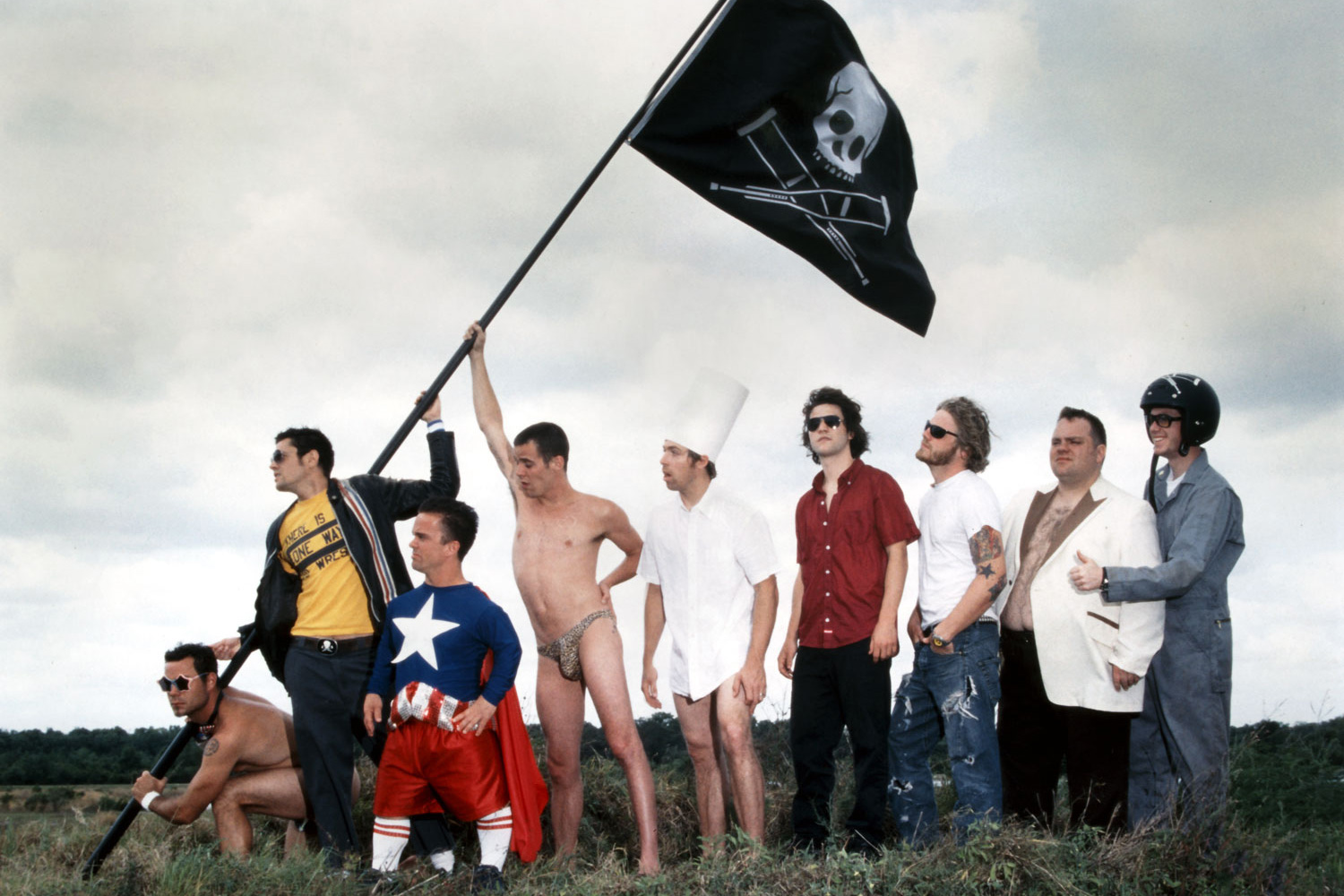
The crew from the Jackass movies, for instance, put their lives and limbs on the line, just to make a living entertaining us. Nothing they do is ever advisable, and certainly isn’t safe. But obviously they are doing what they love for a living, and those of us who find it entertaining are thankful they do. But if all we cared about was safety, nothing like that would ever exist. Thankfully, both the Jackasses and us viewers live a happier life, in some small part, because they do.

The Cast from Jackass

Yet these days, that concept seems to be lost on most Americans as we strive to put warning labels on everything, barricade our children into the house until they’re 18, pass laws to erase any ounce of danger in life (even if we’re only endangering ourselves), and generally destroy anything that is fun in the name of safety.

The whole point of freedom is the ability to do things that other people might not think you should do, but so long as you’re not hurting someone doing it, you should happily be able to do so with no impediment from government.

Whether it be currently legal activities like skydiving and/or road racing, or things currently illegal like using recreational drugs, gambling, hiring a prostitute, or all of the above. It’s your life, you should be free to live it as you see fit.

As with most all things, we’re dealing with a simple trade off. You can lead a riskier life you enjoy more, but may die younger as a result. Or you can lead a more sterile life, live longer, but be miserable doing so.

After reading that last paragraph, you’ve probably thought about it and picked one life or the other for yourself. But here’s the thing that you should really think about. Whichever you picked, you have no right to dictate that someone else pick the same for themselves.

If you opted to go the Evel Knievel route, great! Have fun and good luck. The funny thing about such daredevils, is that they rarely, if ever, try to force that lifestyle on you. Some of them do their shenanigans in public and risk the populace around them, which I would never condone—that’s criminal, violates the rights to life of others, and they rightfully should be locked up.

Evel Knievel Crash - Wembley Stadium
Evel Knievel Crash – Wembley Stadium

But at the opposite end of the spectrum, those who think risk-taking is always bad and avoid them at all costs, love to vote on legislation to ensure you lead their sanitized lifestyle.

It can be something as benign as a helmet or seat belt law, or as intrusive as the aforementioned drug, prostitution, or other vice laws.

If you know a few friends who like to sit around and get high; you know they rarely if ever, hurt anyone. So how is it the business of anyone else if they do that to themselves? I know it’s popular opinion among those who aren’t around such people, mostly based on folklore, that people who sell or use drugs are violent killers, but most are just trying to pay a few bills, and escape the miseries of life peacefully.

While Hollywood paints prostitution to be a crime ridden enterprise, the fact is that many of the consumers are just lonely guys, maybe not very attractive, who want to know what it’s like to be with a beautiful woman, and often treat the providers fairly respectfully.

Here’s where the illegality part becomes the problem. If the consumers are abusive, the laws against prostitution actually work against the victims, because they cannot call the police to help them without admitting they were engaging in prostitution.

Some areas stipulate police cannot check a person’s immigration status if that person calls the police to report a crime, because we want those people to report those crimes without fear of deportation. Yet somehow, if someone’s rights are violated during a vice encounter such as drugs or prostitution, now the same legislators don’t seem to care.

It’s rather hypocritical, quite immoral, and nearly unconstitutional to worry about the rights of someone who isn’t a citizen, yet care less about the rights of someone who is, just because they were engaging in behavior you think is wrong.

So I will always argue that America should be safety second, and enjoy your life to the fullest should be the resounding first.


Dear Formula 1 Racing: I’m Here to Help

(This is humor with a touch of truth to it. Please no hate mail if you were offended)

Hey there, my beloved Formula 1 racing. I know you added a waste gate exhaust this year to improve the noise coming from your latest crop of competitive machinery, but these cars do not in fact, sound any better. I fear you’ve lost your way.

So I have some suggestions, if you’ll indulge me a moment.

  • Add two or more cylinders to the current powertrains. No one has ever said, “I’m going to build the worlds most amazing supercar,” then followed it up with, “I know, I’ll put a V6 in it.”
  • A Toyota Prius has never been a race car, nor ever professed to be one. Modeling your powertrain after a Prius’ powertrain might have been a mistake. And I use the word “might” loosely. The Prius was designed with fuel economy in mind, not speed.

    Toyota Prius
    Toyota Prius
  • You had a problem in the 1980s with turbos driving up the cost of cars so high, no one but the top teams could compete. So much so, you banned them in 1989, and a significantly more competitive series ensued. Now, you’ve not only brought them back, but added an expensive electric motor too! Did you forget the lessons of the 80’s so soon? Or just decide you don’t want a competitive series anymore?
  • A car from over ten years ago, still holds most of your track records. The goal of Formula 1 wasn’t to make junky technology less junky. It was to make the fastest technology faster. If the cars of the current year aren’t consistently faster than the cars of the previous year, you’re doing technology wrong. At this rate, you’ll be racing electric wheelchairs by 2030.

    Ralph Schumacher's brother's Ferrari F2004 car, and holder of several F1 records 12 years later
    Ralph Schumacher’s brother’s Ferrari F2004 car, and holder of several F1 records 12 years later
  • I get that Renault fought vehemently to bring this style powertrain into Formula 1 after they won a constructor’s championship in order to add road car relevance to the series. But Renault are French, and the French don’t build supercars. When have the French ever shown themselves to be a guiding force in motorsport? The Italians, the Germans, the British, the Americans; they’re all known for motorsports enthusiasm and expertise. But no one has ever thought, “I want to start a racing series, then knocked on the door of a Frenchman.” They don’t even host a Grand Prix anymore! Maybe, you should listen to your fans instead. They do kinda pay your salary after all. If you had listened to us, you’re current grid would look something like this. Fans would be dreaming about owning or driving one of your cars, instead of reminiscing about how awesome the cars were three years ago and counting.

    Red Bull X2010 Concept Formula 1 Car
    Red Bull X2010 Concept Formula 1 Car

I love Formula 1, with a passion. And while I mean this as a somewhat humorous quip, please know that you have angered many fans, and we’re losing interest. A gussied up qualifying system isn’t the answer, the baddest car ever devised is. Leave the glorified Teslas to the Formula E series.

The “Currently Isn’t Working” Fallacy, The 1% Myth, and Misleading Statistics

On a recent episode of Stossel, Neil Sroka; the communications director for Democracy for America came on the show. He is an ardent supporter of Bernie Sanders, and his ideals of democratic socialism.

Here’s a transcript of a portion I’d like to discuss. I’m not going to type out the entire interview, but since this was the first real question, there was indeed nothing preceding it that would leave you missing any context.

John Stossel - Fox Business Network
John Stossel – Fox Business Network

Stossel: Now socialism generally means that the government owns the means of production. Do you want that?

Sroka: Well, I think there is [sic] some antiquated views about what socialism is. I don’t think anyone’s calling for, you know, state ownership of the gas station down the street. But what we are saying is, is [sic] that the current system that we have right now isn’t working. Uh, you know, when over 40 million Americans are still living in poverty at the same time that, you know, a millionaire and billionaire class is trying to essentially own all political discourse in this country, that [sic] that’s problematic. And that’s what we have to work together to dismantle.

John did a pretty good job of debating the issues with Neil, I don’t need to belabor those further here.

But one thing that is often repeated that wasn’t addressed in the interview, is a claim by many on the left (and the right for that matter); the notion that whatever “it” is in America, “it” somehow isn’t working or is broken.

The United States of America is the single most powerful nation in the world—by a wide margin. Not just in military force, but in economic force.

Misleading Statistics

Neil argued that there are over 40 million people (It’s 45 million, in fact) under poverty in America, but that number is a bit misleading.

Neil isn’t ignorant when he uses that number, it’s such a large number, it sounds horrible—giving it quite the shocking impact.

It convinces people, with actual facts (albeit misleading ones), that there is a massive problem. But the reality is, it’s only about 15% of the American populous, or approximately one out of seven people, as shown in this census bureau report. Which means 85%, or nearly 255 million, are in fact, NOT at the poverty level. Also quite factual, but significantly less shocking when thought of in that light.

While I feel for such people (I am almost one of them, so I really do feel for them), they are at the bottom 15%, and aren’t even close to the majority. Poverty is always a problem for people, and I don’t deny that. But America doesn’t have a poverty problem, I’d argue that the large majority of people under poverty have a personal problem—they’re not doing what is needed to get themselves out of poverty.

Still not convinced? Think about this. Imagine a random seven people you might meet on any given day. Then consider whether you think at least one of them, on average, is not really putting forth the kind of effort needed to be successful enough in life to be above the poverty level. I genuinely don’t feel like that’s a stretch by any measure.

People also love to point at “money buying elections” as part of the problem, but Obama spent less than Mitt Romney in 2012, yet he still won quite resoundingly.

In 2007, Obama didn’t start with a lot of money when he initially ran for president either. Hillary was the one with all the money behind her at the onset of that election cycle.

Presidential candidate Sen. Bernie Sanders, I-Vt.

Socialists like Sanders like to create a cause-and-effect argument between money spent, and elections won, as if the money came first and drove the election results.

But it’s also entirely possible that instead; the money follows the person with the best ideas, and is therefore the effect versus the cause, which seems to be the case with Obama versus Clinton in 2007; assuming we can agree Obama is more charismatic and interesting than Hillary Clinton, and I think we can.

Stating that the system is broken and doesn’t work, appeals to people who are driven to have more, by exploiting the human tendency for confirmation bias. Americans know subconsciously that America is a strong and powerful economic nation. But many of these socialist supporters are unhappy with their own lives because of whatever their shortcomings might be, and it hurts to think of yourself as worse than average in any way.

So when someone points out that the system is broken, it gives such people a way to argue that their own inadequacies aren’t their problem after all; society, corporations, or rich people are actually to blame—just ask that guy.

Everything in the world is capable of improvement, and America is no exception. But if you’re an American, you should be incredibly thankful for what you have. As much as socialists like to talk about the poor 99% in America suffering the top 1%, if you’re an American making over $32, 400, when looking at the rest of the world, you are indeed part of the 1% yourself.

So unless those of you in that $30k bracket or higher, who are behind socialists like Bernie, are ready to give up 80-90% of your salary to the rest of the world as many socialists suggest the richest 1% in American be forced to give to the rest of us Americans, you are indeed, quite the hypocrite—congratulations and #FeelTheBern.


Will Computers Catch Humans?

By the year 2030, famed inventor and Google futurist Ray Kurzweil predicts a singularity. The idea that because of Moore’s Law, an idea proposed by Intel’s co-founder Gordon Moore, which states that the number of transistors that can be packed into a given unit of space will roughly double every two years, that humans and machine will become one, indistinguishable being.

Ray Kurzweil
Ray Kurzweil

You may be wondering if Ray is somewhat like a modern-day Nostradamus, but that would be rather insulting to Ray.

Where Nostradamus had predicted very generic events that could have been attributed to just about anything, and thus people often correlated to very specific events and called his predictions a hit, Kurzweil predicted very specific things to occur in very specific time periods, and has a success rate of about 86%.

So much so, that Google hired him as their futurist, to help guide their own corporate endeavors in the direction Ray predicts the future is going.

Ray’s singularity prediction is rather interesting, because what he’s ultimately arguing is that because of the advances in memory technology, computers will meet the human brain’s computing power in this time frame.

While I don’t profess to have the knowledge Ray has, one thing I would like to point out, is that humans are not just a product of our memory, we are also a product of our intellect. Let’s look at how we’re different from computers, as an example.

Kim Peek - Autistic savant; the man the movie Rain Man was based on.
Kim Peek – Autistic savant; the man the movie Rain Man was based on.

Imagine a Microsoft Excel spreadsheet, with 1,000 rows and columns in size. Your computer remembers them flawlessly; every single character, like a mechanical Rain Man.

But ask a human to do this feat, and nearly no one can. So the argument that computers haven’t caught humans yet is somewhat misleading.

The average human brain has about 100 billion neurons, and many more glial cells. If we think of neurons as computer bits; the smallest level of computer memory, or the thing that is actually a one or a zero; then we can extrapolate how much memory a computer must have to match the human brain.

Four computer bits make a byte, 1,024 bytes make a kilobyte (KB). This 1,024 successive unit pattern then progresses as follows: megabyte (MB), gigabyte (GB), terabyte (TB), petabyte (PB)…and the list goes on.

This means, that the human brain has about 12.5 gigabytes of memory in the neurons alone. Add in the glial cells, and that number grows by at least double, since there are more of them. The above link references that opinions vary wildly about the real storage capacity of the human brain, but put it somewhere between 1 to 1,000 terabytes, the latter of which seems awfully high to me based on the number of neurons.

But the point I think that is missed in Ray’s hypothesis is that where computer memory is virtually flawless, the human brain seems to have mastered what it should and shouldn’t forget in a rather advantageous way. Where the human can’t remember the aforementioned massive spreadsheet data, it makes up for in its ability for inferring things not provided to it. This being the difference between memory (or knowledge), and computing power (intellect).

It’s this human ability to forget, that actually makes it better at processing information. For instance, you might talk to a co-worker all day, and entirely forget what color their shirt and pants are. Why? Because your brain has developed the ability to know that’s not important information, and immediately dumps it into your brain’s recycle bin.

But if your co-worker misspells a word in an email, your brain doesn’t crash and end its comprehension of the data like a computer might. Instead, you quickly understand what was inferred.

The fact is that there are computers with 1,000 terabytes, or nearly one petabyte already; they have the brains memory power. And one look at IBM’s Watson on Jeopardy, shows you that computers can already beat humans in knowledge alone quite easily.

IBM's Watson
IBM’s Watson

So how is it that a computer could beat Jeopardy’s best competitors, yet still cannot replicate human behavior?

One point to remember is that computers are digital, whereas the human brain is analog.

For instance, think of today’s modern digital cameras, which store a massive amount of mega pixels. We marvel in how much memory they can store, yet an analog camera from 50 years ago, effectively stores more, because it isn’t storing it digitally, as ones and zeros, but instead, as just one big picture on a film. Effectively, each molecule of film is one pixel, and that’s a significantly higher amount of data.

Blow up a digital picture, and eventually, you will see it displaying in its smallest constituents (pixels).

Example of a normal digital picture, when blown up, showing the individual pixels.

But if you blow up an analog picture, it never pixelizes, it just becomes so small of an area you can no longer make out what it is.

It’s this difference between analog and digital, that makes Ray’s prediction so uncertain for me. While he may be right, as long as computers rely on digital memory, I’m not convinced they’ll ever be on the level of humans. But instead, machines, and natural life, will always be somewhat separate.

A complete overhaul in the way computers memorize and process information will be needed, not the Moore’s Law doubling of memory in the digital realm.

But it is also worth noting, that Moore’s Law is inappropriately named. It is not in fact scientific law, nor even scientific theory, it is simply something Moore noted, and a pattern that has simply been repeated over the last 50 years, but is not by any stretch going to continue for eternity.

As the Journal of Nature reports, after fifty years, it may indeed be starting to break down. Whereas actual scientific law, such as gravity, and Isaac’s laws of motion; Moore’s “Law” almost invariably must fail at some point, once a transistor has been shrunk to its smallest level.

Speaking theoretically, a transistor, having two states (on and off), if it were shrunk down to one atom, with either one or two electrons depending on whether it’s “on” or “off;” making it smaller would likely prove impossible, and in that moment, Moore’s Law is no more.

Do I believe Kurzweil is crazy? Heck no, the man’s a genius. Do I believe he’s wrong? Not necessarily. More than anything, I would love to ask him about the things I pointed out, and just have an amazing discussion with an amazing man.

Instead, what I’m offering is that you should always be skeptical, and question everything. Whether it’s someone you respect and consider more brilliant than you, or someone you suspect is more likely to be wrong than you. It’s how you learn, and occasionally, it’s how they learn as well. Even the smartest of people can over-analyze something, and miss a simple key aspect, a lesser mind might have caught.

A Skeptical Look At The Steven Avery Case

I, as most of you, was compelled by the Making a Murderer series on Netflix. The validity of the claims aside for a moment, it was certainly compelling TV, and Netflix deserves all credit for the entertainment value of it.

Also, like you, after watching it, I felt as though Avery and his nephew were wrongly convicted in both instances, not just the initial conviction of Avery we know was wrong.

Steven Avery: Making a Murderer on Netflix

But I’d ask you all to apply come critical thinking for a second.

Most of you who watched the documentary feel he’s innocent. I’d say a fair estimate is at least 11 out of 12 of you anyway.

Yet, in a court of law, where all the evidence was presented, 12 out of 12 people all came to the opposite conclusion and agreed Avery and his nephew were guilty beyond a reasonable doubt. Not the majority of them, but every single one of them. Such a large disparity cannot be explained away by a simple anomaly.

Clearly, they heard a different story than us Netflix viewers did. This story would be one where the prosecution and the defense presented their cases with equal opportunity.

I’m not saying a jury never gets it wrong, surely they do, and did in fact for his initial conviction. But let’s understand that the jury is made of people just like you and I. So if the majority of us think he’s innocent, yet all of them found him guilty, clearly we’re missing some info that the jury heard.

Here’s a link to some evidence that was left out of the documentary, in my opinion, somewhat shamefully if they intended to be fair. It paints a very different picture of Avery.Making A Murderer

Let’s also remember that the car was found on Avery’s property. If Avery is entirely innocent as he claims, and was framed by the police, when they found Halbach’s vehicle, instead of investigating her murder in earnest, they immediately opted instead to use the opportunity to plant the evidence at Avery’s place, hoping that someone would find it. It’s pretty far-fetched.

Either way, let’s explore another possibility that fits with all the evidence, not just the evidence supporting Avery’s innocence.

It is entirely possible that Avery is guilty, but prosecutors and police didn’t have enough evidence to convict him, and thus planted evidence to get that conviction they needed.

If this is true, this means both Avery and Manitowac county are villains.

By all means, it was an entertaining series which in my opinion shows that the Manitowac county government has some serious ethics issues. When libertarians like me try to convince the populace to stop growing government, it’s because government has corruption issues like this throughout. We understand that the only way to lessen government corruption is to lessen the size and scope of government itself.

But let’s not assume Avery is innocent based on a documentary with a clearly biased agenda. While I don’t argue they presented false information, it is obvious they ignored presenting information that paints Avery out in a bad light; specifically all the evidence that led to his ultimate conviction. As well as the evidence that shows he exhibited psychopathic and violent behavior.

Avery being guilty, and Manitowac County being corrupt are not mutually exclusive hypotheses. Keep in the back of your mind that it is entirely possible both are true. Watch the series, find it interesting. Look at other sources and find them interesting as well. But no one should be asserting that they know one or the other is true. Question everything, and enjoy the journey.

log·i·cal: capable of reasoning or of using reason in an orderly cogent fashion lib·er·tar·i·an: an advocate of the doctrine of free will; a person who upholds the principles of individual liberty especially of thought and action