Last year, Kevin Folta, host of Talking Biotech agreed to let me grill him on all the questions I have about gene editing, GMO foods, and genetic engineering in general. I’m a layperson, he’s most definitely not. His qualifications in the field are pretty well documents, and only the hardcore anti-GMO crowd doubts him, but they’re a bunch of zealous twits who are at level zero on the objectivity scale.
Kevin took all my questions and answered them in a way, hopefully everyone can understand.
I know that sounds like a joke is coming, but instead, a respectful conversation is coming instead. My good friend Drew Collins hosts a page called MAARS Alive, that’s designed to help recovering musician alcoholics deal with their addiction through faith.
But instead of me talking about how this discussion came about, below is what he wrote on his own Facebook page. I largely agree with what he said, except the part about me getting more “talk time” (we really are great friends, and that’s just him “taking the piss” as the British would say).
But like Drew, I agree it’s disgusting the way we often talk to each other about politics, religion, or any other topic we’re passionate about. So we hope you like the discussion, and hope it motivates others to discuss “hot button” topics in a similar manner. Enjoy:
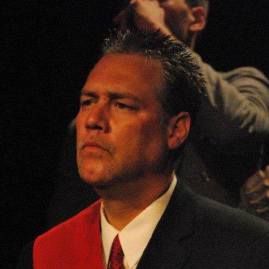
Drew Collins – Singer, Songwriter, Actor, Pastor, and Best Friend
One day, I got really disgusted with how people go online and allow their friendships to be destroyed, simply because their views are different. I thought of my good friend, Gary Nolan.
We agree on most everything, with one exception; faith/belief in God.
I called Gary and asked him if he would like to get together and talk about the one thing we both disagree on, strictly for the purpose of demonstrating to people that civil conversation can be far more productive and enjoyable than venomous hostility.
Gary came ‘loaded for bear’ and, in my opinion got more “talk time” than I did. That being said, I chose to post this in it’s unedited form so that I could not be accused, by others, of putting a “spin” on the talk. The whole idea was not about “winning” or “losing” an argument. It was about communicating with another person, whom I disagree with, in a respectful manner.
Despite the miles between us on the reality of God, Gary remains one of my best and most trusted friends to this day. A special THANKS! to my close friend, Dwight Farmer for all his work on filming this.
People who fancy themselves as intellectuals often take pride in citing someone’s argument for being a logical fallacy. While it’s good that people are aware of logical fallacies, and know the value of avoiding them in reasoned debate, it appears many know the words, but don’t necessarily understand what they so eloquently recite.
Logical fallacies are ways people make arguments, where they make a definitive statement, as if something must be true or false, when the argument may be either/or.
For instance, there’s the Tu Quoque Fallacy which translates to “you too” is basically that just because someone doesn’t do the thing they said you should do, doesn’t mean it’s invalid. For people not familiar with the name of this fallacy, they might simply argue someone is guilty of “do as I say, not as I do” hypocrisy.
Imagine I advise you not to drink alcohol, citing all the health issues that go along with it. That is genuinely good advice. Even if I drink myself, it doesn’t mean it’s bad advice. So arguing that because I drink, it must mean that my argument that drinking is bad for you must be invalid, or I wouldn’t drink myself.
These are matter-of-fact statements which is what the tu quoque fallacy seeks to correct. However, it’s not applicable to subjective claims.
For instance, if I say that I believe drinking is immoral, and then I drink anyway, and someone criticizes me for it, they’re not committing the tu quoque fallacy, they’re just rightfully calling me out for being a hypocrite.
In the first example, I made a factual statement, the second example I shared an opinion.
Another example where logical fallacies are mis-attributed is when people assume the answer is binary, in that it must be true or false.
For instance, imagine I say that someone wants to legalize marijuana because they just want to smoke it themselves. That’s a logical fallacy, arguably either a Non-Sequitur, or a Strawman fallacy, depending on how it was presented, because it’s entirely plausible that such a statement is not true.
Click Image for more info
However, that doesn’t mean it is automatically false, either. And this is where many people who correctly cite the argument as logically fallacious go into their own logically fallacious whole, by assuming it must not be true.
What may be logically fallacious may still be more likely than not, or at least plausible. It’s just a logical fallacy because the person who made the argument, argued as if it must be true, which is false. It’s merely plausible.
So I applaud everyone for trying to be a better debater, or for educating people (and themselves) on logical fallacies. It’s just important not to go down your own logically fallacious hole doing it.
Political correctness is a term that typically evokes annoyance and hatred from almost anyone who hears the term. Yet despite this nearly universal hatred for it, political correctness seems to be as pervasive as ever.
As an example, in 2017, the TV show Bates Motel, a TV adaptation of Alfred Hitchcock’s 1960 epic thriller Psycho, opted to rescript what is arguably the most famous scene in movie history. The story is about a man (Norman Bates) who suffers from multiple personality disorder. Aside from his own personality, he would also take on the persona of his mother, a psychopathic killer who would murder women she felt were immoral.
No Merchandising. Editorial Use Only. No Book Cover Usage. Mandatory Credit: Photo by Moviestore/REX/Shutterstock (1622408a) Psycho (On Set) Film and Television
When Norman became his mother, he would often dress up as her, and in the original and now famous shower scene, where a young woman is stabbed to death by Norman during a schizophrenic episode, he was wearing his mother’s dress.
However, the Bates Motel show runners, for fear of offending the trans-gender community it seems, opted to not have Norman (played by Freddie Highmore) wearing his mother’s clothes. The argument being they didn’t want to paint transgender people in a negative light. On the face of it, this can sound fair, but political correctness always does at first.
Freddie Highmore as Norman Bates – A&E Series Bates Motel
The first issue should be glaringly obvious. Norman Bates wasn’t transgender, he was schizophrenic with multiple personality disorder. He wasn’t a man who identified as a women. In his mind, he was his mother. So the show runners, for fear of offending people they weren’t even depicting, made the scene less accurate, out of irrational fear.
The referenced article above shows the writers clearly understood this, but the fear of offending someone and having the show be attacked by those who misunderstood the show’s intent was so great, they decided not to risk offending them.
In general, the idea of political correctness can be broken down into a couple of camps.
One is a selfless reason—you don’t want to offend someone because you’re a good person, and you just don’t like offending people.
The other is selfish—you have concerns that it might harm your brand or business if people happen to be offended. You don’t so much care that they’re offended, but if they make a lot of noise in attacking your business (or you personally), you’re concerned it could harm you financially when they do so. The above example falling into the latter camp.
If either camp is genuinely trying to avoid offending people, why is this a problem, then? Shouldn’t that be a good thing? The answer is a little murky, but let’s dig into the dirt a bit.
The Straw Man Argument
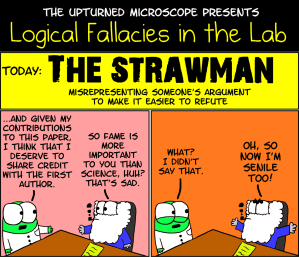
You may have heard of the logical fallacy known as the straw man argument. If not, click the video above from PBS. But the Straw Man Fallacy principle also applies to those who are easily offended.
Imagine I said, “I like Gary Johnson, the Libertarian candidate for president in 2012 and 2016.” Full stop. Now imagine a Trump or Clinton supporter who hears my statement, then gets offended and responds to me, “Oh, so you think Hillary/Trump is a bad person then? You’re a horrible person.”
Hopefully you see the problem here. I didn’t say anything about Hillary or Trump, and it’s genuinely quite possible I like all three people. So they’re mad at a straw man version of my argument, not what I actually said and intended.
This is why being easily offended is often the problem of the person who chose to mischaracterize your argument and be offended by it, and not the problem of the person who said something they were offended by.
For this reason, it’s important we not coddle such people, and give their behavior credence. They’ve made a mistake, and condoning and/or excusing that mistake doesn’t help anyone. Worse yet, it creates a whole new problem.
Factitious Disorder Imposed On Self (Munchausen Syndrome) is a condition where people claim to be ill in some way, when they’re either making it up, or they’ve actually harmed themselves, in order to gain sympathy for their illness from people who don’t know they’ve done it to themselves.
Many people who claim to be offended may not actually be offended per se, but much like those who suffer from factitious disorder, have learned that by proclaiming they’ve been offended on social media or some other public forum, gain sympathy from their followers, fans, or friends. They’re being conditioned to be offended about things going forward to attain even more attention (sympathy), creating this downward spiral of dishonest dialogue, fake outrage, and people who are afraid to be speak their mind.
So just by the virtue of it not even being honest outrage, or an honest assessment of the thing that outraged them, it’s already an illogical and potentially immoral condition. But this isn’t where the negatives end.
The Wisdom Of The First Amendment
Congress shall make no law respecting an establishment of religion, or prohibiting the free exercise thereof; or abridging the freedom of speech, or of the press; or the right of the people peaceably to assemble, and to petition the Government for a redress of grievances
U.S. Constitution: 1st Amendment
As most people know, the first amendment of the US Constitution wasn’t written so we can discuss the weather freely, nor to believe things we all believe. Our founding fathers understood you should have the right to say something offensive if it’s what you truly feel or believe. You should also be encouraged to speak truth to power when leaders say things that simply aren’t true.
This was of course about freedom from prosecution by government for saying such things, but the logic of protecting that speech is important outside of first amendment constraints as well. If people are afraid to speak their mind, you’ll never learn what they’re thinking. They might have ideas that could change the world, or at least maybe your world view—hear them out.
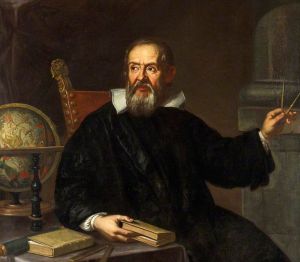
Martin Luther King Jr. for instance, was saying things we understand are true and not controversial now, but were quite controversial then. So much so, he was murdered over them. But you can go a lot further back in history to see why this is important. Galileo for instance, was famously convicted of heresy, and sent to jail for his arguments about the nature of our solar system. He described heliocentrism—the idea that our sun is at the center of the solar system, and not the Earth, as the Catholic church believed at the time. Not only is this not controversial now, only the most delusional of people think it isn’t fact.
Galileo
While some things may be controversial forever, many things that are edgy today, will almost assuredly be commonplace tomorrow, and this should be deemed as typically a good thing. People are often afraid of change, but adaptation is the key to survival, and free speech is key to having the discussions that help us to evolve our way of thinking as time goes on.
Political correctness and being easily offended are the biggest detriment to these discussions, and reasonable people should make an effort to ensure such discussions aren’t quashed by aggressive social justice warriors.
As for how to fix this, the answer isn’t attacking people verbally with insults and such, that’s not going to win over hearts and minds. Technically, I’m arguing that you do nothing. No really, don’t do a thing. if someone gets upset, and demands apologies because they were offended, don’t say a thing. Let them realize no one agrees with them by not agreeing with them.
These people are seeking attention. If you don’t give them any, they will be conditioned to not waste the energy for their ineffective technique. We made it effective in the first place, we can make it ineffective, too.
Internet Troll
There will surely be a knee-jerk reaction to respond by either giving in, if you’re not buying into my idea that it’s a problem, or to troll by lashing out at them for behaving childishly. You would think that those options are opposite each other, but the fact is that they’re both attention. And if you respond negatively to it in an effort to get them to “grow up,” others who don’t share your view (and mine) will sympathize with them even more because you were such a meanie to them.
Now that we’ve talked about how to stifle the political correct and easily offended, how do we promote the reasons for stifling them in the first place?
Also a pretty simple answer. Talk. Not yell or attack, but have respectful discourse with people. If you’re the type to avoid discussions that might get contentious, don’t. If they can’t respond in kind, then again, go back to not responding.
You can also stand up for facts. If someone says something you know isn’t true, chime in respectfully, and let them know they may be incorrect. Cite sources for extra credit. If at any point the conversation devolves, again…walk away. If enough people do this, eventually, reasonable discourse can and will prevail.
When debating some controversial science claim, I’ve often heard people argue that “scientists are always wrong.” Usually it’s from those arguing for some “thing,” medicinal or otherwise, that’s supposed to make your life better, but seems to fly in the face of science, or at least isn’t backed by any reputable study.
For example: people arguing marijuana (or at least some of its chemical constituents) kills cancer, but “western medicine” wants to keep you sick with things like chemotherapy, so they’re suppressing the evidence. Something I largely debunked here with just a little critical thinking. So I don’t need to rehash that specific point again.
But what I do want to cover, is the notion that scientists are often wrong. If you were to ask this question, and require a simple “yes” or “no” answer to whether scientists are often wrong, the answer I suppose is “yes, yes they are.” But that’s partly by design, and this is an important part few seem to understand.
If you were to ask most people outside the science community what science is, they’d probably conjure up people in a lab with beakers mixing chemicals together, and hoping that by combining bleach, marijuana, gluten-free wheat, and organic apple seeds, somehow, you’ll have a cure for any particular rare condition that ails you.
But what is science really? It’s a method—thus the moniker “the scientific method.” It’s a means by which you can most likely find the truth about something.
This is WAY oversimplified, but it basically goes like this:
You observe something in the world, and go “Hmm?” Emphasis on the question mark.
This is how science starts—people have questions.
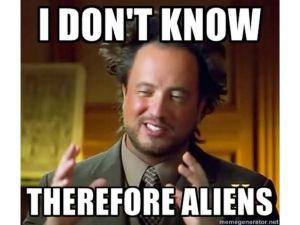
Non-scientists will often answer them with something complicated and/or supernatural like gods or aliens, if they’re struggling to find a more natural answer to their question. Others just make a random guess based on what they think is most likely the best answer, and go with it, evidence-be-damned.
Why?
Because science is hard work, and moving on past this phase requires far more than just imagination.
Scientists however will assume nothing until there is evidence of something. So if they’re compelled to answer the question, they’ll move to phase 2.
2. You gather as much evidence as you can on the thing you saw.
From this point forward, we separate the scientists (or skeptics like myself, since I’m not a professional scientist) from the non-scientists, because non-skeptics/scientists stopped after phase 1 when they opted for a guess.
If there’s no evidence to gather, sadly your work here is done, and you must accept that you don’t know. Think of cryptozoology, like Bigfoot ‘experts” or ghost hunters and such. They have no evidence to test (like an actual bigfoot to observe and test—alive or dead), yet they make claims anyway which are always pure speculation.
So whatever they’re doing, trust me, it isn’t science. Using scientific words, and scientific equipment doesn’t make one a scientist, following the rules of the scientific method does.
3. If you are able to gather evidence, you form a hypothesis, what a layperson might call an “educated guess,” based on the evidence you’ve gathered.
This forming of a hypothesis is different from a guess, in that it is based on the evidence you’ve gathered so far, and none of the evidence gathered should be contrary to your hypothesis.
A guess is often just what you think is most likely, but isn’t always weighed against the evidence you have. You see this often in political or religious debates, where people have an ideology, and any evidence they’ve gathered so far, if it doesn’t support their ideology, is thrown out as if the evidence must somehow be flawed. It’s a process called confirmation bias, and sadly we all do it. Especially if we’re not even aware it’s a thing, and that we should avoid it.
4. Here’s where those beakers might come in. Time to do some testing.
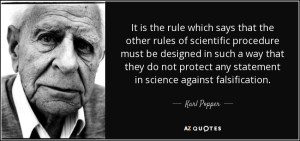
Now here’s the interesting part. If you’re a scientist, you try to prove yourself wrong. Yeah, I said it—WRONG. It’s a principle called falsification.
If you can’t disprove (falsify) your hypothesis, then you assume you have a potentially true hypothesis. Professionals will try to get such findings published in a peer-reviewed and reputable journal, then hope other scientists in their field will test it.
Know what those others will do?
You guessed it, try to prove the hypothesis wrong as well. Not because they want the first scientist to be wrong, or are their competition, but because that’s just how it works.
So why try to prove it wrong, versus prove it right? Derek Muller from the highly-respected YouTube channel Veritasium made an excellent video explaining why, in a pretty unique presentation. I encourage you to watch it. It will make you think differently, if you don’t already think this way.
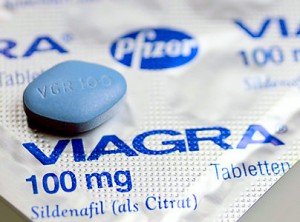
It’s not all bad, though. One of these drugs for instance, was sildenafil, the active ingredient in Viagra. It was initially meant for the treatment of blood pressure, and through clinical testing proved ineffective for that purpose, but highly effective at “pitching tents.” Serendipity at its finest, since Viagra has proven to be far more profitable for its founder, than the blood pressure medicine would likely have been.
But such serendipity is simply an added benefit of rigorous testing, and the proper documentation of all findings. Science is technically always about the unknown. You can ignore things that don’t fit into your desired outcome, or you can follow the data wherever it takes you and learn from it.
But with medicine, obviously lives are at stake in a pretty profound way, so the level of scrutiny there is rightfully going to be higher than any other field of science.
To a layperson, this might seem like the argument is that scientists are wrong 4,999 times out of 5,000, and this is where the “scientists are always wrong” myth starts to germinate. Not because they are wrong, but because of how science is often reported.
You see, technically, they weren’t wrong. They never made the claim you often heard. They formed a plausible idea, and then tested it rigorously to see if it stood up to the scientific method. With medicine, the number of phases a drug goes through is staggering.
Again, very oversimplified, but it’s something like this:
Test it in a lab (say in a petri dish), basically taking some live diseased cells, put them in a dish, and see if the chemical in question kills them, or otherwise does what you’re hoping it does.
Test them in animals, like rats
Test them on an animal that may be closer to humans genetically, like a apes
Test them on a few healthy humans to make sure they don’t get sick
Test them on a very small amount of humans to see if it helps
Test them on a medium-sized group of humans to see if you can show a statistically significant result
Test them on a large group of humans so you have a result you can argue is most certainly one certain assumptions could be made about.
Now you can start to understand why it can take 12 years for a drug can get to market. But here’s where the “scientists are always wrong” argument often comes into play. Because after phase 1, the findings are published. After phase 2, the findings are published. After phase three, again, the findings are published. This will be true for all phases.
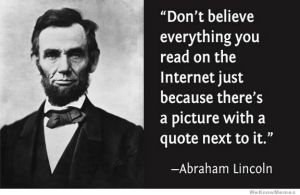
Abraham Lincoln Weighing In On the Internet
Now, a reporter, website, or any other type of media who knows nothing about science, picks up the published study from phase 1, and writes a big, attention-grabbing headline that reads “Scientists discover cure for cancer,” and a straw man of the finest quality is born.
Because they don’t understand these results are merely a step along the road of a cure, and with respect to cancer, each one is different anyway. The tests would surely be against one type of cancer, such as lung, breast, or prostate cancer, for instance. Not just cancer as a whole.
A year later when this substance fails phase 2, another reporter reports that scientists show the same substance now is not effective at curing cancer. And the public is left thinking scientists screwed up—they didn’t.
People who know nothing about science irresponsibly misrepresented the phase 1 story, the populace which aren’t largely scientists didn’t know how to decipher the misleading clickbaity headline, and voila, “Scientists are always wrong.”
You can also find this notion with people who are skeptical of larger theories, like the big bang theory, or evolution. They’ll point out that “evolution doesn’t explain how life started” or other things we don’t know yet.
But what such people seem to not understand, is that large theories have a couple important facets they aren’t considering.
First, think of a particular scientific theory as a puzzle depicting Albert Einstein standing in his study. Your puzzle has a thousand pieces, and you’ve so far rightly inserted 950 of them. You can clearly see it’s Einstein in his study at this point, but there’s a few small details (missing pieces), maybe a few books on the shelf in the background, that you can’t yet identify. You’re still not sure about such facts, and that may change the picture significantly, but it is much more likely it will not, instead just filling in those small blanks.
For evolution for instance, this might be the fact it isn’t understood how non-living organics (carbon-based substances) became living organisms (carbon-based life forms). Just because we don’t understand that facet, doesn’t mean the other “950 pieces” we do understand aren’t true, or are suspect.
The other important part to understand about a theory, is that it’s a theory instead of a law, because it isn’t entirely observable. We can see the effect of gravity on something and measure it accordingly, so that’s a law.
Charles Darwin: Author of The Origin of Species and impetus for the Theory of Evolution
But with evolution or the big bang, we can’t go back in time and watch it happen. So all we can do is theorize based on data we have, and try to recreate the event in some small way so we can observe it. From there, we can make a fair assumption the theory holds true if replicated.
Since skeptics are often religious in nature, they’ll refute science with the Bible, Quran, or other religious works, as if we should assume such works are true. But almost all claims made by modern-day scientists which contradict religion, have a mountain of evidence supporting them, to the point that people like the pope himself, have acquiesced to, as reported here. And it’s important to understand that such religious works aren’t supported by evidence either, as far as we know. We can’t go back in time and observe them being written, nor do we have any supporting documents to back up their claims. It could literally have been written by one delusional person thousands of years ago, sold to a larger group of people as truth, a religion was born thereafter, and we’d have no way of knowing. So assuming such religious texts must be right on the subject of gaps in scientific knowledge does not follow any reasonable logic.
So are scientists always wrong? Of course not. Through the course of their methods, they form hypothesis which they often prove wrong, but by the time they get to a point where they make a claim, they are demonstrably far more correct than any other group of people on the planet. Be a skeptic and question everything, including science. But proper skepticism should lead you to find that the scientists did their part correctly; the errors came in how that information made its way to you along the way.
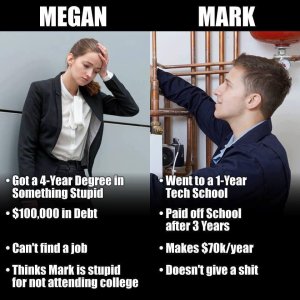
As memes become a pervasive influence in our lives, it’s important to always approach them with a healthy dose of skepticism. A good meme will cite sources that are credible, but many like this one largely just espouse a particular ideology, and aren’t exactly subject to fact checking. For the most part, they’re just intended to appeal to your emotions.
Nonetheless, it’s still worth questioning if the premise even makes sense, and this one is a perfect example of a meme that feels good, especially to someone who is like Mark in the meme, but is severely flawed in premise, despite the strong hint of truth in it.
So first, let’s address the logical argument to be made here.
In this country, it can be difficult to find a good career where a college degree isn’t required, even if the degree is unrelated to the career you seek. I find this notion of “any degree will do” infuriating, but sadly my beloved free-market, coupled with ignorance, likely created it. Although, I think a fair argument could be made that a lack of decent tort reform by government hasn’t helped either, which I’ll address as well.
Because the factory and the dealer are independent of each other, when someone takes their car in for a warranty repair, the dealer will fix it, then charge the factory for what they’ve done. The factory then will audit and sometimes inspect the parts replaced to be sure the dealer is not performing unneeded repairs, or fraudulent claims.
My friend had over a decade of experience working the parts counter at our dealership. He was intimately familiar with why parts were replaced under warranty, and how to assess the condition of those parts. This knowledge made him highly qualified to review and audit warranty claims for General Motors. So he applied for the corporate job, and was refused consideration because he had no college experience, despite his clear knowledge and expertise on the issue.
The person who was hired by GM to do this job did have a degree, entirely unrelated to automotive repair, and had almost no mechanical repair experience to speak of. As a result, their ignorance made it easy for us on the dealer side to take advantage of them, highlighting the flaw of choosing a college degree over relevant experience. It’s a bad business decision that can cost a company a lot of money.
Recently, as CNBC notes here, many tech companies are starting to see the light, and have removed the college degree requirement, understanding that there were a lot of talented people they were passing up. People who went to trade schools, or maybe just have relevant work history to the field. Kudos to them for recognizing this practice was less than ideal.
As for the tort issue, in some instances, if a company is worried about getting sued, having someone who is “qualified” by virtue of having a degree may help indemnify them. You see something similar in the auto repair field where a shop will hire an ASE certified mechanic over one who doesn’t have such certifications, even if the latter is clearly more knowledgeable, because this helps protect them in the event a car is improperly repaired, the shop can say they at least hired someone who was “certified.”
But what should matter is simply whether the person did the job correctly or not, and did the person have any relevant experience in auto repair, to the point they should be trusted to do such repairs.
The truth of the meme is that skilled trades can indeed pay quite well, often beating their college-educated counterparts when the degree is something with a very small job market. When is the last time you saw a job opening for a philosopher after all? This is not meant to attack philosophy, it’s an important way of thinking. It’s only to say that as a stand-alone skill, it doesn’t offer up many career opportunities outside of teaching philosophy.
The issue is a little deceptive however, because if many of these degree-holding future employees pursued a career related to their degree, they would likely land a more lucrative career. But sadly, I’ve known many who simply got a degree to have a degree, because that would help them find a career, and they took the path of least resistance by getting what they felt was the easiest degree possible, with no real interest in that field.
The problem with this meme is that it does the one thing it’s trying to prevent, and that’s to demean people who choose an alternative career path by going to college for a degree they might actually want to pursue a career in.
So instead of creating a divide, it would be better to understand that just as genetic diversity is incredibly important for the advancement of life, diversity of career also creates a stronger economy that isn’t in danger of collapse because it relies on others.
We need college-educated people to do things like cure diseases and engineer safe buildings. But we also need skilled trade people to do things like fix our cars, electric, or plumbing. We need people to mow our lawns, stock shelves, and do the things which require almost no training at all, too.
If you vilify any one of those people for their life choices, you’re behaving poorly. We need them—all of them, to do their thing. If you don’t want to do those things yourself, be thankful someone else is willing to do them for you.
If you want to lash out at someone, may I suggest these three groups instead?
1) The person who could be a productive person and do one of those jobs, but instead opts to live off the taxpayer, parents, or just becomes a vagrant.
Photo from a story on how to be homeless, which outlines effective survival tactics for those who simply choose that life. Click photo for details
To be clear, I’m not talking about the people who can’t work because of a disability. I’m referring to those who refuse to do their part in society, and worse yet, expect others like me to subsidize their lives.
2) The person who gets an education in a field they have no intention of using, gets poor grades doing it, and did it because they just didn’t want to work, or weren’t driven enough to commit to a career path. They wasted their parent’s money, or racked up student loans for a degree they’ll basically never use. That’s a bad investment at best, and potentially depraved indifference if they’re wasting their parent’s money willingly. Their parents worked hard for that money, and probably could have used it for something more worthwhile if their child hadn’t recklessly wasted it.
Since some do it on the premise you need any degree to get a good job, this leads me to my third group…
3) Employers who put people with an irrelevant degree (in relationship to the job they’re seeking), above people with real world experience in that role, but no college degree. Those college-educated employees have shown they’re uncommitted, and that they make poor life choices. The person who started working at 18 has shown that they just want to work.
One thing is for certain, whatever makes someone happy and solvent should not be condemned if it isn’t harming others, especially when they’re being a useful component to society. Diversity is always good, and all levels of career are required for a successful society—we can’t all be doctors or lawyers and expect the world to sort out its own problems. If you find yourself looking down on people who do or don’t have a degree because they’re different from you, the problem isn’t them, it’s you.
Despite those with maybe some rare psychological condition (libertophobia?), we all want to be free. Specifically; I don’t think a single person has something they want to do, that they then want government to prevent them from doing it. So denying others similar freedoms should reasonably be thought of as hypocritical.
While everyone can apply their own nuance to what liberty or freedom means to them, I’d like to politely take the role of arbiter for a moment, and share where I think many go wrong when proposing roles of government. Here are a few instances I’ve come up with. Feel free to add more in the comments below.
You have the right to say whatever you want. You don’t have a right to be heard or to be uninterrupted.
Because I have a decent number of people I enjoy interacting with on social media, I am rather uninterested in disrespectful discourse, since there’s so much respectful discourse I could be having instead.
As a result, many often insinuate when I mute or block those people on Twitter, I’m stifling free speech. Which is a pretty outlandish false premise.
On social media, you might get blocked. In person, people might walk away from you. But, if you want to be heard, and people are exercising the right to take their leave of your message, maybe you need to work on your delivery of said message, or the message itself. But you don’t get to compel them to listen. Nor should you argue that them blocking you is anti-free speech.
Milo Yiannopoulos
Your right to free speech means you can’t be impeded by government for exercising your right to speak. It doesn’t mean that protesters can’t protest Milo Yiannopoulos, employers can’t fire you for saying something inappropriate, or people on social media can’t block you.
You have a right to seek employment, but not a right to be employed.
If you go to seek a job, assuming it’s a private business versus a government job, the business OWNER owns that business, no different from you owning your home stereo for instance.
If no one has a right to dictate to you what music you play on that stereo, you don’t have a right to dictate who they hire, serve, what they pay you, or anything else.
The job market and the consumer markets are intended to be free markets. Either both parties agree to terms on what is to transpire, or one/both of them walk away. But forcing one party to comply with the other’s wishes is a mafia tactic, not something the people should be sanctioning.
Does that mean a bigoted jerk could put a sign out front denying service to gays, blacks, whites, women, Latinos, Asians, et al.? Yes, it does.
Does a private citizen who is offended by that practice have a right to share it on social media, maybe get local news involved, protest this business, etc., until the market decides that this bigoted jerk doesn’t deserve their money, then watches his business fail due to lack of revenue?
Why yes…yes it also does!
You have a right to engage in free speech, you don’t have a right to put someone in harm’s way utilizing speech.
Using the “Fire in a crowded theater” analogy, you can say the word “Fire” in a theater, you can even yell it if the theater were empty, or if the people know you were joking. If there’s actually a fire in the theater, you’ve not only broken no law, you’re potentially a hero.
But if there’s no fire, you have instead put people in danger by creating a stampede that may lead to people falling, getting walked on, and harmed. So it’s not the “Speech” that is being prosecuted, it’s the act of putting others in danger.
Think of it this way. The 2nd amendment guarantees your right to own and fire a gun, but it doesn’t allow you to shoot someone who is no threat to you.
In the same vein, the first amendment guarantees your right to free speech, you can’t use that speech to harm someone either.
You have a right to ask someone for help. You do not have the right to dictate they help you.
If your car breaks down, you don’t have a right to demand a mechanic fix it so you can get to work.
So that should also mean you don’t have a right to demand a teacher educate you because you need a better job, or demand a doctor help you because you’re sick.
Doctors and teachers have the same rights as everyone else. As such, consumers have no right to free services or goods.
Free Education and Free Health Care are nothing more than servitude (if you force them to provide a service) and/or theft (if you force the people to pay for their services). If it’s volunteers and private donations, that’s the only way it is a completely moral exercise.
You have a right to equal protection and service from government, not from the private sector.
Waiting in Emergency department
If you’re LGBTQ, you have a right to dictate that the government acknowledge your marriage, and under our current system, to have a judge (a government employee), perform the ceremony. You’ve paid taxes into that system, and the government cannot discriminate. If the government employee doesn’t like it, they should have joined the private sector.
But you do not have a right to ask a private pastor to do the ceremony, nor do you have a right to dictate a baker bake you a cake. Why? Because they have the same rights you do.
Summary
People often think those who champion freedom are being selfish, and it is certainly true for some. But the people who are truly libertarian in their beliefs are also not hypocrites. They believe others should have the same rights and don’t have to agree with someone to support the rights of another.
A teetotaler can support the rights of alcohol drinkers
A monogamist can support the rights of a sex worker
An atheist can support the rights of churches, synagogues, etc.
A non-gun owner can support the 2nd amendment
A heterosexual can support gay marriage
Someone does not like abortion can support a woman’s right to choose
A clean person can support another’s right to use recreational drugs
A helmet-wearing motorcycle rider can support another person’s right to not wear a helmet
I can go on forever about what it means to do liberty right. Hypocrisy is never considered a good trait to have. So hopefully, after reading this, you can find an area where you’ve had the opinion that government should restrict someone’s rights and are now second guessing that thought. Liberty for me, must come with liberty for thee.
log·i·cal: capable of reasoning or of using reason in an orderly cogent fashion lib·er·tar·i·an: an advocate of the doctrine of free will; a person who upholds the principles of individual liberty especially of thought and action




















 The Logical Libertarian™