Average Joe SCOTUS: North Carolina Department of Revenue v. The Kimberley Rice Kaestner 1992 Family Trust

Back in 1992, this dude Joe Rice set up a trust in New York for his three kids. We’re all gonna die someday, gotta take care of that shit before it happens. Then in 2002, the trust was broken up into three separate trust for his kids individually, and each of their kids, Joe’s grandchildren. But they were still based in New York.

None of his kids at the time the trust was set up, lived in North Carolina. But eventually, Kim found herself living there. And when a new trustee was appointed in 2005 to manage the trust, those greedy commie motherfuckers in North Carolina decided to start taxing the trust. The whole fucking trust…you know…the one that was in New York and not North Carolina? Clearly, NC is learning from California.

North Carolina’s argument was that, “Hey, we provide protections for this ungrateful bitch, and we pay for that via taxes, so we want our motherfucking cut.”

So Kim was like, “this is some bullshit!”

So off to SCOTUS to try to get her fucking trust back.

At one point, and incredulous Justice Breyer said:

Stephen G. Breyer

Look, the trustee lives in New York, okay? The settlor is in New York.

All the administration is in New York. There is one thing that’s going to happen in North Carolina.

The thing that’s going to happen in North Carolina is if she is there when it’s distributed, she’ll get some money. Okay? Which you’re totally free to tax. But that isn’t what you want to tax. You want to tax all these things which are everyone except her is in New York, and moreover, we don’t even know if she’ll ever get the money. Now there’s something wrong with that. I don’t know, it doesn’t say specifically about trusts in the Constitution, but, thus, I mean, lots of trusts say there are 10 beneficiaries, each one lives in a different state, and I, the trustee, have total discretion as to who give this money to and maybe I’ll give it to none of them. So here’s a woman who might get none of it, and you want to tax that.

Is that right? Do I have the facts right?

Matthew W. Sawchak

I would — I would point out some additional facts, Your Honor.

First of all, Ms. Kaestner did actually receive this money.

Stephen G. Breyer

Well, is that — is that — I’m talking about the law of North Carolina.

And I’d only add to this that, by the way, if the trust has a million dollars extra income in year 4, and if you say she’s entitled to that, she isn’t going to get it ’til year 14, at most, do you discount the increased value of the trust by the time she has to wait? Because she has nothing that increased in value more than the million discounted by the probability that she will ever get it and when.

Matthew W. Sawchak

So —

Stephen G. Breyer

Is that how the law works in North Carolina, is what I’m asking. And, of course, I suspect the answer is no, but go ahead. (Laughter.)

The solicitor for Kaestner rightly pointed out, Kaestner didn’t receive a fucking dime while North Carolina did. And there was no guarantee she would ever receive a dime while living in North Carolina, or not at all if she dies, or the trust somehow bankrupted itself. But in the meantime, North Carolina was taking their cut.

Clearly, North Carolina is whack on this bullshit, and SCOTUS wasn’t having it. Surprising unanimous decision for Mrs. Kaestner. A clear, “Go fuck yourself” to those greedy commies in North Carolina.

On a side note, this is a great example of SCOTUS being their own best skeptics. You cannot listen to this case, and think Sotomayor was ever going to side with Kaestner. Her questions seemed like she was firmly in the camp of North Carolina. But since it was a unanimous decision, it would appear she was just truly questioning her own beliefs, and came to the conclusion her own beliefs were against the principles laid forth in the constitution.

Average Joe SCOTUS: Parker Drilling Management Services Ltd. v. Newton

Parker Drilling Management Services (PDMS) hired this lazy motherfucker named Newton. He took breaks like he was part of a labor union, so they fired his lazy ass.

Being pissed he was fired, he decided to sue PDMS for unfair labor practices. He could have sued while he still worked there, if it bothered him that much, but he didn’t. He was just a lazy fuck trying to get revenge. The nature of his business was that he was on a drilling rig 14 days in a row, working in often 12-hour shifts.

The Fair Labor Standards Act, a federal law, has certain labor standards on how many breaks are required and shit. The Socialist Republic of California has their own commie bullshit laws. The drilling rig, while off the coast of California, was still not within California’s borders. So the issue was whether state law or federal law governs what goes on there. Sort of an argument as to whether “off the coast of California” is part of California, or its own unique district.

Newton sued in California, because he was hoping they’d rule in his favor with their commie bullshit laws. But PDMS presumably realized this was a federal case and took it to federal court, whose laws favored them. The federal court determined that the Outer Continental Shelf Lands Act  (OCSLA) allows for state laws to intervene on wage issues and such not covered in FLSA. But that it didn’t protect Newton in this instance over his excessive lazy-ass breaks. But the ninth circuit was like, “get fucked federal court” and vacated the judgement. They were arguing that state law should preempt federal law when the state law addresses the issue at hand. As if to say, that state law goes before federal law.

So off to SCOTUS we go.

SCOTUS clearly thought Newton was a lazy fuck, and that as usual, the ninth circuit was probably smoking crack—unanimous decision for PDMS. They basically said that if the Federal Law covers the scenario, that’s the applicable law and Cali’s commie bullshit is irrelevant. But if there is no standard in FLSA for an issue, then and only then can California law be used.

Average Joe SCOTUS: Iancu v Brunetti

So this dude Eric Brunetti owns a clothing company called FUCT. Now, we can act like it’s an acronym all we want, but the point is clearly that it’s to be pronounced as “fucked.”

In 2011, an intent-to-use patent was filed for his brand, but the Lanham Act governs such patents, and section 2(a) says:

No trademark by which the goods of the applicant may be distinguished from the goods of others shall be refused registration on the principal register on account of its nature unless it—

(a) Consists of or comprises immoral, deceptive, or scandalous matter; or matter which may disparage or falsely suggest a connection with persons, living or dead, institutions, beliefs, or national symbols, or bring them into contempt, or disrepute; or a geographical indication which, when used on or in connection with wines or spirits, identifies a place other than the origin of the goods and is first used on or in connection with wines or spirits by the applicant on or after one year after the date on which the WTO Agreement (as defined in section 3501(9) of title 19) enters into force with respect to the United States.

So the attorney processing the request for the patent told the applicants to get fucked. (See what I did there?)

Brunetti appealed, and the appeals court agreed with the finding that it violated 2(a), but decided that such a restriction was a violation of the first amendment which guarantees free speech.

So off we go to SCOTUS, and it was a slam dunk. While Iancu tried to argue that government has a role to play in protecting our fragile little ears, and our fragile little psyches from such dastardly phrases as the word “fuck” or anything that sounds like it, despite the fact that we damn near all say it every day, the justices weren’t having it.

Iancu even busted out the George Carlin argument, about words you can’t say. Classic bit. But to no avail.

All nine justices agreed, it is a restriction on free speech, and Iancu from the Secretary of Commerce office can get FUCT.

Hear oral arguments or read about the case here.


Average Joe SCOTUS: Kisor v. Wilkie

James Kisor, retired marine, and damn fine American went to fight in the Vietnam conflict years ago. As a result, he suffered PTSD. So he went to the VA for disability benefits, and was denied.

Under statute 38 C.F.R. § 3.156(a), if a petitioner has new evidence, their denial may be reopened, and considered in light of the new information provided. So Kisor was like, “Listen here you motherfuckers, I deserve my benefits, and here’s why.”

The information Kisor submitted was not new evidence, however. It was evidence he had at the time of his first evaluation, it was just not in his file, and thus not considered at the time. It was Kisor’s Form 214 and the Combat History documents.

Since it wasn’t new information, but just previously not submitted information, we had what is known as a technicality. And the government loves technicalities, instead of just doing the right thing. They basically argued that those two documents do not prove PTSD, and therefore weren’t sufficient reason to provide him the relief he sought, and denied his shit again.

The Court of Appeals and Federal Circuit court couldn’t be bothered to help Kisor, either. So off to SCOTUS we go.

The issue at hand, largely seemed to be, was that if the VA writes its regulations, it should be the one interpreting them based on how they wrote them, and not others laws congress may have written in a different manner, since the VA knew what the fuck they meant to do when they wrote it. They cited Auer v. Robbins, 519 U.S. 452 (1997) as case history, which basically told salaried cops seeing overtime under federal labor rules, to go fuck themselves and their overtime requests. That the police department had it’s rules on what a salaried employee is, and they don’t get no fucking overtime.

So in order for Kisor to win, they’d have to overrule that case, and  Bowles v. Seminole Rock & Sand Co., 325 U.S. 410 (1945).

They didn’t. Unanimous decision for Kisor, while not opting to overrule Auer or Bowles.

You can read about the case or hear oral arguments here.

Another well written explanation from Cato here.


Average Joe SCOTUS: Emulex Corp. v. Varjabedian

Tech company Emulex Corp. was about to merge with Avago Technologies Wireless Manufacturing. Typically, when a company does this, it notifies shareholders about the intention to do so, and tells them all the deets. They then get to vote accordingly.

Avago hired Goldman Sachs to review the deal and advise if it was a fair deal for shareholders. Goldman Sachs was like, “Hey, as deals go, it’s OK. They’re not totally fucking you in the ass or anything, but it ain’t great, either.”

So some shareholders decided to sue Emulex and Avago , believing they were some lying motherfuckers saying that they were all like, “this is a sweet deal” when in fact it was a shitty ass deal.

Lower courts had decided the case, and the ninth circuit had contradicted all the other lower courts which had reviewed.

Once SCOTUS heard all the arguments, they apparently were bored AF, and decided to say that the lower courts had been some lazy mother fuckers and not even properly considered whether the Securities Exchange Act of 1934 Section 14(e) even allows private entities to sue for this shit. So they sent it back, and went golfing. No decision.

Read about the case and hear oral arguments here.

Read about the arguments here

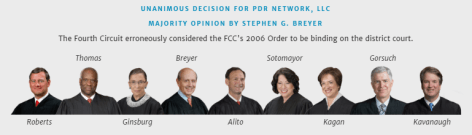
Average Joe SCOTUS: PDR Network, LLC v. Carlton & Harris Chiropractic Inc.

The fine folks at PDR network make publications for the medical community, such as physicians reference books and shit. They’re apparently stuck in the 1990’s, because these motherfuckers sent a fucking fax to the respondent, Carlton & Harris Chiropractic, Inc., trying to peddle some of their books via eBook.

PDR offered the respondent specifically, a free version of their eBook. Which is presumably why the 4th circuit tried to say it wasn’t a “commercial aim,” meaning they weren’t selling something, but instead giving it away.

The FCC’s Telephone Consumer Protection Act (“TCPA”) bans companies from soliciting via fax all unannounced and shit. If you do it, you may get your ass slapped with a $500 fine, and up to $1500, if they find you knew you shouldn’t do it, but you did it anyway.

PDR ‘s argument is: “How the hell can you sue for damages, when a fax offering a free book, caused you no fucking harm whatsoever?Like, seriously. We tried to give you that shit for free, asshole!”

When PDR Network went to the 4th circuit, they were all like, “We need not harmonize the FCC’s rule, with the underlying statute.” Meaning, they felt they didn’t have to worry about the FCC’s wording in their rules, only the law that underpins their rule. Seemed a little contradictory in nature, so PDR was all like, “WTF?”

SCOTUS decided they didn’t even give a fuck about PDR and those scumbag chiroquackers. Saying, “Fuck you, you’re not even real doctors.” Instead, all they decided to weigh in on, was who has the authority to rule on this shit. Even I got so confused with this nonsense I couldn’t be bothered.

So, siding with PDR, judgement against the 4th circuit’s action for PDR, they told the chiroquackers to eat a bag of dicks.

Hear oral arguments and read about the case here.

Here’s a couple other links as well.

https://supreme.justia.com/cases/federal/us/588/17-1705/

https://www.law.cornell.edu/supct/cert/17-1705

https://www.justice.gov/jm/criminal-resource-manual-2402-hobbs-act-generally

Average Joe SCOTUS: The Dutra Group v. Batterton

So this dude Batterton worked on a boat owned by Dutra Group. The boat was missing a piece of equipment that the boat was supposed to have as a matter of law, because Dutra were soem cheap ass motherfuckers. As a result, there was an accident that destroyed Batterton’s hand.

Needless to say, Batterton was pissed! That was probably his masturbating hand. So he sued the fuck out of Dutra, seeking punitive damages.

Side note: Punitive damages are damages over and above financial damages like medical bills, and future earnings lost. It’s literally meant to PUNish (the same root as PUNitive) the person. Imagine for instance, the financial damages are small, like a thousand bucks, and it’s a huge company doing it. They might keep doing a bad thing, content to pay the $1,000 each time they’re sued, because it’s cheaper than not doing that bad thing. 

So punitive damages are meant to hit them in the nutsack, and make sure that they’re fully deincentivized from doing a bad thing. But that being said, it’s mean to be used against parties who knew they were doing the wrong thing, and did it anyway. You don’t typically want to punish someone for something they didn’t do on purpose.

Dutra Group went to the ninth circuit, and asked them to reject Batterton’s claim, because under the Jones Act, punitive damages aren’t available in such an incident. They cited an old SCOTUS case,  Miles v. Apex Marine Corp., 498 U.S. 19 (1990) as justification, because in that case, punitive damages weren’t available.

The ninth circuit politely told Dutra to go fuck themselves. They were all like, “Look at Batterton’s hand, motherfuckers? It’s wrecked! You’re gonna pay!”

So Dutra, thinking the ninth circuit was on crack, asked SCOTUS to step in.

SCOTUS conservatives, coupled with Kagan, decided to help Dutra out. Batterton referred to another previous SCOTUS case,  Atlantic Sounding Co. v. Townsend, 557 U.S. 404 (2009), where punitive damages were awarded, and felt like there was good precedent for recovering them.

But, in the Miles v. Apex Marine Corp., 498 U.S. 19 (1990) they were not awarded, and apparently the six justices felt like getting reimbursed for medical bills, and lost future earnings was enough. No need to punish Dutra beyond that.

6:3 Judgement for Dutra. Get your fucked up gnarly hand outta here.

Read about the case or hear oral arguments here.

log·i·cal: capable of reasoning or of using reason in an orderly cogent fashion lib·er·tar·i·an: an advocate of the doctrine of free will; a person who upholds the principles of individual liberty especially of thought and action