Average Joe SCOTUS: Fort Bend County Texas v. Davis

Lois Davis worked for Fort Bend County in Texas. Her boss at the time, we’ll call him Scummy McScummerson, apparently fancied her, and decided to go for it. But Lois wasn’t having that shit, and filed a sexual harassment claim.

After an investigation Scummy McScummerson resigned, and Lois was assigned a new boss. Her new boss, being friends with Scummy, decided to put Lois in the cross-hairs, and get rid of her.

One day, Lois needed the day off for a religious event, applied for the day off, and her new asshole boss declined. But Lois was like, “Fuck this shit, I’m going.” So she straight up ghosted those motherfuckers and went to church.

So then her new asshole boss was like, “Bingo, I can fire this bitch now.”

But Lois ain’t no pushover. She took their asses to court, and now dropped a new bomb on them, the “religious discrimination” bomb, that is.

Here’s the thing. There were outlined procedures in place for Lois to follow in appealing her termination and shit, but she didn’t pass Go, and didn’t collect $200. She went straight to court. So the assholes in Fort Bend tried to say she circumvented the process, and therefore had no case.

Davis was like, “Fuck you, and your process. I’m taking your trifling asses straight to court anyway.”

As usual, multiple federal circuits have two different precedents for the same god damn law, because every fucking law is simply not black and white. Most are grayer than gray.

So SCOTUS listened to all the arguments, and were like, “We’re the courts. We don’t give a fuck about your piss ant procedural rules. Fuck you. If someone wants to ask our opinion, they can come on in and do it. Any court that disagrees, well fuck you, too. Do as your told bitches. Thug SCOTUS life!”

Unanimous decision for Davis.

Hear oral arguments, or read about the case here.

Average Joe SCOTUS: United States v. Davis

OK, y’all. Let’s talk about an important legal principle. The idea of constitutionally vague. The “Vagueness Doctrine” is simply a principle that says because of the 5th and 14th amendments which guarantee due process, the vagueness doctrine require that citizens be given enough information to clearly know what could get their dumb ass landed in jail. You can’t write a law that “might” land you in jail—that’s bullshit. You and I need to know the line we cannot cross and expect to be safe from punishment, and that line should be clear and understandable.

This was famously the argument against Wade, in Roe v. Wade, along with many others, and now it’s what this case is all about. You see, this douchebag Maurice Lamont Davis, and his douchebag buddy Andre Levon Glover decided to rob several Texas gas stations. To make it even more fun, they even took cops on a high speed chase after one robbery.

Firearms law 18 U.S.C. § 924(c), which addresses the penalty has two parts. An elements clause and a residual clause. The case focuses on the residual clause which says:

(B) that by its nature, involves a substantial risk that physical force against the person or property of another may be used in the course of committing the offense.

So, because some of their convictions were in part, due to this clause, they believed that saying there was a substantial risk, is not clearly defined as violence. You’re asking a jury to ask what the offender might have done, versus asking what they did do. And thus, they think that’s vague AF.

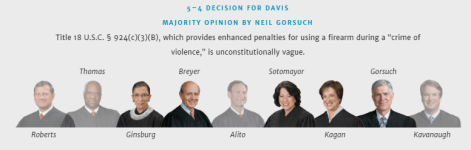
SCOTUS gave it a listen, and in a mixed 5:4 majority, with Gorsuch siding with the the left-leaning justices, Davis was given the nod. He’s still going the fuck to jail—his scumbag ass deserves it, but at least it won’t be as bad.

On a side note, Sotomayor mentions congress has a redraft of this statute on the docket. So clearly, even they know they wrote this law shitty AF. But in the meantime, SCOTUS sees fit to tell them they fucked up anyway.

Hear oral arguments, or read about the case here.

Average Joe SCOTUS: McDonough v. Smith

This case is the ugly side of politics at its finest folks. Two election officials in Troy New York, LeTorno and McDonough, were indicted in 2009 on election fraud charges. It didn’t look good, y’all. They were handcuffed and everything. People were forging signatures, and giving them to these two ass-clowns, who then submitted them accordingly. If they knew they were forged when they accepted them and submitted them, they were guilty. But it appears, they were just ignorant AF, and didn’t have a fucking clue.

They were eventually acquitted on all charges, and it appeared that the prosecutor Youel Smith engaged in his own level of corruption by trying to prosecute these ignorant fucks, when they were clearly just dumb-asses who knew nothing.

Either way, after McDonough was acquitted, he filed a Section 1983 claim (basically suing the government for bad acts against the people) against Smith, for malicious prosecution. So heres where it gets even more fun. Because there was a mistrial and shit initially, this whole process of going after McDonough took a while. And a 1938 malicious prosecution has a 3-year statute of limitations (SOL), Smith’s defense decided to say that three years had passed since they knew about whatever evidence they had showing malicious prosecution, and therefore, they were too fucking late.

But then McDonough’s team was like, “Listen mother fucker. We were wrapped up in a criminal trial because of your corrupt ass. We had to deal with that shit first, before we could come after you with a 1938, because we can’t run two trials at the same fucking time. We’re not Superman.

The district court agreed to dismiss based on the statute of limitations argument, and the second circuit agreed. But they were like, “We know other circuits have decided that SOL starts when the trial in question ends, to give you time to prepare accordingly, but we don’t give a fuck. We agree with the district court, so fuck off, McDonough, you corrupt motherfucker. You got away with this shit—be happy about that. Now get out of here.”

McDonough not being impressed with their bullshit argument, took it to SCOTUS, and they were asked to resolve it accordingly.

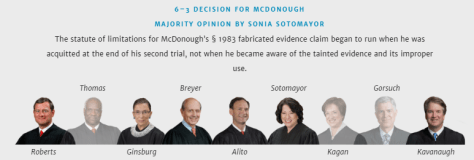
SCOTUS was less impressed with Smith’s argument, the district court, and the second circuit. They sided 6:3 with McDonough, and wished Smith good luck on his upcoming lawsuit.

On a side note, I’m also pretty fucking sure Smith’s petitioner Thomas J. O’Connor was drunk or high AF when he argued this. Just listen to it. I’ve had bowel movements argue more coherently than this mother fucker on this day. Jesus H. Christ! No wonder he lost. Like seriously, listen to that shit below.

Hear oral arguments or read about the case here.

Average Joe SCOTUS: North Carolina Department of Revenue v. The Kimberley Rice Kaestner 1992 Family Trust

Back in 1992, this dude Joe Rice set up a trust in New York for his three kids. We’re all gonna die someday, gotta take care of that shit before it happens. Then in 2002, the trust was broken up into three separate trust for his kids individually, and each of their kids, Joe’s grandchildren. But they were still based in New York.

None of his kids at the time the trust was set up, lived in North Carolina. But eventually, Kim found herself living there. And when a new trustee was appointed in 2005 to manage the trust, those greedy commie motherfuckers in North Carolina decided to start taxing the trust. The whole fucking trust…you know…the one that was in New York and not North Carolina? Clearly, NC is learning from California.

North Carolina’s argument was that, “Hey, we provide protections for this ungrateful bitch, and we pay for that via taxes, so we want our motherfucking cut.”

So Kim was like, “this is some bullshit!”

So off to SCOTUS to try to get her fucking trust back.

At one point, and incredulous Justice Breyer said:

Stephen G. Breyer

Look, the trustee lives in New York, okay? The settlor is in New York.

All the administration is in New York. There is one thing that’s going to happen in North Carolina.

The thing that’s going to happen in North Carolina is if she is there when it’s distributed, she’ll get some money. Okay? Which you’re totally free to tax. But that isn’t what you want to tax. You want to tax all these things which are everyone except her is in New York, and moreover, we don’t even know if she’ll ever get the money. Now there’s something wrong with that. I don’t know, it doesn’t say specifically about trusts in the Constitution, but, thus, I mean, lots of trusts say there are 10 beneficiaries, each one lives in a different state, and I, the trustee, have total discretion as to who give this money to and maybe I’ll give it to none of them. So here’s a woman who might get none of it, and you want to tax that.

Is that right? Do I have the facts right?

Matthew W. Sawchak

I would — I would point out some additional facts, Your Honor.

First of all, Ms. Kaestner did actually receive this money.

Stephen G. Breyer

Well, is that — is that — I’m talking about the law of North Carolina.

And I’d only add to this that, by the way, if the trust has a million dollars extra income in year 4, and if you say she’s entitled to that, she isn’t going to get it ’til year 14, at most, do you discount the increased value of the trust by the time she has to wait? Because she has nothing that increased in value more than the million discounted by the probability that she will ever get it and when.

Matthew W. Sawchak

So —

Stephen G. Breyer

Is that how the law works in North Carolina, is what I’m asking. And, of course, I suspect the answer is no, but go ahead. (Laughter.)

The solicitor for Kaestner rightly pointed out, Kaestner didn’t receive a fucking dime while North Carolina did. And there was no guarantee she would ever receive a dime while living in North Carolina, or not at all if she dies, or the trust somehow bankrupted itself. But in the meantime, North Carolina was taking their cut.

Clearly, North Carolina is whack on this bullshit, and SCOTUS wasn’t having it. Surprising unanimous decision for Mrs. Kaestner. A clear, “Go fuck yourself” to those greedy commies in North Carolina.

On a side note, this is a great example of SCOTUS being their own best skeptics. You cannot listen to this case, and think Sotomayor was ever going to side with Kaestner. Her questions seemed like she was firmly in the camp of North Carolina. But since it was a unanimous decision, it would appear she was just truly questioning her own beliefs, and came to the conclusion her own beliefs were against the principles laid forth in the constitution.

Average Joe SCOTUS: Parker Drilling Management Services Ltd. v. Newton

Parker Drilling Management Services (PDMS) hired this lazy motherfucker named Newton. He took breaks like he was part of a labor union, so they fired his lazy ass.

Being pissed he was fired, he decided to sue PDMS for unfair labor practices. He could have sued while he still worked there, if it bothered him that much, but he didn’t. He was just a lazy fuck trying to get revenge. The nature of his business was that he was on a drilling rig 14 days in a row, working in often 12-hour shifts.

The Fair Labor Standards Act, a federal law, has certain labor standards on how many breaks are required and shit. The Socialist Republic of California has their own commie bullshit laws. The drilling rig, while off the coast of California, was still not within California’s borders. So the issue was whether state law or federal law governs what goes on there. Sort of an argument as to whether “off the coast of California” is part of California, or its own unique district.

Newton sued in California, because he was hoping they’d rule in his favor with their commie bullshit laws. But PDMS presumably realized this was a federal case and took it to federal court, whose laws favored them. The federal court determined that the Outer Continental Shelf Lands Act  (OCSLA) allows for state laws to intervene on wage issues and such not covered in FLSA. But that it didn’t protect Newton in this instance over his excessive lazy-ass breaks. But the ninth circuit was like, “get fucked federal court” and vacated the judgement. They were arguing that state law should preempt federal law when the state law addresses the issue at hand. As if to say, that state law goes before federal law.

So off to SCOTUS we go.

SCOTUS clearly thought Newton was a lazy fuck, and that as usual, the ninth circuit was probably smoking crack—unanimous decision for PDMS. They basically said that if the Federal Law covers the scenario, that’s the applicable law and Cali’s commie bullshit is irrelevant. But if there is no standard in FLSA for an issue, then and only then can California law be used.

Average Joe SCOTUS: Iancu v Brunetti

So this dude Eric Brunetti owns a clothing company called FUCT. Now, we can act like it’s an acronym all we want, but the point is clearly that it’s to be pronounced as “fucked.”

In 2011, an intent-to-use patent was filed for his brand, but the Lanham Act governs such patents, and section 2(a) says:

No trademark by which the goods of the applicant may be distinguished from the goods of others shall be refused registration on the principal register on account of its nature unless it—

(a) Consists of or comprises immoral, deceptive, or scandalous matter; or matter which may disparage or falsely suggest a connection with persons, living or dead, institutions, beliefs, or national symbols, or bring them into contempt, or disrepute; or a geographical indication which, when used on or in connection with wines or spirits, identifies a place other than the origin of the goods and is first used on or in connection with wines or spirits by the applicant on or after one year after the date on which the WTO Agreement (as defined in section 3501(9) of title 19) enters into force with respect to the United States.

So the attorney processing the request for the patent told the applicants to get fucked. (See what I did there?)

Brunetti appealed, and the appeals court agreed with the finding that it violated 2(a), but decided that such a restriction was a violation of the first amendment which guarantees free speech.

So off we go to SCOTUS, and it was a slam dunk. While Iancu tried to argue that government has a role to play in protecting our fragile little ears, and our fragile little psyches from such dastardly phrases as the word “fuck” or anything that sounds like it, despite the fact that we damn near all say it every day, the justices weren’t having it.

Iancu even busted out the George Carlin argument, about words you can’t say. Classic bit. But to no avail.

All nine justices agreed, it is a restriction on free speech, and Iancu from the Secretary of Commerce office can get FUCT.

Hear oral arguments or read about the case here.


Average Joe SCOTUS: Kisor v. Wilkie

James Kisor, retired marine, and damn fine American went to fight in the Vietnam conflict years ago. As a result, he suffered PTSD. So he went to the VA for disability benefits, and was denied.

Under statute 38 C.F.R. § 3.156(a), if a petitioner has new evidence, their denial may be reopened, and considered in light of the new information provided. So Kisor was like, “Listen here you motherfuckers, I deserve my benefits, and here’s why.”

The information Kisor submitted was not new evidence, however. It was evidence he had at the time of his first evaluation, it was just not in his file, and thus not considered at the time. It was Kisor’s Form 214 and the Combat History documents.

Since it wasn’t new information, but just previously not submitted information, we had what is known as a technicality. And the government loves technicalities, instead of just doing the right thing. They basically argued that those two documents do not prove PTSD, and therefore weren’t sufficient reason to provide him the relief he sought, and denied his shit again.

The Court of Appeals and Federal Circuit court couldn’t be bothered to help Kisor, either. So off to SCOTUS we go.

The issue at hand, largely seemed to be, was that if the VA writes its regulations, it should be the one interpreting them based on how they wrote them, and not others laws congress may have written in a different manner, since the VA knew what the fuck they meant to do when they wrote it. They cited Auer v. Robbins, 519 U.S. 452 (1997) as case history, which basically told salaried cops seeing overtime under federal labor rules, to go fuck themselves and their overtime requests. That the police department had it’s rules on what a salaried employee is, and they don’t get no fucking overtime.

So in order for Kisor to win, they’d have to overrule that case, and  Bowles v. Seminole Rock & Sand Co., 325 U.S. 410 (1945).

They didn’t. Unanimous decision for Kisor, while not opting to overrule Auer or Bowles.

You can read about the case or hear oral arguments here.

Another well written explanation from Cato here.