Category Archives: Science & Skepticism

Right To Try Laws

“Right to try” laws have become very contentious in recent years. Because we here at Logical Libertarian pride ourselves on being logical, as you can imagine, our position is that there are two opposing sides of the debate, and the truth is probably somewhere between these ideologies.

Both sides have very valid points, and should be considered. Sadly, what doesn’t happen, is both sides acknowledging the validity of the opposition’s argument, which then might lead to an acceptable solution they both agree is best.

So let’s explore…

First, in one corner, we have the proponents. These are largely libertarian-minded folks like myself. They rightly point out that the FDA approval process for new treatments or medicines is painfully slow.

They’re correct of course, but this is for good reason. When it comes to someone’s life, drugs and treatments shouldn’t be approved willy-nilly. If someone dies because a drug or treatment was harmful, we can’t exactly undo that.

But there’s another problem, even if the drug or treatment is benign.

If there is an approved treatment that works, but for whatever reason, the patient or their doctor don’t opt to use it, because they buy into this unproven and ineffective treatment instead, that ignorant choice could cost them their life. (See Steve Jobs choosing homeopathy for his cancer instead of chemotherapy—a decision he later admitted was wrong.)

Where these proponents are correct, are situations where someone has a treatment resistant issue, or an issue with no approved treatment, they’re potentially suffering from a terminal illness, and they’re open to try anything at this point to save their life. In this scenario, it seems to make sense to allow them to try unapproved treatments, because there’s simply no better option available.

I’m very sympathetic to this argument.

In the other corner, we have scientists. They argue that by allowing people to use these unapproved treatments, we’re opening the door to charlatans and snake oil salesmen, scamming desperately ill folks who are grasping at straws.

They’re 100% right that this does happen, and will happen at a higher level, if we allow “right to try” laws to pass unilaterally.

The FDA approval process is slow for a reason. There are multiple steps to show efficacy in non-humans, safety in humans, then eventually controlled studies with large sample sizes in humans. After that, it takes years to potentially understand the long term effects of these treatments.

Until scientists understand the mechanisms, outcomes, drawbacks, side effects, etc., giving doctors the green light to try these things, could do much more harm than good.

In a third corner, is me. A non-doctor, philosophical libertarian, who thinks there might be some middle ground which can be found.

My first argument is that unapproved treatments can be placed into four buckets:

  1. Treatments with no studies/data supporting or rejecting them
  2. Treatments with studies/data supporting them, but not enough to reach FDA approval yet
  3. Treatments with conflicting studies supporting and rejecting them
  4. Treatments with studies/data rejecting them

With these buckets, “right to try” laws could have different rules for each, that allay the fears of scientists, while ensuring the rights of people to try potentially promising treatments are also preserved.

Just to disclose my own bias, I think there should be a constitutional amendment forbidding government to get in between a patient and their licensed physician. When I say licensed physician, I’m referring to someone who went to medical school and has a license to practice medicine. Not homeopaths, naturopaths, chiropractors, or others who don’t have a license to practice medicine, but attempt to pass themselves off as “doctors.” I find such behavior reprehensible, immoral, and arguably criminal. They’re con artists if they actually know what they’re doing, and they’re ignoramuses if they don’t.

I know chiropractors are contentious, and some are certainly better than others. But unless they went to medical school and attained their doctorate,  which they didn’t, calling themselves doctors is misleading.

That said, some are at least honest that what they do, provide some temporary relief. But others claim they can cure diseases and such, which are the original claims of chiropractic. That has been thoroughly debunked, and is very irresponsible for any chiropractor to claim.

I hold this idea for an amendment, partly to preserve a woman’s right to have an abortion, especially if her health is at elevated risk. But more generally, just because I think government shouldn’t be passing laws preventing a doctor from performing a treatment that they, and the patient, agree is best for them.

That said, I think government’s most important job, is to protect us from those who would do us harm, including quacks recommending procedures that aren’t backed by an ounce of science (still thinking about Steve Jobs and his choice to treat his cancer with homeopathy).

So I’d reconcile these conflicts of protecting doctor-patient interactions versus protecting patients from malicious practitioners by outlining how I feel about the four buckets above. But understand that first and foremost, my argument to protecting doctor-patient interactions is only about actual medical doctors.

Other so-called health gurus should receive no such protections, and frankly, in my opinion, should mostly be tarred and feathered.

Bucket #1: Treatments with no studies/data supporting or rejecting them

If there are no studies/data supporting them, I’m curious why any doctor would recommend it. But I can imagine a scenario where a doctor has some reason to believe a particular treatment could work, despite no data on it, for or against. That seems to be significantly less likely than charlatans, though.

In this scenario, if a doctor is licensed, that doctor should be required to disclose quite clearly, that there is zero science supporting the idea. But, that the doctor suspects it might be helpful, explain their reasons why, and if the person is willing to take an absolute shot in the dark, then they may proceed.

Bucket #2: Treatments with studies/data supporting them, but not enough to reach FDA approval yet

This is the bucket that I think most people are envisioning when they think of “right to try laws.”

These would be medicines or treatments making their way through the FDA approval process, or being done in other countries with some success, but just aren’t approved here in the United States yet.

Again, let’s assume the position of a well-intentioned physician. They might see the data, and think there’s reason for hope with these. If there’s no approved option for this patient, and the patient has weighed the costs, risks, etc., then by all means, allow them to proceed.

Again, I think it must include full disclosure that it isn’t an approved treatment, and it should be viewed as something to try, only if there aren’t more effective approved treatments, which I think most doctors would choose anyway.

What could get tricky, is if there as an approved treatment that has a low efficacy rate, but there’s this new unapproved treatment that seems to show a much higher efficacy rate, what would a doctor recommend and a patient choose.

We hate to roll the dice on someone’s life, but it’s their life. I think again, as long as they’re well-informed, it should be their choice.

I don’t see an avenue for many charlatans on this path, as they tend to peddle in things which show no efficacy—if there were efficacy, it would be promoted by actual doctors.

Bucket #3: Treatments with conflicting studies supporting and rejecting them

This bucket is admittedly quite challenging. But in the end, since there are some studies showing efficacy, it has some level of hope or promise.

I’d again, make sure that the patient is made fully made aware of the conflicted status, a basic understanding of why it might work, and why it might not, the risks and side effects observed, etc.

From there, the patient can make an informed decision, and move forward.

Bucket #4: Treatments with studies/data rejecting them

For me, this one is pretty easy. It’s not like we don’t have data on these treatments—we do. They have been tested and failed every time.

Of course, any good scientist doesn’t deal in absolutes. Just because there’s no data supporting such treatments doesn’t mean they don’t work. It just means we have no reason to believe it does.

I don’t think any reputable physician should be prescribing such a treatment, and they should be excluded from “right to try” until there is some data to suggest they are safe and effective.

A doctor should inform the patient that such treatments have never been shown to be helpful, and that the doctor, in good conscious, wouldn’t recommend it, lest they be charged with malpractice.


As you may have noticed, in each scenario, I focus on informing the patient thoroughly. This is how I propose the government protect the patient, without standing in the way of preventing a potentially life-saving treatment.

I think these buckets are important, because when many talk about “Right to try” laws, they tend to not differentiate between a treatment which is showing efficacy, versus one that has been thoroughly debunked—those two things should be treated quite differently.

Your Feelings Probably Aren’t Valid

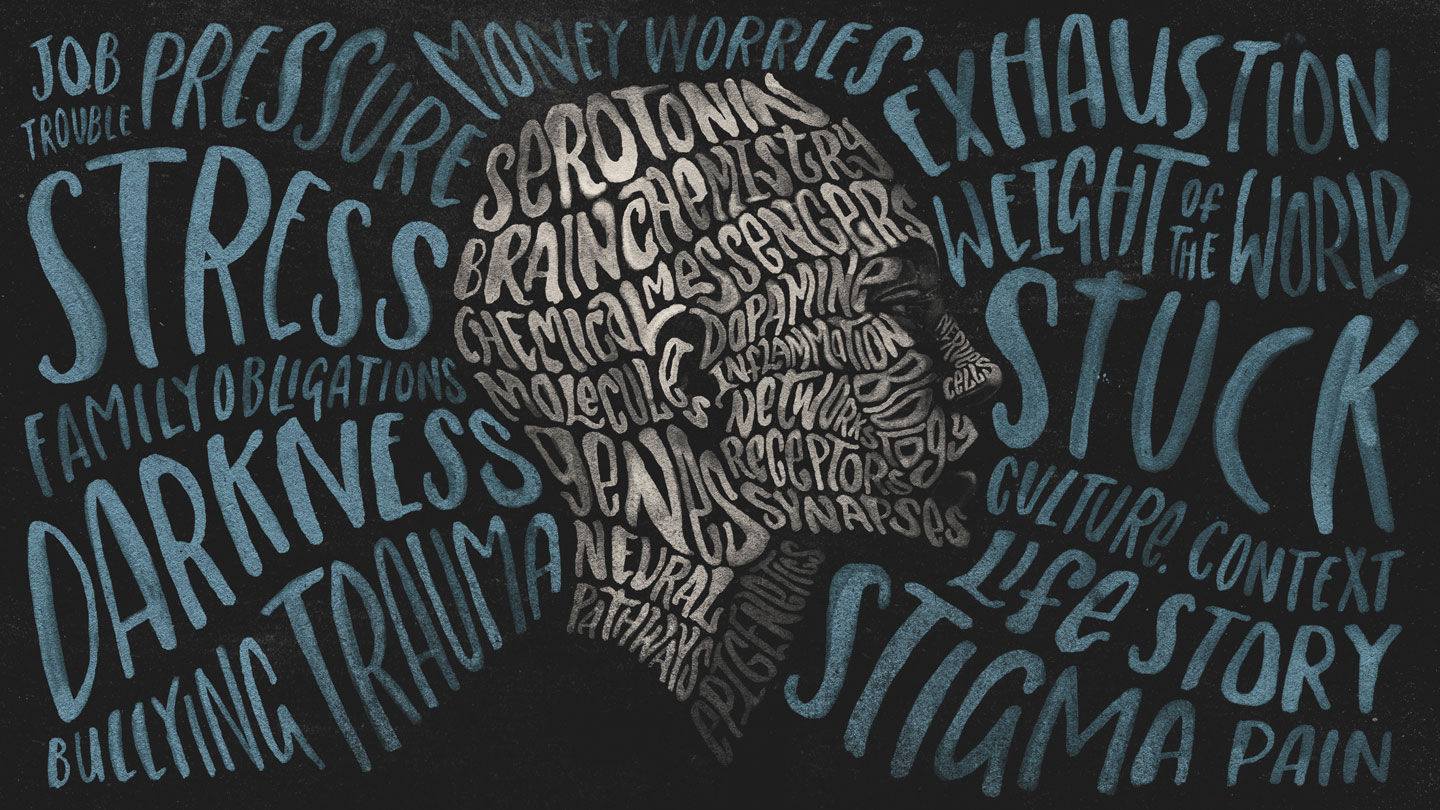
In today’s world, a prevailing theme centers around the belief that everyone’s feelings are valid. The underlying message is clear: people are constantly grappling with emotional struggles, and the outdated advice to “suck it up and tough it out” is not only misguided but also detrimental to society’s collective mental well-being.

Things like clinical depression, and other depressive disorders can’t just be prayed or willed away. They are the result of something gone awry within the network of our minds, and should be treated with sympathy and science, not dismissive attitudes.

Families and friends alike should be more inclined to ask how their loved ones are doing. Not just out of politeness, but instead, out of a desire to help—to be an outlet for someone they care about.

But it’s important to do it in a way that’s helpful. It shouldn’t have a “suck it up” tone, nor should it be a deflection such as suggesting you both go get drunk. Let them know that you care about them, and you’re willing to listen and/or help—full stop.

This approach mirrors the fundamental principles of therapy practiced by psychologists, where empathy and understanding are paramount.

Yet, amid this push for acknowledging feelings, it’s essential to recognize the fine line between validating emotions and enabling harmful beliefs. Telling someone their feelings are valid implies that their emotional response aligns with the situation they are confronting, even when this may not be the case, especially for individuals dealing with disorders such as bipolar disorder.

The potential pitfall of validating feelings is akin to committing a logical fallacy known as the Strawman Argument.

A logical fallacy is an argument someone uses that suggests one thing MUST lead to another, when that isn’t true. This fallacy arises when an argument misrepresents someone’s position to make it easier to attack.

In the case of a straw man argument, an example would be if I say, “I like Coca-Cola.” Someone who hears this responds, “Oh, so you hate Pepsi? I can’t trust anyone who hates Pepsi.”

The issue should be obvious that in my statement, I didn’t even mention Pepsi. It’s entirely plausible I like both.

Yet the person arguing against me made an assumption that I hated Pepsi, and argued against that “straw man” of my argument, instead of my actual argument that I simply like Coke.

Make sense?

So why does this mean people’s feelings aren’t valid?

Imagine we meet someone who seems really depressing and cold to talk to. Our feelings might lead us to believe they’re a jerk. Now imagine, we find out this person just got news that they have terminal cancer. Do we still feel that they are a jerk, or do we now realize that we’ve misread the situation?

The fact is, too many of us make assumptions based on far too little information, because it’s uncomfortable feeling like we don’t know things. We think it would mean we’re stupid. So we make up our minds before having even remotely enough factual information to fairly do so.

Through these exercises of jumping to conclusions through false assumptions (the equivalent of straw men), we develop feelings that are often invalid. What’s worse is we often get those invalid feelings reinforced by a society that tells us our feelings are always valid.

We see this play out with people who have taken offense over something. If we are offended at someone, it should be based on the idea that they’ve been disrespectful to us or others.

But being disrespectful requires intent. It is an act of knowing someone wouldn’t like something, and yet doing it anyway. But what if the person who did the thing that offended us had no clue we’d find it upsetting. Maybe they thought we’d find it funny, or completely benign. Were they disrespectful to us? We shouldn’t be able to accidentally disrespect someone, that’s not how any of this works.

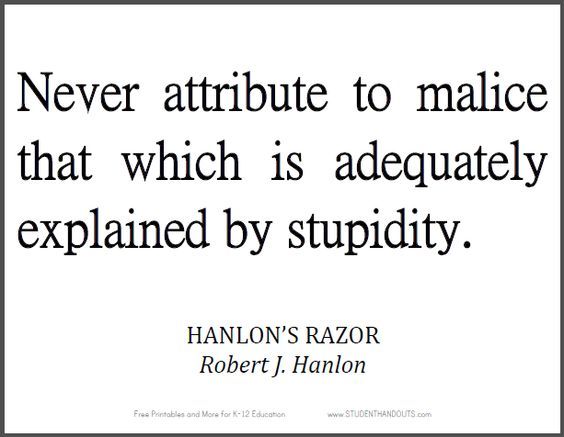
Hanlon’s razor is a good thought on this subject. It says,

The point being, next time we see someone on the internet upset about how disrespectful someone else was, we should first consider whether there’s an explanation that isn’t disrespectful, such as they didn’t know better.

It’s also important to consider if it’s really something to be bothered by in the first place. Society has become obsessed with having reasons for outrage. It makes sense, because the more upset we are about something, the more attention we’ll often get.

It could be because people already agree with us on other stuff, so they don’t want to disagree with us now.

As much as I hate to say it, maybe we’re attractive and people want to hook up with us, so they’ll support whatever nonsense we’re upset about.

I would bet at least $107, if you put an attractive woman on the internet, and have her talk about how all the hate that’s directed towards Nazi’s is wrong, you’ll have a thousand guys respond with an argument as to why they agree, Nazi’s aren’t that bad, they just have a different opinion than the rest of us, and people should be more kind to them.

The point of my post is this. Next time we find ourselves offended or upset by the actions of others, we should take a moment to consider whether there is a scenario where this was innocent. If we can think of at least one, then assuming it must be the worst scenario isn’t fair of us.

One option is to assume the innocent scenario, but that may also be wrong.

A better option is to ask questions of the person if we’re able. This isn’t always doable if the person is famous, but if it’s a friend or an acquaintance, making the effort to ask, “What did you mean by that?”, could be the difference between a fight versus an respectful and interesting discussion.

One of the biggest errors humans make, is the false dichotomy. The idea that there are only two sides and we have to choose one of them.

Maybe an interaction between a cop and citizen goes awry. If we think blue lives matter, we might assume the cop is in the right. If we think cops are bad, we might assume the cop is a serial rights violator. But there are at least two other options.

It could be that both of them behaved poorly. Maybe the cop was being a jerk, but instead of trying to deescalate the situation, the citizen decided to antagonize the cop and ended up making it worse.

The best reaction however, is to simply accept we weren’t there, didn’t see it all, we’re likely missing some context, and thus shouldn’t choose a side at all. Instead, being 100% ready to accept new information if it comes to light is the best way to think.

So next time we find ourselves with excessive emotions, unless a loved one has just died, or a national tragedy occurred, there’s a good chance our feelings aren’t as valid as we think they are. Especially if those emotions are us taking offense at something.

We are responsible for our emotions, not others. It’s up to us, to learn to let stuff go instead of stewing in a cauldron of rage which we lit the fire under.

Sometimes, we will benefit from just taking the time to analyze the situation with questions like:

Is this something I’m going to care about tomorrow?

If there another explanation for this that isn’t offensive?

Do I know this person intended to be disrespectful to me?

What role did I have to play in this situation going badly, and could I have handled it better? (Self-awareness)

Being full of rage requires a lot of concentration on that rage. The mere act of asking ourselves questions as I outlined above can often distract us from our rage, and push us onto a new set of train tracks from the rage train we were on, to one of emotional mastery. Not to mention the friendships we might save along the way, leading to happier and healthier lives.

Framing and Perception: Using Skepticism to Avoid Being Deceived

We’ve all heard the expression there’s two sides to every story. It implies that one side is the truth, and the other side is lying. While that can be true, it can also be that both sides are right, and are both just leaving out crucial factors. It could be that neither side is right, and the truth is something else entirely. It could be that one side is right, and the other believes they’re right, but are simply mistaken. And most commonly, it could be a matter of opinion, and there simply isn’t a right or wrong in the first place.

The point of skepticism, is to be able to consume information in such a way that you are least likely to be deceived, or make bad assumptions. Thus leading to more intelligent decisions, and typically better outcomes for you. Let’s look at some examples.

In April of 2019, it was reported in several news outlets that just eating one slice of bacon can increase your risk of colorectal cancer by 20%. You can see one instance of this report from CNN here. CNN was not dishonest in this reporting, that data is true.

But when you click the actual study, and apply a little skepticism (and some math), you might look at it a little differently.

There were 475,581 participants in the study, and a mere 2609 case of cancer reported among all participants. So if one group is 20% higher than the other, that means it’s approximately 45.4/54.6 split (45.4/54.6 = 120.2%, or 20% more).

54.6% of 2,609 = 1,425 (0.29% of the total group)

45.4% of 2609 = 1,184  (0.24% of the total group)

So while 1,425 is indeed 20% more than 1184, out of the total group or people observed (475,581) a mere 0.55% contracted colorectal cancer. A total of 241 more were the bacon eaters, or a mere 0.05% overall increase (0.29% vs 0.24%).

An almost entirely insignificant 0.05% or 241 out of 475,581 people doesn’t sound nearly as scary as 20%, does it? But scary sells news media, and journalists are rarely scientists.

This problem isn’t entirely about science, because you can apply these same skills to a myriad of things you’ll read or see in the media.

Imagine a news story we’ll call statement A with a headline that reads, “Woman courageously does all that is needed to put food on the plate for her child.”

Female Shoplifter

But then imagine a different news outlet runs a different headline we’ll call Statement B that reads, “Woman fired for drinking while at work, stole unhealthy snacks and booze from a grocery store.”

Statement A makes her sound like a hero, but Statement B tells a very different story. Both can be 100% true, but the context changes how you feel about the story entirely.

The point of all this are to make you think about any news story you read, and maybe think about changing the way you consume information. So here’s a couple of ideas on how to improve how you consume information.

  • Avoid click-bait headlines from sources you’ve never heard of, or that you know are openly biased. You know they’re all almost entirely bullshit. So why waste your time on them? The good ones will link to credibly sources, and you should click on those to read the whole story, if you do go down that road. But in general, if people stop clicking on clickbait, the people doing it will respond to the lack of demand for it, by ceasing to make it.
  • Read the article and not just the headline. Even reputable sources have resorted to click-bait headlines just so you’ll read their stories over the nonsense from non-reputable sites. You’re missing a lot of context and nuance if you don’t read the story. Not to mention, you look silly when you add your own comment that clearly shows you didn’t read the article.
  • Any story that says something like, “The such-and-such that such-and-such doesn’t want you to know” or “Person A destroys person B” is bullshit. All of it. Like every single one of them.” Stop sharing that nonsense. Seriously.
  • If you see a story and it seems pretty amazing, but you aren’t seeing it on reputable sources, I assure you, some podunk website did not scoop Reuters or AP. It’s bullshit that they didn’t vet properly, or worse, that they just made up.
  • Check a second source. This one is huge. If you see a story on a site that’s kinda reputable but not great, look for it on a site like Reuters or AP. If you confirm from multiple reputable sources, then it’s probably true. But if it’s multiple sources with the same bias, you should probably still avoid it.
  • Think about what’s being said in the story, and could there possibly be another way of looking at it.  For instance, if I told you France gets 75% of its energy from nuclear, where the United States only gets 20%, you could easily assume that France is a leader in nuclear energy compared to the United States. But if I told you France has 58 nuclear power facilities whereas the United States has 98, you’d think the US is the leader. Both are true, but both tell a different story. So it pays to dig into the data when you can, and form your own opinion based on all the information.

    Nuclear Power Plant Emits Only Water Vapor

Hopefully this helps you think about how to consume news differently, and prevents you from being that embarrassing friend on social media always sharing bullshit articles everyone but you seems to know isn’t true. You’ll thank me later. 🙂


Famous People and Their Causes

This may surprise you, but famous people have opinions. Gwyneth Paltrow believes a jade egg shoved in a woman’s hoo-hah somehow makes her healthier (click the link, because it doesn’t).

A large majority of Hollywood believe Trump is basically satan, and many black athletes have taken a knee during the national anthem because they believe the police are too quick to shoot a young black man.

Gwyneth Paltrow/Chris Martin and Family

When they have these opinions, being someone who is used to being in the spotlight, they rarely shy away from sharing their feelings on any given subject—using their bully pulpit to encourage others to follow their lead.

There are a few important facets to these expressions of beliefs that I feel are worth discussion.

First things first. They have a right to an opinion, and they should share such an opinion if they’re passionate about it. They should be shown respect for speaking out on something that’s important to them. Their success means that if it is a cause worth fighting for, they can shine a light on a subject that us non-famous people simply don’t have the ability to do.

I’ve seen the Twitterverse often have regular people telling athletes with an opinion on politics to “Just shut up and play (insert their respective sport here)”, or people tell British physics Professor Brian Cox, who’s quite vocal about Brexit, to “just stick to science.”

Professor Brian Cox

I understand why people might feel this way, since such famous people are not famous for politics, and thus not presumed to be experts on the subject. But politics isn’t science, it’s entirely driven by subjectivity. Meaning one person’s opinion is just as valid as another. And as a libertarian, anyone who speaks truth to power (even if I think they’re misinformed on what is truthful) is still doing something noble.

By all means, make the effort to correct them if you think they’re wrong on the facts, but people should do so respectfully, and applaud anyone with a voice for speaking out.

Phil Mickelson spoke out against California and its high taxes, and was blasted as being an elitist. So what! He’s earned his money with his work ethic. Most people will ever know how hard it is to be that good at anything, and I assure you it didn’t happen with a mere 9-5, 40 hours a week effort.

PGA Tour Golfer Phil Mickelson

Colin Kaepernick started a movement to call out when officers shoot unarmed black men, and little repercussions occur as a result, something we should all be bothered by when it happens. We can quibble over whether some of the shootings he rallied against were justified, some may have very well been, but it does happen nonetheless, and we shouldn’t excuse it.

But all that being said, people should understand that being famous doesn’t make you an expert and thus adds no additional credibility to their argument, versus your neighbor who may be espousing the same opinion, (unless they’re an expert in the field.)

So while we should not discourage them from speaking out with things like, “just shut up and play your sport” or something like that, please bear in mind that you shouldn’t be blindly following them either. You shouldn’t assume they’re in command of the facts, and that the information they provide is truthful. The only thing you could presume to be true, is that their heart is in the right place, and they mean well.

Just about every issue is way more complicated than any non-expert understands. So listen to what people say, but apply your own skepticism, and if you care about the issue, take the time to look up credible sources on the issue, forming your opinions based on them. Doing something, or believing in something because a famous person told you to, is irresponsible at best.

America, Australia, and Guns – My 2nd Visit to Sci-Gasm Podcast

On this episode, my best friend Mike  (a non-active duty Marine) speak with Wade and Byrne from Sci-Gasm about guns, gun culture, and why we love them so much here in the US. But it’s really a conversation on how to discuss controversial topics like gun laws as well.

CLICK HERE and give it a listen!

My Journey To Becoming A Passionate Science Enthusiast

About a year ago, I had the good fortune to be a guest on Sci-Gasm Podcast. We talked about my journey to becoming a passionate science enthusiast. This is how it went. Enjoy!

Everything I Wanted To Know About GMO’s

Last year, Kevin Folta, host of Talking Biotech agreed to let me grill him on all the questions I have about gene editing, GMO foods, and genetic engineering in general. I’m a layperson, he’s most definitely not. His qualifications in the field are pretty well documents, and only the hardcore anti-GMO crowd doubts him, but they’re a bunch of zealous twits who are at level zero on the objectivity scale.

Kevin took all my questions and answered them in a way, hopefully everyone can understand.


CLICK HERE and give it a listen!