Recently, a friend of mine posted a meme from the Prepare to Take America Back Facebook page about a gun dealer who has bacon in his shop, and if a prospective gun buyer intends on buying a firearm from him, you have to eat the bacon. The purpose of course, is to prevent Muslims from buying guns.
A lengthy discussion ensued, so I felt this was a good opportunity to promote skepticism over ideology and point out the flaws in the arguments by analyzing both sides.
The Actions of the Dedicated
If someone is so delusional as to want to murder a number of people at will for their god, it stands to reason they are not subscribing to a rational mindset. They are highly dedicated to an end result, and nothing other than a good person with a gun is likely to stop them. So I’m pretty sure if they’re motivated enough to murder, they could easily justify eating a piece of delicious bacon for the cause. It is likely only rational non-violent Muslims would be restricted from buying guns in this manner.
Remember, they’re not supposed to look at naked women either, but when Bin Laden was killed, he had quite the porn stash.
I should also point out that many gun owners have come out against No-Fly-List restrictions on gun purchases because a few innocent people end up on that list. So preventing law-abiding Muslims from buying a gun just because of the actions of a few violent ones seems rather hypocritical.
The Gun Rights Paradox
Gun rights advocates like myself point out that while it may be true that guns are the #1 tool used to murder people around the world, it’s a flawed argument if you’re using it to argue guns are likely to kill. There are nearly 80 million gun owners in America, but only approximately 32,000 violent incidents are performed by such people. Meaning that for every 100 gun owners, approximately 99.96 of them will harm no one who was of no threat to them.
While the numbers might be slightly different, you could replace the term “Gun Owners” with “Muslims” and make the exact same argument.
Like gun owners, most Muslims are indeed non-violent. So for gun owners fighting for gun rights by pointing to the above statistics to be ideologically consistent, they shouldn’t be promoting anti-Muslim views either.
The Constitutional Argument
The bacon scheme, while clever, many argue is a violation of the 1st amendment that seeks to prevent religious discrimination. But if we look at the verbiage of the first Amendment, it should be obvious it’s not an issue.
Congress shall make no law respecting an establishment of religion, or prohibiting the free exercise thereof; or abridging the freedom of speech, or of the press; or the right of the people peaceably to assemble, and to petition the government for a redress of grievances.
The 1st Amendment
The first five words are, “Congress shall make no law.” As this is a private business owner, he’s not congress. The first amendment restricts government and protects him, not the other way around.
Aside from the Constitutional issue, the government may not discriminate because we all pay our taxes to it and it governs all of us equally, therefore we deserve equal protection under the law.
But whether it be the KKK, Black Panthers, Westboro Baptist Church, a Christian bakery owner not wanting to make a cake for a gay wedding, or this gun shop proprietor, in a free country, while government may never discriminate, they should never have the power to dictate who you are kind to or do business with. Let the free market sort it out.
Credibility Issues
The conversation that ensued on this meme was after a mutual friend commented “94% of terrorist attacks in America are committed by non-Muslims, look it up.”
I, of course, pointed out that since he was the one making the claim, the burden of proof was on him to cite his source, it was not our burden to look it up. So he cited this information from Global Research.
Global research sounds mighty official, but then they cited a graph they stated came from Princeton University’s Loonwatch. Princeton university, being a prestigious institution, should lend some credibility as well. But there’s only one problem—Loonwatch’s “About” page only cites Princeton as the source of the definition of the word Loon from Princeton’s WordNet® 3.0. They may have attended Princeton (they don’t say), but there’s no indication this info is from Princeton University in any official capacity.
Since Loonwatch didn’t compile the data, this makes Global Research’s citation of Loonwatch irrelevant.
As you read the about page, it becomes clear, Loonwatch are opinion bloggers just like me, with no intrinsic credibility that comes from being a well-respected institution or peer-reviewed publication.
Opinion writers only get credibility by citing credible sources, as we don’t compile any of the data ourselves, we merely interpret it. But the genetic logical fallacy requires that we not dismiss their opinion, even if they’re not necessarily a credible source, so we’ll soldier on.
Loonwatch made a graph based on this FBI.gov data, which is a credible citation and to be commended. The thing that differentiates me from Loonwatch is that I won’t be pushing a particular narrative. I will present multiple ways to construe the data so no context is missing. Loonwatch failed to do this, and thus why I’d argue my post is more fair in its analysis.
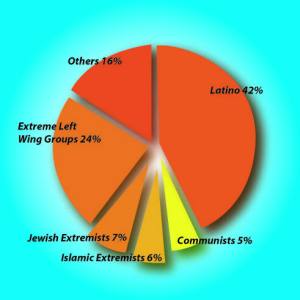
Graph Prepared By Loonwatch of Terrorist Attacks On US Soil from 1980 – 2015
Loonwatch did little to show how they came to their conclusion. The FBI study, cites individual attacks and who was deemed responsible for them, but did not in any way segregate them into the convenient categories Loonwatch used on their graph, so I can only guess that maybe Loonwatch researched each group deemed responsible individually, and categorized them by categories of Loonwatch’s choosing. While there’s nothing wrong with that, it’s important that Loonwatch at least explain their methodology, which they didn’t.
So don’t take anything Loonwatch or I say to the bank. Look at the FBI Data provided, and come to your own conclusions. I just hope to promote critical thinking.
Misleading Statistics
The problems with the 94% statistic are numerous.
The first flaw is that it breaks the groups up into categories that aren’t mutually exclusive. For instance, you could have Latino Communists, so what group do they fall in on the above chart, Latinos or Communists? And wouldn’t Communists be considered an Extreme Left-Wing Group as well?
Second, the caption they have for the graph reads as follows:
Terrorist Attacks on U.S. Soil by Group, From 1980 to 2005, According to FBI Database
But Loonwatch’s groups are not how the FBI classified them. The FBI classified them by name, such as Al Qaeda, versus grouping them as Muslims like Loonwatch did, making the caption dishonest as they aren’t the groups “according to” the FBI as the caption states. That doesn’t mean Loonwatch’s interpretation of the data is inaccurate, but when people make false assertions like that, it talks negatively to their credibility, as they’re either being dishonest or sloppy in their work.
Thirdly: It counts each attack as one incident out of 316, no matter how many were killed or injured in that incident including many that resulted in no death or injury at all.
This means that they count the 9/11 attacks which officially killed 2972 people and injured an estimated 12,000 others as if they’re somehow one unit equal to the November 11th 2005 Hagerstown, MD arson which killed no one.
Loonwatch headed their post by saying, “Terrorism Is a Real Threat … But the Threat to the U.S. from Muslim Terrorists Has Been Exaggerated.” As such, including incidents which resulted in no human harm, is certainly a bit misleading. The FBI was simply tracking terror attack numbers, but Loonwatch used that data to argue threats to the U.S., which aren’t quite the same thing. The non-injurious attacks may or may not have been intended to harm anyone (a threat), but only scare people into compliance (terrorism). It’s entirely possible those attackers purposefully sought to avoid being a threat to life and limb by bombing unoccupied property, effectively making them non-threats.
Analyzing the data myself
First, let’s eliminate the aforementioned incidents that resulted in no harm to anyone and we’re left with 44 attacks versus 316 to analyze. I’m eliminating these because the narrative is about who is a threat to Americans, so incidents which resulted in no harm should be irrelevant. I researched every group responsible individually to categorize them myself and determine which were Muslim and not.
Muslims committed 6 of those 44 attacks, or 14%. This is more than double the 6% Loonwatch presented, using their same metric. But, it still supports their underlying argument that non-Muslims committed more attacks than Muslims, by far.
After I had done that, instead of treating each incident as if they’re the same, I’m going to categorize them by how many were killed at the hands of terrorists, which is more relevant to the narrative of the threats to Americans.
Of 3,178 terrorist murders, Muslims committed 2,982 of them (94%), which is ironically (and completely coincidentally) the same percentage, yet polar opposite, of the narrative Loonwatch portrayed. There were approximately 13,048 Muslim-committed injuries out of a 14,017, (93%) as well.
Now that may seem like I’ve refuted Loonwatch’s argument since that’s a 188% swing, but I haven’t. I’ve merely presented the same data in a different light.
To be fair, I will also point out that almost all of them are from the September 11th attacks. So one incident of 44 is severely skewing the data. But nonetheless, while Muslims don’t account for most of the incidents, by a landslide they account for the most deaths.
Using the same data Loonwatch did, I could make that argument, leave out the context I gave you, and give a conversely biased opinion to Loonwatch. It’s a lesson in how people leave out info without lying to lead you into a false impression.
What’s This Puerto Rico Stuff?
While we’re on the subject of skewing the data, I could eliminate the events in Puerto Rico as well.
While Puerto Rico is a U.S. Property, I think if you asked both Americans and/or Puerto Ricans whether they consider Puerto Ricans to be Americans, most would say no. They’re not a state, plus they’re not even allowed to vote in U.S. general elections. Again, the narrative was whether Americans are mostly under threat from Muslims, so adding Puerto Ricans to the list is a bit misleading to that narrative for most Americans
Eliminating non-injurious and now Puerto Rico attacks, I have 35 remaining incidents, of which Muslims were responsible for 6, or 17%, which still supports Loonwatch’s claim that non-muslims are responsible for more attacks.
Puerto Rico
We can agree to disagree on whether Puerto Rico should be excluded from this list or not, but at least I’m telling you I’m doing it, so you can make up your own mind.
Where’s the Current Data?
The FBI Crime Data table cited was 1980-2005. This is data that ended early in Bush’s second term. Click here for what the FBI gives for data after 2005. It’s vague at best, and not in a nice table like the 1980-2005 report, making it difficult to compile any data from it. Maybe the FBI has this info hidden away somewhere convenient for some reason, maybe they’re just lazy. But nonetheless, the data used for the argument is 11 years old.
But scrubbing through this less-than-helpful timeline from the FBI, while there were several terror attacks thwarted two were successful which killed thirteen people and injured thirty more, all committed by Muslim extremists. Add in the recent Orlando attack that happened after the Loonwatch study, there are 49 more deaths on that list, and you realize for the last decade, the only terror threat to Americans, if we’re going by recorded incidents, has been from Muslims.
Conclusion
I’m atheist, and thus against all religion, because I think religious extremists of any faith are capable of doing heinous things. But in the modern era, I do not think anyone could reasonably argue that most ideological unprovoked violent acts in the modern era are not committed by people who claim to be doing those acts in the name of Allah.
But it is important to understand that just because they are responsible for such violence, it does not in any way mean that a majority or even a disproportionate amount of Muslims are violent. Arguing the converse is pure bigotry. But the evidence is clear that for every one American killed or injured in a terrorist attack by non-Muslims, there have been approximately 93-94 who were harmed or killed by Muslims. A narrative that is rather different from the one made by Loonwatch, yet also entirely true.
I have no animosity towards Muslims that I don’t equally have against all religion, my only issue is with misleading stats to push a particular narrative. Whether someone is killed by a religious extremist, or killed by a gang member robbing a store, the end result is identical. As with anything in life, I believe it is important to remain skeptical and question everything, because data can always be presented in a quite misleading manner to serve someone’s agenda. I hold myself to a higher standard, but you can’t possibly know that. And you can’t know it about any other op-ed write either.
One of the biggest fads of the current decade must be the rise of people promoting all-natural, organic, chemical-free, non genetically modified foods. The argument sounds quite romantic, healthy, and wholesome, for sure. There’s only one problem—scientifically speaking, it’s largely bunk…all of it. Let’s jump right in and address them one by one.
Organic
This word is often used to describe non-genetically altered foods that use natural fertilizers, like animal dung, as opposed to man-made fertilizers containing what people fear are harmful chemicals.
Calling unaltered foods “organic” is deceptive language used to mischaracterize and stigmatize man-altered foods because some are skeptical about the safety. It serves to give the impression that, biologically-speaking, they are not “real” foods, which they certainly are. If such foods weren’t organic, they wouldn’t have genes to modify in the first place. So by no scientific metric could you accurately label such foods, “non-organic.”
The FDA, being in the business of protecting us through science, should be bound to the scientific method in their decision-making process and use scientifically accurate terms. They’re appointed, not elected officials. Appointed officials are supposed to ignore public opinion, instead making decisions based on facts, because they are shielded from the pressures of getting voter support to get elected—a premise they violate using these improper terms.
The FDA should simply classify them with accurate terms, like maybe “non-synthetically fertilized,” and leave the politics to the politicians.
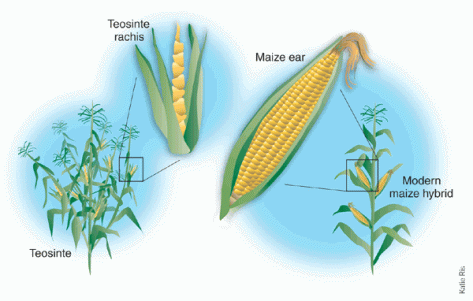
But the fact is that most everything you eat from the fruit and vegetable aisle has been modified by people through cross-pollination for millennia in order to grow higher crop yields or achieve other desirable traits. Almost nothing we consume today exists in its all-natural state—unaltered by humans.
Almost no one wanders the forest looking for wild fruits and vegetables, picks them, then brings them straight to market. Even if people had a jungle in their back yard, which most don’t, it would be a highly inefficient way to do it; you’d spend most of your time looking for food versus picking it. (Ever watch a Bear Grylls episode? He spends hours just to find a cockroach to eat.) This would lead to both ridiculously high food costs and increased starvation by virtue of the extreme low crop yields it would produce.
Bear Grylls eating “who knows what.”
On a side note, I’d like to point out that almost every disease known to mankind is all natural. So even if you did genuinely find all your food in a jungle somewhere and lead an all-natural lifestyle like primitive man, you’d probably never live past 30 or 40 (also like our primitive ancestors) because something else all-natural would kill you. Ironically for you, something entirely man-made, like many modern-day pharmaceuticals, would easily save your life.
Chemical-Free
Thanks to the efforts of people like Vani Hari, aka The Food Babe, who frequently criticizes food for containing too many “chemicals” in them, people have become chemophobic.
On Vani’s website, she does at least have a disclaimer that effectively admits she doesn’t have any qualifications on her blog’s subject, her education is in computer science, not biology or medicine.
Vani Hari aka The Food Babe
Yet despite the fact that she admits her ignorance, (which is forgivable if she cited credible sources to back up her opinions) people follow her so vehemently, that she has a Food Babe Army!
Why is this? Aside from the fact that she’s visibly attractive, and many studies have shown attractive people tend to garner higher perceived credibility, Vani speaks in a language that people who have little knowledge in science easily understand. Among other things, she often argues that all those chemical names you don’t recognize sound scary. (Hint: Anything you don’t understand would sound scary)
Thankfully, there are people like Yvette d’Entremont aka The SciBabe, who holds a B.S. in chemistry, and an MSc in forensic science, and thus is significantly more qualified in the field. She vigorously debunks people like Vani, hopefully educating those willing to listen, as to why people like Vani are misguided. As Patricia C. Hodgell once wrote, “That which can be destroyed by the truth, should be.” A mantra Yvette epitomizes with her website.
Yvette d’Entremont aka The SciBabe
So where does Vani go wrong? When she lashes out at chemicals, and their scary-sounding names, the obvious and simple answer is that EVERYTHING is a chemical. The only thing that isn’t a chemical is a vacuum, and no I don’t mean a vacuum cleaner, I mean the absence of something.
Does dihydrogen-monoxide sound scary? Because it’s water. (Di meaning two, mono meaning one, it’s two hydrogen atoms and one oxygen, aka H2O). Does sodium chloride sound bad? It’s just table salt.
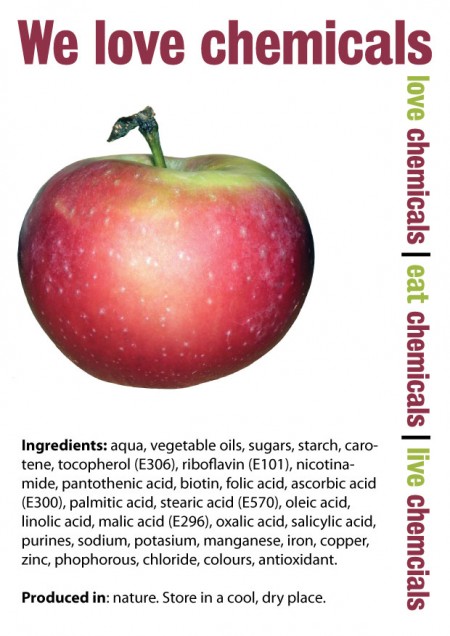
An accurate list of all the naturally occurring chemicals in an apple.
See this pic here showing the list of naturally-occurring chemicals that exist in a simple apple. These are not fertilizers added later, nor genetically added traits by man, they’re just what makes up what the FDA would call an organic apple.
While the sentiment to be cognizant of what you put in your mouth is a good thing, Vani’s logic is pure fear-mongering from a point of ignorance, not based on any scientifically-accurate knowledge on her part. Nothing is more dangerous than a charismatic, yet ignorant person on a mission.
The SciBabe has done such a great job debunking Vani’s false claims, I highly recommend checking out her work if you want to learn more.
Genetically-Modified Organisms
This one is by far the most complicated of the four, but I will attempt to lay it out in a way that makes sense without getting too jargony, although it may be a bit oversimplified for brevity’s sake.
“Genetically” refers to an organism’s genes or DNA. The easiest way to explain this, would be to start with the Theory of Evolution.
A human’s DNA has approximately 3-billion base pairs, or variables, in its makeup. But mankind is a fairly new species on Earth. If we go back to the beginning, there would have been a single-celled organism called LUCA (Last Common Universal Ancestor). As the name insinuates, much like you share most of your parent’s DNA and can use that information to trace a family’s genealogy, every living thing on Earth shares some DNA with one another. All the DNA that all living things share would eventually lead you back to LUCA.
Click for more info on LUCA from Georgia Tech Research
So how did life go from LUCA to your humble correspondent? By accident—that’s how.
In my previous post about cancer myths, we discussed how cancer is simply your own cell’s DNA mutating to a new, “non-you” DNA, which then becomes its own organism. That doesn’t happen on purpose. Your body is constantly replacing most of the cells within it that die off (with a few exceptions).
But occasionally, rebuilding a 3-billion piece jigsaw puzzle leads to an error here and there. The likelihood of such errors can be increased by things like UV light from the sun causing skin cancer. Those things that increase the odds of cancer-causing mutations are called carcinogens.
Some of those mutation errors are small and have little if any real effect, or produce something that cannot sustain life and dies quickly because it’s bad code. But some however are viable life forms, and they become a new organism.
While cancer is an example of the negative impacts DNA writing errors can do, all the life on Earth today, including humans, are great examples of mutations having a mostly good outcome. I say “mostly” because it also brought us things like mosquitoes and viruses.
But if LUCA never mutated, LUCA would be one lonely organism—remaining today, the only life on Earth, it’s DNA faithfully replicated over and over again, producing an endless stream of LUCA identical twins.
So what does this have to do with genetically modified organisms?
As was discussed, DNA is mutated or modified, quite randomly and by accident, via natural processes. If these processes lead to a life form that is poorly adapted to its environment, it likely dies an early death. Makes sense, right?
Click to go to Wikipedia page on EvolutionBut if nature “selects” a mutated life form that is highly suited to its environment, that life form will thrive. This is called natural selection; the process that made a single-celled organism eventually turn into us.
But those changes take thousands of years, and us humans being somewhat impatient, would like some of those changes now.
As an example, let’s imagine a fictional batch of tomatoes. You plant ten of them, and as they ripen, one seems to stand out as more plump and tastier than the others. There are two reasons why this might be.
Environmental factors affected one more than the other, such as bugs nesting in nine of them, but through dumb luck, avoiding one. As you can imagine though, if they are planted next to one another, it’s unlikely environmental factors would not affect them all equally.
Instead, the more logical reason is that one had a mutation in its genes that simply made it a “better” tomato. I say better, but it’s not better for the tomato, as that tomato is more likely to be eaten. It’s just better for the farmer growing it and the consumer eating it.
Now if you were a farmer 10,000+ years ago, you’d wisely select seeds from that one tomato plant in an effort to make sure all your future tomatoes are more like that one.
Notice I sneaked the word “select” in there? We went from natural selection, to human selection. Where nature did something by accident, your prehistoric farmer would have done that on purpose. No one knows when this may have started, but it’s certain that the earliest farmers would have soon understood this process.
Now imagine in our tomato example, that two tomatoes of our ten were good but in different ways. One was bigger, but the other was tastier. Now our farmer has a problem—which one to pick? The solution is cross-pollination. The plant kingdom’s version of a blue-eyed blond marrying a brown-eyed brunette mating and producing a blue-eyed brunette child.
Here we’ve went from human selection of organisms to the primitive version of genetically modified organisms, because you now have a product that solely exists because mankind wanted it to. This process is believed to be nearly 10,000 years old, and for millennia, has been the extent of man’s knowledge on how best to alter his foods to suit him.
Cross-pollination, while effective, is still dependent on nature and reproduction writing that billion-plus line of DNA code. And as discussed, nature makes mistakes. But the other factor that makes cross-pollination less than ideal is that if we go back to our tomato analogy again, let’s imagine those two good tomatoes also have poor traits we don’t want. Maybe they’re bigger and tastier, but aren’t as easy to grow. Or have a trait that while meaningless to humans, attracts bugs that destroy them. With cross-pollination, you take what nature gives you by mating the two and hope for the best.
Now fast forward to the modern era (sort of). In comes Friedrich Miescher, who on 1869 discovered “nuclein,” what we now know as “deoxyribonucleic acid,” or “DNA.” Then nearly 100 years later, American biologist James Watson and English physicist Francis Crick finally observed the double-helix nature of DNA, and the understanding of life’s building blocks began.
Actual Image of Human DNA through an Electron Microscope. (Click image for more information)
These tiny puzzle pieces in the makeup of organisms are basically binary code (technically it’s quadratic)—on and off switches for traits of every living thing. So going back to our tomatoes yet again, we finally understood that we could map our two good tomatoes’ DNA to understand what each line of code does, turn on or off the traits we did and didn’t want, leaving exactly the tomato we desired. Just as importantly, adding the ability to make that exact tomato over and over again. We no longer had to hope that nature would write the code we wanted though cross-pollination.
Is that tomato something other than a tomato? No, it’s a tomato with the same basic genetic makeup as any other tomato, just precisely the tomato the farmer wanted. It’s important to understand also that it’s entirely possible that evolution would have created such a tomato on its own through random mutations, we just have the technology to bring it to market now.
Many fear the unintended consequences, which is fair. But there are a couple important things to understand as to why this needn’t be the case.
In most instances, nothing has been added to the tomato that makes it dangerous like a synthetic fertilizer might be. A tomato’s DNA was modified (Switches that are already there are turned on or off), not supplemented. Even when code is added, it’s added because scientists understand exactly what that code does, and have every reason to be confident they know what the result will be.
The process used to modify the organism’s code, usually a tool called CRISPR-Cas9, modifies only the lines of code the modifier intended. It is incredibly precise, and therefore is far less likely to lead to unintended consequences compared to cross-pollination.
There is a rigorous process used to test the modified food before they’re approved for human consumption. Not just by the maker, but then by the FDA. This approval process is far more rigorous than most other things you regularly put in your mouth, whereas cross-pollinated foods we’ve been eating for years, are rarely tested at all.
I was listening to the Talking Biotech podcast the other day, and something struck me. Dr. James Dale from the Queensland University of Technology was speaking to a group of people in Uganda about genetically modified foods. And one of the attendees from Uganda stated that he couldn’t understand the argument that people in America are arguing over one good food versus another when in his country, they just desperately want food.
Professor James Dale
His point was pretty powerful, that people like Dr. Dale are helping to grow healthy foods in places that couldn’t grow them otherwise, effectively doing something that few charities have ever been able to do efficiently—feed the hungry. Sending people food has never, nor will ever be, the best method to end starvation—it’s far too costly and inefficient. It’s also not a sustainable and renewable source of food since it depends on people to send it.
Designing food that can grow where the needy live, in a land that has otherwise been barren of real food choice previously, saves lives in a far more meaningful way for all future generations that live there.
As someone who values life over willful ignorance, I cannot stand idly by and watch the scientifically illiterate bemoan this most noble of sciences, endangering the lives of those they may help, without calling them out on their erroneous claims. It’s heinous ignorance at best, and willful, dangerous, depraved, and nearly sociopathic misdirection at worst. People’s lives are at stake every day via starvation, modified foods are the best way to save them.
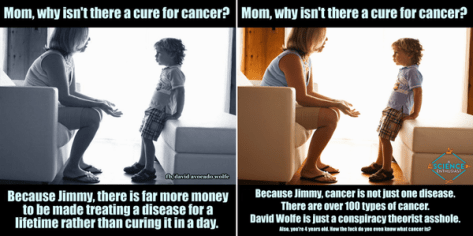
Recently, this meme from Dan Broadbent at AScienceEnthusiast.com was shared on Facebook by Yvette d’Entremont, also known as the SciBabe. Yvette’s science credentials are that she “holds a B.A. in theatre, a B.S. in chemistry, and an MSc in forensic science with a concentration in biological criminalistics.”
Yvette’s science credentials are quite impressive, and as such, her knowledge of the field means that this meme makes perfect sense to her. It also makes sense to me, despite my lack of such credentials, because as an ardent skeptic, I’m an avid consumer of medical science, helping me to understand the argument potentially more than most.
But for many who aren’t so interested in science and medicine, especially those who are somewhat naturally distrusting, the left cartoon seems to have merit.
However, I’m hoping that if I can walk you through some of the knowledge I have, and apply a little skeptical analysis, we can pretty easily dismiss this meme almost entirely—so let’s begin.
Point #1 – The Catch-22
The argument put forth is based on the premise that treating ongoing cancer is much more profitable than curing it, and thus big pharma suppresses the cure for increased profits.
But if this were true, then big pharma would never spend the millions, if not billions that it takes to find a cure in the first place. Because if they did spend such money to find a cure, suppressing it would mean a total loss.
So either they would spend the money and bring the cure to market to get a return on investment like all businesses do, or they wouldn’t spend the money to develop the cure in the first place; instead spending that money elsewhere, or pocketing it like the “greedy bastards” so many want to assume they are.
But spending the money, then refusing a return on the investment, is an obvious catch-22 that makes no sense.
Point #2 – There is no one “Cancer” species to cure.
When people talk about curing cancer, it is said as if cancer is one singular species, similar to mankind’s Homo Sapien or the Road Runner’s Disappearius Quickius. But nothing could be further from the truth.
Cancer is a mutation of a person’s cells, that then becomes its own unique organism living inside that person and feeding off of them.
To severely simplify this, imagine DNA is like binary code, a series of ones and zeros. It’s actually quadratic, adenine (A), cytosine (C), guanine (G), thymine (T) are the four choices. A always pairs with T and C always pairs with G, leaving AT, TA, CG, and GC as your four options because while there’s only two pair combos, their reverse is a different option. That code is like a road map of sorts that tells all the stem cells in your body what to become as they replace the cells that naturally die off. If this imaginary DNA were a 4-digit code (It’s actually more like 3-billion digits) of 1010 for instance, then all the cells in your body should all have that same 1010 code.
Now imagine if one of those cells mutates and changes its code to 1011. In many instances, it would just die because it’s a bad code that can’t sustain life. But occasionally, it is in fact good enough to become viable to live as a new mutant entity. That entity may then begin replicating into a bunch of cells that have that new mutated 1011 code instead of the 1010 code they should have. Going back to my road map analogy; that code error is akin to your road map now showing roads that aren’t there or missing roads that are. This new mutated entity that stops producing new cells for you, and instead becomes its own life-form that feeds off of you is cancer.
Actual Image of Human DNA through an Electron Microscope. (Click image for more information)
Click here and/or this wonderful post from Dr. Michael Wosnick here for much more detailed, accurate, and nuanced explanations of this.
As such, no two cancer strains are likely to be alike in the same way similar species of animals or plants are that inherit their DNA from parents.
So with all that being said, it’s important to understand a treatment that kills one cancer, is highly unlikely to kill all of the others; making the idea that there is one cancer-cure-all, almost entirely implausible.
Point #3 – The Overwhelming Conspiracy
There are several pharmaceutical companies, research hospitals, and science universities working on cancer research, typically focusing on one of the aforementioned 200+ known types. Often, the people doing the research are employees of the company, and aren’t just one person stuck in a lab. It will be a team of researchers/students, all who took up biology, in many cases, to specifically find a cure for cancer.
So in order for this conspiracy to be true, we’d have to assume that the literally thousands of researchers, who probably don’t own the pharmaceutical companies and have no financial interest in suppressing a cure, would have achieved the one goal they hoped to, which was quite altruistic, but then became sociopaths who hid it away from the world in a malicious attempt to profit from the misery of others.
I suppose it is possible that big pharma somehow defied Point #1 above, and then either added the felony of murdering any employee who found such a cure to the dumb things they did, or added the additional expense of paying those researchers off, adding more to their loss mentioned in Point #1. But either scenario simply bolsters the Catch-22, making it even more illogical.
I’d also like to add that if Bill Clinton couldn’t silence one frisky intern with the might of all the US Government agencies on his side, how is a pharmaceutical company going to silence hundreds, if not thousands of researchers?
Point #4 – There’s actually multiple cures for cancer already on the market.
This one is so obvious and simple, it’s a shame it’s completely overlooked.
Do you know someone who was diagnosed with cancer, and through treatments like chemotherapy, surgery, embolization, etc., are now in remission? I know many, including my father.
Each one of them received an effective cure, which is why they no longer have cancer. There may not be one treatment that cures all cancers, but that’s because of the premise I outlined in point #2.
So there is in fact multiple cures for multiple cancers already. Instead, what researchers now work on, is finding more effective cures that are not only more successful at killing the disease, but also less harmful to the affected person.
Point #5 – There’s plenty of money in a cure
Because cell mutation will always occur, and therefore cancer will always exist, cancer can likely never be eradicated like the black plague or small pox were. So there is plenty of money to be made in a cure.
If drug companies lost money from such a cure due to decreased demand, they could easily move to treat other diseases or conditions to replace those lost profits with their humanity in tact.
Point #6 – The smaller conspiracy
If I ignore the big conspiracy in Point #3, it’s still important to remember that there are a lot of drug companies, research hospitals, and science universities out there. We’d still have to assume that these companies, who are trying to beat each other in the free market, all put aside their differences, secretly met in some clandestine office, then suddenly worked together to not release a cancer-curing product that would sell to anyone with the cancer it treats, and harm people in such a brutal way. These people are in business to make a profit selling medicine, and beat their competition. Suppressing it would only help their competition.
Point #7 – Where are the in-betweens?
This conspiracy assumes that big pharma is making a fortune just treating people’s cancer without curing it. But most people who get cancer either receive one of the aforementioned cures from Point #4, or they die somewhat quickly after diagnosis. Rarely do people live a long time with a diagnosed cancer.
No one treats someone who is dead, so if people die, there’s no money to be made off of them. But if big pharma does cure them so they live longer, they’ll likely catch some other condition down the road that big pharma can also treat. So the money is not in suppressing a cure, the money is in helping people to live longer, so they need more conditions to be cured in the future.
Summary
These seven points are by no means all the reasons why this conspiracy makes little sense, they’re merely the ones I was able to come up with in literally two days of thinking about this subject. Plus, I’m well over my 1,000-word count I usually try to maintain in these posts.
So I hope that going forward, instead of assuming the worst in people whom you neither know nor understand their work and their motives, you think skeptically as I have, and allow yourself to believe that people are indeed mostly good. Biologists who took up the cause of curing cancer, are in fact working honestly towards that goal every day, there’s little reason to believe otherwise.
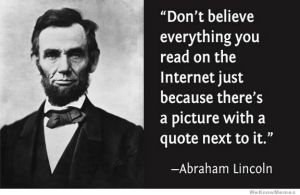
The internet is full of numerous people making claims. Whether it be memes with pictures of famous people saying something they clearly didn’t say, or quotes from famous people who actually did say it.
Abraham Lincoln Weighing In On the Internet
Point #1 I’d like to make is that a famous person isn’t more credible than any other person, unless said famous person is actually educated in the field of the claim being made. (Think Professor of Physics Brian Cox speaking on the subject of physics or science in general for instance).
Professor Brian Cox
Before we start, for purposes of this post, it’s important to define opinions, beliefs, and facts, as I believe they are mutually exclusive.
Opinion – A statement that has no right nor wrong answer.
Belief – A statement that does have a right or wrong answer, but that isn’t substantiated by evidence to know said right and wrong answers.
Fact – A statement that does have a right or wrong answer, and is supported wholly by evidence making it a demonstrable truth.
To give an example of these three, let’s look at someone who chooses a vegan diet.
If a person doesn’t want to be someone who exploits animals, or simply doesn’t like the taste; that is a matter of opinion and they should never be questioned on their choice, as there’s no evidence one can put forth to prove them wrong.
However, if they go vegan because they argue it’s healthier, that is a matter-of-fact statement. If they have no evidence supporting it, it’s merely a belief.
To make it fact, they would first have to define “healthy.” It could mean disease free, not obese, longevity of life, low cholesterol…the list is endless. From there, one would have to do or cite a controlled study comparing veganism to omnivorous or carnivorous diets, and prove it to be true. As such, such matter-of-fact statements, unlike matters of opinion, are indeed open to being questioned.
Now that we’ve covered those points, let’s kick this off with some simple thoughts to keep in mind when you read something on the internet, or see an advertisement on TV.
A claim sans evidence should be deemed as nothing more than an opinion or belief.
A claim sans evidence from an expert, is only an expert opinion or belief.
While an unsubstantiated expert opinion should be trusted more than an unsubstantiated non-expert opinion, neither should be deemed as fact.
Exploring the above three points; they often come into play when viewing a celebrity or expert-endorsed advertisement. They often make claims that you feel potentially make sense. But if you practice some critical thinking, you’ll soon notice that they can’t, don’t, or won’t cite any tests, studies, or evidence-based facts to back up their claim.
When watching a science-looking TV program, it’s important to understand that a proper expert would say “I don’t know” until they have actually seen or performed a study and gathered real evidence; not speculate profusely, presenting it as fact. (Think Ancient Aliens, Ghost Hunters, etc.)
Why do some experts speculate like this? Because science is a LOT of work! It involves loads of money, and a myriad of education and testing that can take years or even decades to complete. Not to mention, it also requires something to actually test. How can someone be an expert on Bigfoot if they don’t have an actual Bigfoot to observe and test, right?
Speculation however is easy; you just start talking.
So what are a couple of tell-tale signs you should look for when you see someone making a claim that you suspect might be less than trustworthy?
Is it an advertisement? If so, it’s biased, and should be ignored almost unilaterally. On a credibility scale, from zero being pure bullsh*t, and ten being “Take it to the bank;” advertisements are a zero. A celebrity endorsement likely ranks no more than a one, and an expert endorsement maybe a two. Why do endorsements add any value at all if they’re just being paid to say whatever their told to say? Because their credibility is on the line, so you’d like to think they care as much about their credibility as you do yours. But that being said, Dr. Oz proved this is still not that trustworthy.
Dr. Mehmet Oz
If the advertisement cites an independent study, look up the study. If it’s legitimately independent, that sends it way up the credibility scale, and such companies should be commended for doing so. Although to be fair, if the independent study hadn’t been favorable, it would not have been in the ad, so it’s still partially comfirmation-biased as you’ll likely not hear any negative portions the study might have reported.
If it’s not an advertisement, does it actually give you evidence-based answers versus speculation? These pseudo-science shows, like the aforementioned alien, cryptozoology, or ghost shows are famous for presenting themselves as science, but being anything but. They bring dubious experts on who ask provocative questions, but then never follow it up with evidence-based answers. It makes them seem smart, but most of the time, it’s ridiculous nonsense with big words.
Why is this important? Ignorance is bliss, after all. Right?
If you were building a home, would you cut a framing board at what appears to be six feet to you (Not science)? Or would you measure the board (Science)?
People spouting unsubstantiated nonsense as if it is fact are some of the most dangerous people on the planet. They convince people who don’t know any better, to act on their claims as if they’re fact. Sometimes to grave consequences. Think Steve Jobs being duped to treat his cancer with “alternative,” instead of actual medicine. Such false medicinal advice may have cost him his life; a claim that cannot be proven since we don’t have two different Steve Jobs (one who took a doctors advice versus one who didn’t) to test, as the linked article points out.
At this point, I’m sure you are wondering who exactly you CAN trust. Assuming you don’t know how to, or have the means to carry out a proper controlled study, or do actual research yourself, I’ve prepared a makeshift credibility scale to help you suss out the chaff.
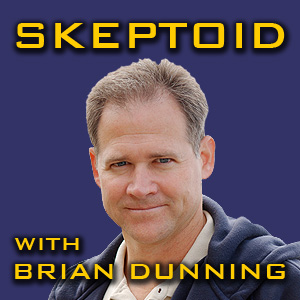
Websites like Snopes, Skeptoid, or Science Based Medicine are largely devoted to debunking false claims, and do a great job of bringing just well-researched facts sans opinion. I would trust them nearly as much as scientific journals.
Skeptoid’s Brian Dunning
So what about non-scientific information like politics, human interest stories, etc.?
Unbiased news sources are a very credible venue. Reuters and the Associated Press are two of the most commonly cited news sources by other commercial news outlets, and this speaks to their credibility. They don’t do opinion, so when you read an article from them, it may be somewhat less interesting, but that’s because it’s just the facts.
News sites with opinion, like MSNBC, CNN, Fox News, ABC News, CBS News, The New York Times, Wall Street Journal, and more are still fairly credible, despite being laden with opinion—this is mostly due to their market share.
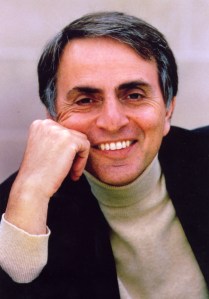
Carl Sagan once said, “If it can be destroyed by the truth, it deserves to be destroyed by the truth.” If these mainstream outlets were consistently delivering false information, or didn’t make an effort to present both sides of an argument, this is exactly what the market would do to them.
Carl Sagan
While their ideological counterparts hate such news sources, independent minded people generally understand that while they’re biased, they at least validate sources and make an effort to be accurate and fair. It’s not perfect, but it’s at least reasonably credible.
Openly biased news sources like Drudge Report or The Daily Kos still have a market to answer to, and often break accurate information first due to their aggressive desire to defeat their ideological opponents. But I would avoid citing them as fact, because their information is suspect unless you can corroborate their findings with other news sources as mentioned above.
Blogs like mine are laden with bias. They are so small and rarely ever cited, that you should almost never consider blog claims as reputably truthful. If they cite credible sources along with their opinions (This is why I often do exactly that), it increases their credibility, but you should never treat them with full reverence.
Hopefully, you’ll start to notice that “opinion” is a consistent point to avoid when looking for the truth, but the bottom line is you should question everything. Question people who make claims without providing evidence. Question people who claim to be experts but can’t back up their opinion with fact. If you’re qualified, question proper scientific studies and do your own peer review.
Either way, enjoy the information you gather throughout life, just be skeptical every step of the way. Happy hunting!
Your humble correspondent has many favorite pass-times. At the top of my list is autocross racing; a form of road racing for beginners—using their own cars to get the thrill of something like Formula 1, without the $100 million dollar budget, death-defying 200+ mph speeds, or the need to be the best driver in the world. See the video below for a short, but wonderful documentary on autocross. If you like motorsports, I encourage you to check out your local SCCA or NASA (not that NASA) club and check it out. It’s cheap yet awesome!
Before every event, they have a driver’s meeting where the person running the event (a volunteer) lays out the plans for the day, and the safety steward (also a volunteer) explains the rules of safety.
One of these officers from the events I went to, one Jon Beerman, would always say, “Safety second! If we put safety first, we wouldn’t be out here doing this in the first place.” Jon has a crazy fast Corvette, and if you know me or follow me on Twitter, you know I have a deep love for all things Corvette, so this makes Jon a well respected man in my book straight away.
Jon Beerman and his Corvette of Death
All kidding aside, I always thought this was pretty insightful of him, but also, a great analogy for the American spirit. We were a country born out of a passion for freedom. The freedom to do something really dumb, adventurous, dangerous, and/or even crazy (as long as you don’t hurt anyone doing it). Why would you do such a thing? Why not?!
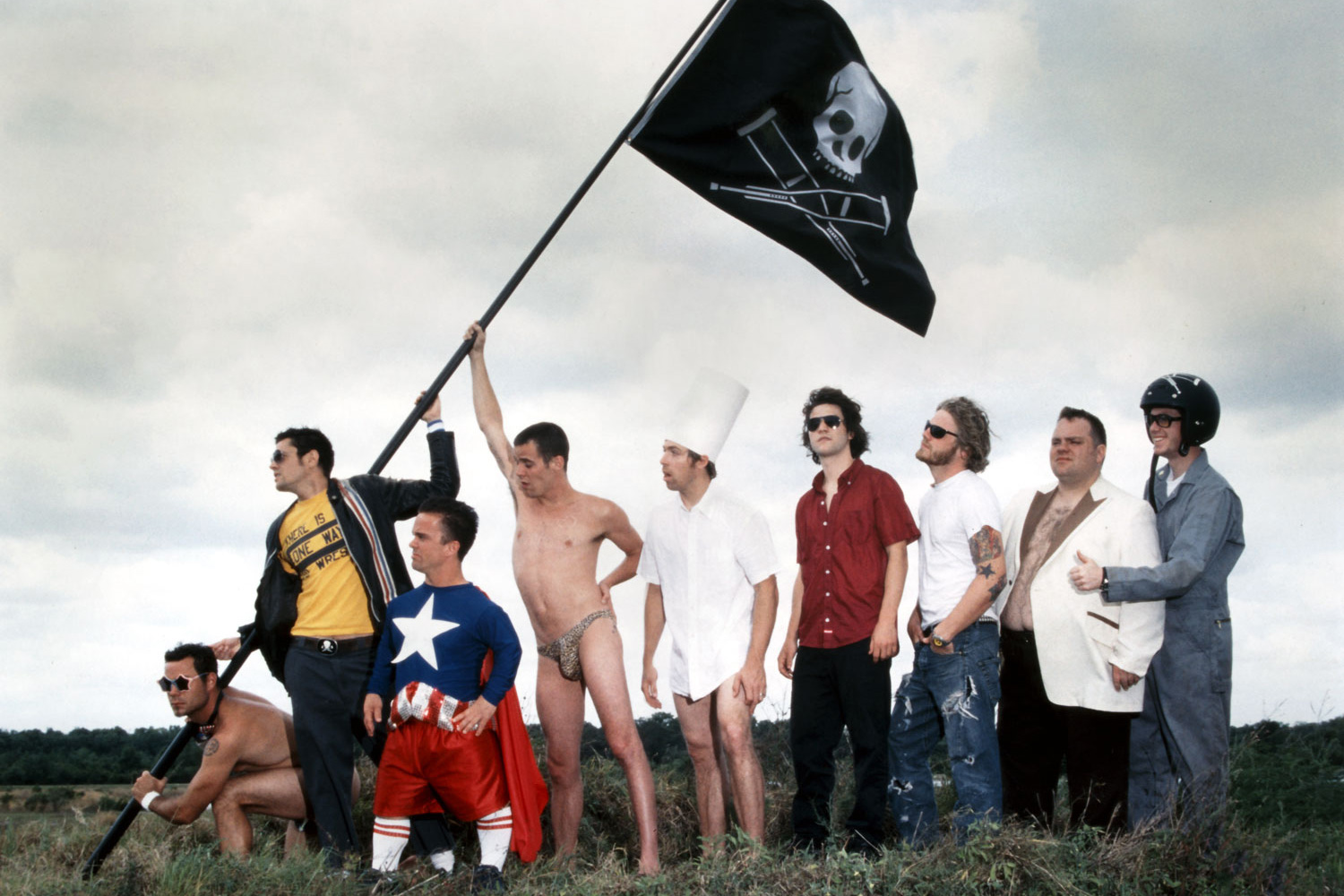
The crew from the Jackass movies, for instance, put their lives and limbs on the line, just to make a living entertaining us. Nothing they do is ever advisable, and certainly isn’t safe. But obviously they are doing what they love for a living, and those of us who find it entertaining are thankful they do. But if all we cared about was safety, nothing like that would ever exist. Thankfully, both the Jackasses and us viewers live a happier life, in some small part, because they do.
The Cast from Jackass
Yet these days, that concept seems to be lost on most Americans as we strive to put warning labels on everything, barricade our children into the house until they’re 18, pass laws to erase any ounce of danger in life (even if we’re only endangering ourselves), and generally destroy anything that is fun in the name of safety.
The whole point of freedom is the ability to do things that other people might not think you should do, but so long as you’re not hurting someone doing it, you should happily be able to do so with no impediment from government.
Whether it be currently legal activities like skydiving and/or road racing, or things currently illegal like using recreational drugs, gambling, hiring a prostitute, or all of the above. It’s your life, you should be free to live it as you see fit.
As with most all things, we’re dealing with a simple trade off. You can lead a riskier life you enjoy more, but may die younger as a result. Or you can lead a more sterile life, live longer, but be miserable doing so.
After reading that last paragraph, you’ve probably thought about it and picked one life or the other for yourself. But here’s the thing that you should really think about. Whichever you picked, you have no right to dictate that someone else pick the same for themselves.
If you opted to go the Evel Knievel route, great! Have fun and good luck. The funny thing about such daredevils, is that they rarely, if ever, try to force that lifestyle on you. Some of them do their shenanigans in public and risk the populace around them, which I would never condone—that’s criminal, violates the rights to life of others, and they rightfully should be locked up.
Evel Knievel Crash – Wembley Stadium
But at the opposite end of the spectrum, those who think risk-taking is always bad and avoid them at all costs, love to vote on legislation to ensure you lead their sanitized lifestyle.
It can be something as benign as a helmet or seat belt law, or as intrusive as the aforementioned drug, prostitution, or other vice laws.
If you know a few friends who like to sit around and get high; you know they rarely if ever, hurt anyone. So how is it the business of anyone else if they do that to themselves? I know it’s popular opinion among those who aren’t around such people, mostly based on folklore, that people who sell or use drugs are violent killers, but most are just trying to pay a few bills, and escape the miseries of life peacefully.
While Hollywood paints prostitution to be a crime ridden enterprise, the fact is that many of the consumers are just lonely guys, maybe not very attractive, who want to know what it’s like to be with a beautiful woman, and often treat the providers fairly respectfully.
Here’s where the illegality part becomes the problem. If the consumers are abusive, the laws against prostitution actually work against the victims, because they cannot call the police to help them without admitting they were engaging in prostitution.
Some areas stipulate police cannot check a person’s immigration status if that person calls the police to report a crime, because we want those people to report those crimes without fear of deportation. Yet somehow, if someone’s rights are violated during a vice encounter such as drugs or prostitution, now the same legislators don’t seem to care.
It’s rather hypocritical, quite immoral, and nearly unconstitutional to worry about the rights of someone who isn’t a citizen, yet care less about the rights of someone who is, just because they were engaging in behavior you think is wrong.
So I will always argue that America should be safety second, and enjoy your life to the fullest should be the resounding first.
On a recent episode of Stossel, Neil Sroka; the communications director for Democracy for America came on the show. He is an ardent supporter of Bernie Sanders, and his ideals of democratic socialism.
Here’s a transcript of a portion I’d like to discuss. I’m not going to type out the entire interview, but since this was the first real question, there was indeed nothing preceding it that would leave you missing any context.
John Stossel – Fox Business Network
Stossel: Now socialism generally means that the government owns the means of production. Do you want that?
Sroka: Well, I think there is [sic] some antiquated views about what socialism is. I don’t think anyone’s calling for, you know, state ownership of the gas station down the street. But what we are saying is, is [sic] that the current system that we have right now isn’t working. Uh, you know, when over 40 million Americans are still living in poverty at the same time that, you know, a millionaire and billionaire class is trying to essentially own all political discourse in this country, that [sic] that’s problematic. And that’s what we have to work together to dismantle.
John did a pretty good job of debating the issues with Neil, I don’t need to belabor those further here.
But one thing that is often repeated that wasn’t addressed in the interview, is a claim by many on the left (and the right for that matter); the notion that whatever “it” is in America, “it” somehow isn’t working or is broken.
The United States of America is the single most powerful nation in the world—by a wide margin. Not just in military force, but in economic force.
Misleading Statistics
Neil argued that there are over 40 million people (It’s 45 million, in fact) under poverty in America, but that number is a bit misleading.
Neil isn’t ignorant when he uses that number, it’s such a large number, it sounds horrible—giving it quite the shocking impact.
While I feel for such people (I am almost one of them, so I really do feel for them), they are at the bottom 15%, and aren’t even close to the majority. Poverty is always a problem for people, and I don’t deny that. But America doesn’t have a poverty problem, I’d argue that the large majority of people under poverty have a personal problem—they’re not doing what is needed to get themselves out of poverty.
Still not convinced? Think about this. Imagine a random seven people you might meet on any given day. Then consider whether you think at least one of them, on average, is not really putting forth the kind of effort needed to be successful enough in life to be above the poverty level. I genuinely don’t feel like that’s a stretch by any measure.
In 2007, Obama didn’t start with a lot of money when he initially ran for president either. Hillary was the one with all the money behind her at the onset of that election cycle.
Presidential candidate Sen. Bernie Sanders, I-Vt.
Socialists like Sanders like to create a cause-and-effect argument between money spent, and elections won, as if the money came first and drove the election results.
But it’s also entirely possible that instead; the money follows the person with the best ideas, and is therefore the effect versus the cause, which seems to be the case with Obama versus Clinton in 2007; assuming we can agree Obama is more charismatic and interesting than Hillary Clinton, and I think we can.
Stating that the system is broken and doesn’t work, appeals to people who are driven to have more, by exploiting the human tendency for confirmation bias. Americans know subconsciously that America is a strong and powerful economic nation. But many of these socialist supporters are unhappy with their own lives because of whatever their shortcomings might be, and it hurts to think of yourself as worse than average in any way.
So when someone points out that the system is broken, it gives such people a way to argue that their own inadequacies aren’t their problem after all; society, corporations, or rich people are actually to blame—just ask that guy.
So unless those of you in that $30k bracket or higher, who are behind socialists like Bernie, are ready to give up 80-90% of your salary to the rest of the world as many socialists suggest the richest 1% in American be forced to give to the rest of us Americans, you are indeed, quite the hypocrite—congratulations and #FeelTheBern.
So much so, that Google hired him as their futurist, to help guide their own corporate endeavors in the direction Ray predicts the future is going.
Ray’s singularity prediction is rather interesting, because what he’s ultimately arguing is that because of the advances in memory technology, computers will meet the human brain’s computing power in this time frame.
While I don’t profess to have the knowledge Ray has, one thing I would like to point out, is that humans are not just a product of our memory, we are also a product of our intellect. Let’s look at how we’re different from computers, as an example.
Kim Peek – Autistic savant; the man the movie Rain Man was based on.
Imagine a Microsoft Excel spreadsheet, with 1,000 rows and columns in size. Your computer remembers them flawlessly; every single character, like a mechanical Rain Man.
But ask a human to do this feat, and nearly no one can. So the argument that computers haven’t caught humans yet is somewhat misleading.
The average human brain has about 100 billion neurons, and many more glial cells. If we think of neurons as computer bits; the smallest level of computer memory, or the thing that is actually a one or a zero; then we can extrapolate how much memory a computer must have to match the human brain.
Four computer bits make a byte, 1,024 bytes make a kilobyte (KB). This 1,024 successive unit pattern then progresses as follows: megabyte (MB), gigabyte (GB), terabyte (TB), petabyte (PB)…and the list goes on.
This means, that the human brain has about 12.5 gigabytes of memory in the neurons alone. Add in the glial cells, and that number grows by at least double, since there are more of them. The above link references that opinions vary wildly about the real storage capacity of the human brain, but put it somewhere between 1 to 1,000 terabytes, the latter of which seems awfully high to me based on the number of neurons.
But the point I think that is missed in Ray’s hypothesis is that where computer memory is virtually flawless, the human brain seems to have mastered what it should and shouldn’t forget in a rather advantageous way. Where the human can’t remember the aforementioned massive spreadsheet data, it makes up for in its ability for inferring things not provided to it. This being the difference between memory (or knowledge), and computing power (intellect).
It’s this human ability to forget, that actually makes it better at processing information. For instance, you might talk to a co-worker all day, and entirely forget what color their shirt and pants are. Why? Because your brain has developed the ability to know that’s not important information, and immediately dumps it into your brain’s recycle bin.
But if your co-worker misspells a word in an email, your brain doesn’t crash and end its comprehension of the data like a computer might. Instead, you quickly understand what was inferred.
The fact is that there are computers with 1,000 terabytes, or nearly one petabyte already; they have the brains memory power. And one look at IBM’s Watson on Jeopardy, shows you that computers can already beat humans in knowledge alone quite easily.
IBM’s Watson
So how is it that a computer could beat Jeopardy’s best competitors, yet still cannot replicate human behavior?
One point to remember is that computers are digital, whereas the human brain is analog.
For instance, think of today’s modern digital cameras, which store a massive amount of mega pixels. We marvel in how much memory they can store, yet an analog camera from 50 years ago, effectively stores more, because it isn’t storing it digitally, as ones and zeros, but instead, as just one big picture on a film. Effectively, each molecule of film is one pixel, and that’s a significantly higher amount of data.
Blow up a digital picture, and eventually, you will see it displaying in its smallest constituents (pixels).
Example of a normal digital picture, when blown up, showing the individual pixels.
But if you blow up an analog picture, it never pixelizes, it just becomes so small of an area you can no longer make out what it is.
It’s this difference between analog and digital, that makes Ray’s prediction so uncertain for me. While he may be right, as long as computers rely on digital memory, I’m not convinced they’ll ever be on the level of humans. But instead, machines, and natural life, will always be somewhat separate.
A complete overhaul in the way computers memorize and process information will be needed, not the Moore’s Law doubling of memory in the digital realm.
But it is also worth noting, that Moore’s Law is inappropriately named. It is not in fact scientific law, nor even scientific theory, it is simply something Moore noted, and a pattern that has simply been repeated over the last 50 years, but is not by any stretch going to continue for eternity.
As the Journal of Nature reports, after fifty years, it may indeed be starting to break down. Whereas actual scientific law, such as gravity, and Isaac’s laws of motion; Moore’s “Law” almost invariably must fail at some point, once a transistor has been shrunk to its smallest level.
Speaking theoretically, a transistor, having two states (on and off), if it were shrunk down to one atom, with either one or two electrons depending on whether it’s “on” or “off;” making it smaller would likely prove impossible, and in that moment, Moore’s Law is no more.
Do I believe Kurzweil is crazy? Heck no, the man’s a genius. Do I believe he’s wrong? Not necessarily. More than anything, I would love to ask him about the things I pointed out, and just have an amazing discussion with an amazing man.
Instead, what I’m offering is that you should always be skeptical, and question everything. Whether it’s someone you respect and consider more brilliant than you, or someone you suspect is more likely to be wrong than you. It’s how you learn, and occasionally, it’s how they learn as well. Even the smartest of people can over-analyze something, and miss a simple key aspect, a lesser mind might have caught.
log·i·cal: capable of reasoning or of using reason in an orderly cogent fashion lib·er·tar·i·an: an advocate of the doctrine of free will; a person who upholds the principles of individual liberty especially of thought and action

![13432228_1052807718107590_6392247220183571472_n[1]](https://logicallibertarian.com/wp-content/uploads/2016/06/13432228_1052807718107590_6392247220183571472_n11.jpg?w=300&h=198)


![Princeton-University[1]](https://logicallibertarian.com/wp-content/uploads/2016/06/princeton-university1.jpg?w=280&h=198)
![Terrorism11[1]](https://logicallibertarian.com/wp-content/uploads/2016/06/terrorism111.jpg?w=474&h=490)
![Terrorism10[1]](https://logicallibertarian.com/wp-content/uploads/2016/06/terrorism101.jpg?w=474&h=360)


![fda_sign_web_14_0_0[1]](https://logicallibertarian.com/wp-content/uploads/2015/04/fda_sign_web_14_0_01.jpg?w=300&h=168)



![2000px-Mutation_and_selection_diagram.svg[1]](https://logicallibertarian.com/wp-content/uploads/2016/06/2000px-mutation_and_selection_diagram-svg1.png?w=300&h=272)
![tomato-plant[1]](https://logicallibertarian.com/wp-content/uploads/2016/06/tomato-plant1.jpg?w=201&h=300)
![g-CRISPR_web[1]](https://logicallibertarian.com/wp-content/uploads/2016/06/g-crispr_web1.jpg?w=474&h=542)


![road_runner[1]](http://image.rakuten.co.jp/marukawa7/cabinet/top3/road_runner.jpg)

![liver-cancer-profile-7[1]](https://logicallibertarian.com/wp-content/uploads/2016/05/liver-cancer-profile-71.jpg?w=474)
![ecc7d1d27275a4b9cb29cf31ea08780d[1]](https://logicallibertarian.com/wp-content/uploads/2016/05/ecc7d1d27275a4b9cb29cf31ea08780d1.png?w=300&h=137)