Category Archives: Logic & Reason

Anti-War ≠ Anti-Self-Defense

Imagine a libertarian in the United States. It’s midnight, and he’s sitting at home in his underwear, binge-watching Better Call Saul reruns when he hears the door knob rattling. He spots the silhouette of a suspicious figure trying to gain entry. Is this person looking to rob the house, harm the homeowner, or who knows what?

So anyway, what does the libertarian do? He grabs his gun, which is basically required of all libertarians to own, and as soon as this miscreant steps an uninvited foot into our hero’s home, Captain Liberty turns him into Swiss cheese!

i-started-blasting-so-anyway-i-started-blasting[1]

Libertarians are staunch supporters of the Second Amendment and the right to bear arms because they believe it levels the playing field in potential combat situations between individuals.

In the pursuit of freedom, people must have the means to defend themselves using the tools available to them. While it’s possible the intruder is a 120-pound weakling with no weapon and minimal combat skills, our libertarian homeowner, clad only in his underwear, can’t afford to take chances. He must prepare for the worst and ensure that he’s in the best possible position should a confrontation ensue.

As someone who identifies philosophically with libertarianism, I agree with this sentiment entirely. I own several handguns, which I have placed strategically in my home and cars in case someone hurts my feelings. I’ve never drawn down on anyone, but if me, friends, or loved ones are threatened, I’ll do my best to end the threat.

Contrast all this with another tenet of libertarianism—the peacenik. Someone who is staunchly anti-war. How can one support owning a gun as a right, but still be all about peace?s-l1600[1]

I’d like to think most people understand that being anti-war doesn’t mean anti-self-defense. Many reasonable libertarians agree the country should have a military prepared to defend our nation, in the same manner as they personally might be armed in such a way to defend their home.

The issue I’m raising here, is about being unprepared.

Today, we face potential threats from Russia, North Korea, and China, and the specter of a catastrophic conflict looms, especially if nuclear weapons come into play.

This scenario seemed very unlikely 10-15 years ago. Even President Obama seemed oblivious to the idea Russia could be a threat. Remember this debate where he degraded Romney’s opinion on Russia?

This issue is where I often find myself breaking with ideological libertarians, because as someone who places logic & reason over ideology, I think being prepared for the worst-case scenario, is the wisest thing to do.

I also oppose wars of aggression. We shouldn’t be attacking others who weren’t threatening us or our allies. However, it’s naive to assume that we won’t face a serious threat at some point. We must ensure we’re fully prepared. If attacked, we should respond with overwhelming force to swiftly end the conflict. Appearing weak and easily exploited is not a winning strategy.

Those who were around during the Reagan era, might recall the talk of a Strategic Defense Initiative (SDI) program, also known as “Star Wars.”Strategic Defense Initiative SDI Star Wars

To say this program was ambitious, would be an understatement. I won’t try to explain how this system worked entirely, but it was multi-faceted, expensive as hell, and involved things like space lasers.

Reagan felt nuclear weapons were inherently immoral, and that eliminating the threat of them from Russia at the time, was in the interest of all mankind.

But as the Berlin Wall fell, and Russia became our BFFs, the need for such initiatives was considered obsolete. So spending on such technology was thought to be frivolous and wasteful.

Many libertarians go a step further and bash military spending almost entirely, using derogatory terms like “bootlicker” for anyone who disagrees with them.

Such insults hinder productive debate and reveal a lack of intent to discuss the topic fairly. We can acknowledge instances of wasteful military spending while recognizing the importance of maintaining a strong defense against existing threats.

While it’s true Russia and China were largely friendly to the United States between Reagan’s tenure and now, we find ourselves in a position of defending Taiwan and Ukraine, and in so doing, being under threat of nuclear attack from countries we thought were our friends.

APTOPIX Russia China
Russian President Vladimir Putin, right, and Chinese President Xi Jinping pose for a photo during a signing ceremony foillowing their talks at The Grand Kremlin Palace, in Moscow, Russia, Tuesday, March 21, 2023. (Vladimir Astapkovich, Sputnik, Kremlin Pool Photo via AP)

We should all be able to agree there are instances of large wasteful spending on the military. Especially when it’s for a weapon the military says it has no need for.

But being anti-war should not mean cutting spending in such a way as to make ourselves vulnerable to an existing threat.

While China and Russia were becoming rather friendly with the US, they weren’t exactly eliminating their nuclear arsenal—the threat was there the whole time.

Ronald Reagan was right that the best thing we could do for the future of mankind, was to find a way to make such weapons “impotent and obsolete” as he put it.

Libertarians are correct to oppose wars of aggression. But just as they keep guns to protect themselves from unlikely threats—it would be hypocritical to think the US and our NATO allies shouldn’t advance technology to eliminate the threat of other nations, even from those we currently consider friendly.

The free world should understand that Oppenheimer and company opened Pandora’s box of human mass eradication, and working towards systems that can neutralize that threat is spending that shouldn’t be criticized nearly as much as it is.

Robert Oppenheimer
Robert Oppenheimer 1956 by Yousuf Karsh

We are on the brink of human extinction from not one, not two, but two and a half dictators (I’m not elevating North Korea to the level of Russia and China). While they were friendly once, the threat never fully went away, it was just our resolve to prepare for it that did. That lax attitude could end us all.

Our current defense systems are thought to be about 50-60% effective at stopping such weapons from hitting their targets. That’s not good.

If we were to face a nuclear catastrophe at the hands of Russia and China, it might have been preventable had we stayed vigilant. Remember the old adage: Si vis pacem, para bellum – if you wish for peace, prepare for war.

Your Feelings Probably Aren’t Valid

In today’s world, a prevailing theme centers around the belief that everyone’s feelings are valid. The underlying message is clear: people are constantly grappling with emotional struggles, and the outdated advice to “suck it up and tough it out” is not only misguided but also detrimental to society’s collective mental well-being.

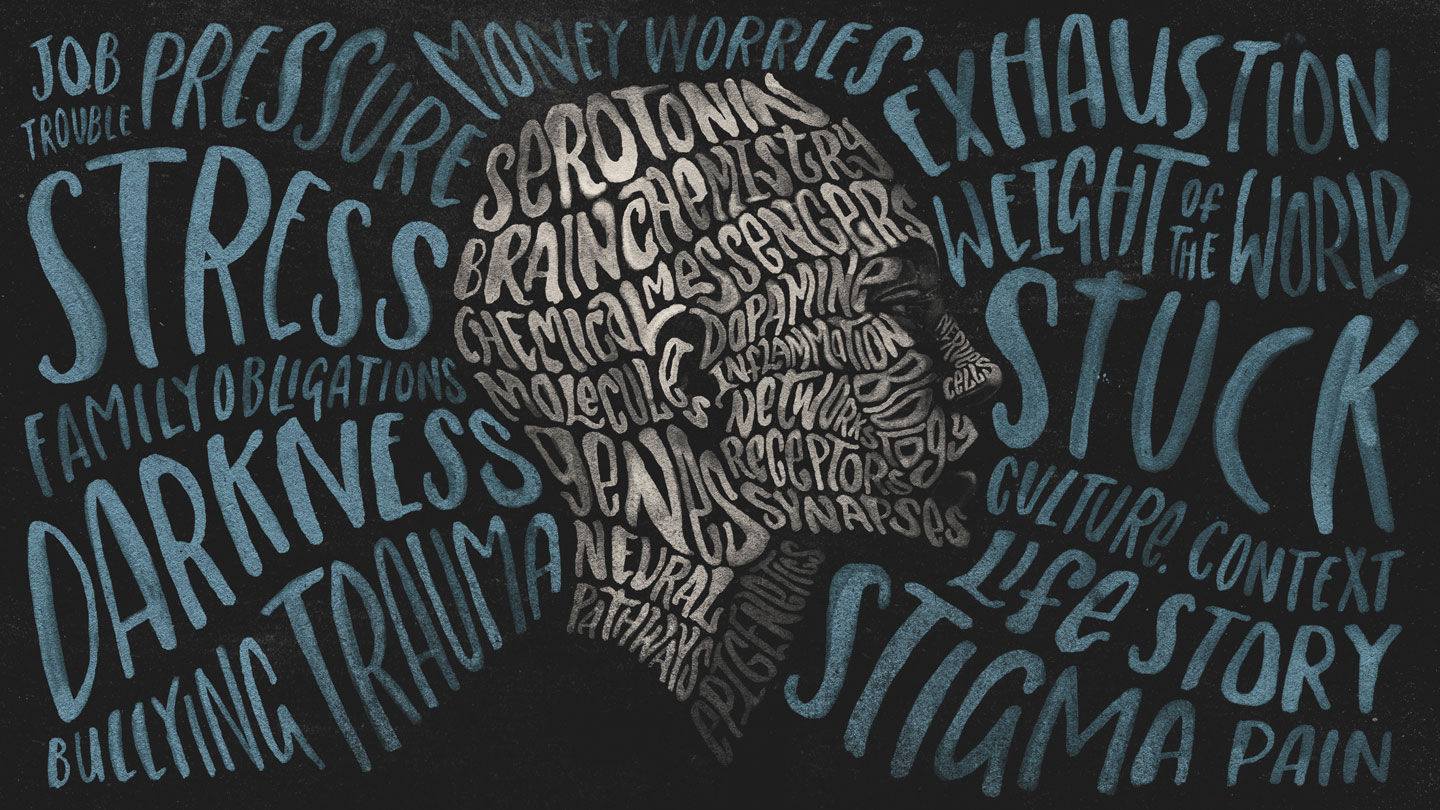
Things like clinical depression, and other depressive disorders can’t just be prayed or willed away. They are the result of something gone awry within the network of our minds, and should be treated with sympathy and science, not dismissive attitudes.

Families and friends alike should be more inclined to ask how their loved ones are doing. Not just out of politeness, but instead, out of a desire to help—to be an outlet for someone they care about.

But it’s important to do it in a way that’s helpful. It shouldn’t have a “suck it up” tone, nor should it be a deflection such as suggesting you both go get drunk. Let them know that you care about them, and you’re willing to listen and/or help—full stop.

This approach mirrors the fundamental principles of therapy practiced by psychologists, where empathy and understanding are paramount.

Yet, amid this push for acknowledging feelings, it’s essential to recognize the fine line between validating emotions and enabling harmful beliefs. Telling someone their feelings are valid implies that their emotional response aligns with the situation they are confronting, even when this may not be the case, especially for individuals dealing with disorders such as bipolar disorder.

The potential pitfall of validating feelings is akin to committing a logical fallacy known as the Strawman Argument.

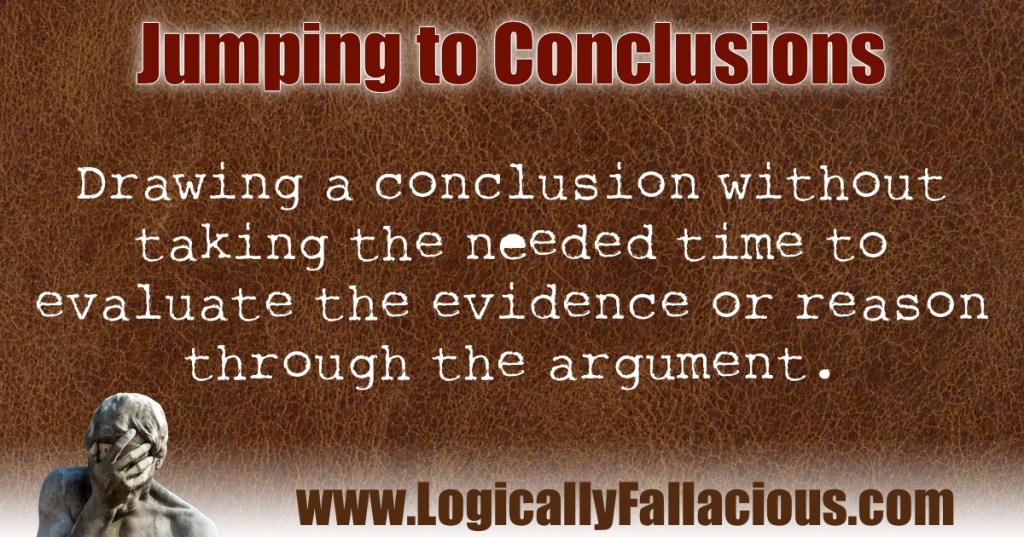
A logical fallacy is an argument someone uses that suggests one thing MUST lead to another, when that isn’t true. This fallacy arises when an argument misrepresents someone’s position to make it easier to attack.

In the case of a straw man argument, an example would be if I say, “I like Coca-Cola.” Someone who hears this responds, “Oh, so you hate Pepsi? I can’t trust anyone who hates Pepsi.”

The issue should be obvious that in my statement, I didn’t even mention Pepsi. It’s entirely plausible I like both.

Yet the person arguing against me made an assumption that I hated Pepsi, and argued against that “straw man” of my argument, instead of my actual argument that I simply like Coke.

Make sense?

So why does this mean people’s feelings aren’t valid?

Imagine we meet someone who seems really depressing and cold to talk to. Our feelings might lead us to believe they’re a jerk. Now imagine, we find out this person just got news that they have terminal cancer. Do we still feel that they are a jerk, or do we now realize that we’ve misread the situation?

The fact is, too many of us make assumptions based on far too little information, because it’s uncomfortable feeling like we don’t know things. We think it would mean we’re stupid. So we make up our minds before having even remotely enough factual information to fairly do so.

Through these exercises of jumping to conclusions through false assumptions (the equivalent of straw men), we develop feelings that are often invalid. What’s worse is we often get those invalid feelings reinforced by a society that tells us our feelings are always valid.

We see this play out with people who have taken offense over something. If we are offended at someone, it should be based on the idea that they’ve been disrespectful to us or others.

But being disrespectful requires intent. It is an act of knowing someone wouldn’t like something, and yet doing it anyway. But what if the person who did the thing that offended us had no clue we’d find it upsetting. Maybe they thought we’d find it funny, or completely benign. Were they disrespectful to us? We shouldn’t be able to accidentally disrespect someone, that’s not how any of this works.

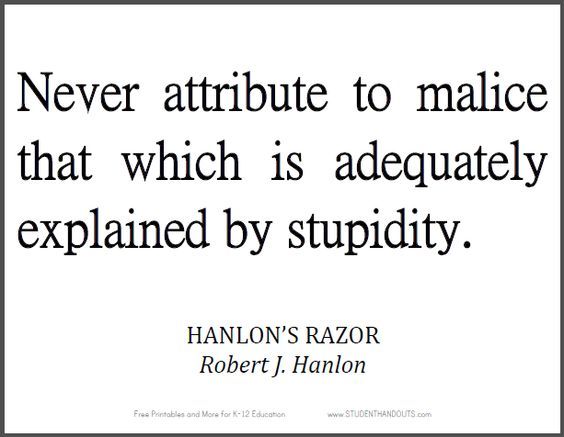
Hanlon’s razor is a good thought on this subject. It says,

The point being, next time we see someone on the internet upset about how disrespectful someone else was, we should first consider whether there’s an explanation that isn’t disrespectful, such as they didn’t know better.

It’s also important to consider if it’s really something to be bothered by in the first place. Society has become obsessed with having reasons for outrage. It makes sense, because the more upset we are about something, the more attention we’ll often get.

It could be because people already agree with us on other stuff, so they don’t want to disagree with us now.

As much as I hate to say it, maybe we’re attractive and people want to hook up with us, so they’ll support whatever nonsense we’re upset about.

I would bet at least $107, if you put an attractive woman on the internet, and have her talk about how all the hate that’s directed towards Nazi’s is wrong, you’ll have a thousand guys respond with an argument as to why they agree, Nazi’s aren’t that bad, they just have a different opinion than the rest of us, and people should be more kind to them.

The point of my post is this. Next time we find ourselves offended or upset by the actions of others, we should take a moment to consider whether there is a scenario where this was innocent. If we can think of at least one, then assuming it must be the worst scenario isn’t fair of us.

One option is to assume the innocent scenario, but that may also be wrong.

A better option is to ask questions of the person if we’re able. This isn’t always doable if the person is famous, but if it’s a friend or an acquaintance, making the effort to ask, “What did you mean by that?”, could be the difference between a fight versus an respectful and interesting discussion.

One of the biggest errors humans make, is the false dichotomy. The idea that there are only two sides and we have to choose one of them.

Maybe an interaction between a cop and citizen goes awry. If we think blue lives matter, we might assume the cop is in the right. If we think cops are bad, we might assume the cop is a serial rights violator. But there are at least two other options.

It could be that both of them behaved poorly. Maybe the cop was being a jerk, but instead of trying to deescalate the situation, the citizen decided to antagonize the cop and ended up making it worse.

The best reaction however, is to simply accept we weren’t there, didn’t see it all, we’re likely missing some context, and thus shouldn’t choose a side at all. Instead, being 100% ready to accept new information if it comes to light is the best way to think.

So next time we find ourselves with excessive emotions, unless a loved one has just died, or a national tragedy occurred, there’s a good chance our feelings aren’t as valid as we think they are. Especially if those emotions are us taking offense at something.

We are responsible for our emotions, not others. It’s up to us, to learn to let stuff go instead of stewing in a cauldron of rage which we lit the fire under.

Sometimes, we will benefit from just taking the time to analyze the situation with questions like:

Is this something I’m going to care about tomorrow?

If there another explanation for this that isn’t offensive?

Do I know this person intended to be disrespectful to me?

What role did I have to play in this situation going badly, and could I have handled it better? (Self-awareness)

Being full of rage requires a lot of concentration on that rage. The mere act of asking ourselves questions as I outlined above can often distract us from our rage, and push us onto a new set of train tracks from the rage train we were on, to one of emotional mastery. Not to mention the friendships we might save along the way, leading to happier and healthier lives.

Framing and Perception: Using Skepticism to Avoid Being Deceived

We’ve all heard the expression there’s two sides to every story. It implies that one side is the truth, and the other side is lying. While that can be true, it can also be that both sides are right, and are both just leaving out crucial factors. It could be that neither side is right, and the truth is something else entirely. It could be that one side is right, and the other believes they’re right, but are simply mistaken. And most commonly, it could be a matter of opinion, and there simply isn’t a right or wrong in the first place.

The point of skepticism, is to be able to consume information in such a way that you are least likely to be deceived, or make bad assumptions. Thus leading to more intelligent decisions, and typically better outcomes for you. Let’s look at some examples.

In April of 2019, it was reported in several news outlets that just eating one slice of bacon can increase your risk of colorectal cancer by 20%. You can see one instance of this report from CNN here. CNN was not dishonest in this reporting, that data is true.

But when you click the actual study, and apply a little skepticism (and some math), you might look at it a little differently.

There were 475,581 participants in the study, and a mere 2609 case of cancer reported among all participants. So if one group is 20% higher than the other, that means it’s approximately 45.4/54.6 split (45.4/54.6 = 120.2%, or 20% more).

54.6% of 2,609 = 1,425 (0.29% of the total group)

45.4% of 2609 = 1,184  (0.24% of the total group)

So while 1,425 is indeed 20% more than 1184, out of the total group or people observed (475,581) a mere 0.55% contracted colorectal cancer. A total of 241 more were the bacon eaters, or a mere 0.05% overall increase (0.29% vs 0.24%).

An almost entirely insignificant 0.05% or 241 out of 475,581 people doesn’t sound nearly as scary as 20%, does it? But scary sells news media, and journalists are rarely scientists.

This problem isn’t entirely about science, because you can apply these same skills to a myriad of things you’ll read or see in the media.

Imagine a news story we’ll call statement A with a headline that reads, “Woman courageously does all that is needed to put food on the plate for her child.”

Female Shoplifter

But then imagine a different news outlet runs a different headline we’ll call Statement B that reads, “Woman fired for drinking while at work, stole unhealthy snacks and booze from a grocery store.”

Statement A makes her sound like a hero, but Statement B tells a very different story. Both can be 100% true, but the context changes how you feel about the story entirely.

The point of all this are to make you think about any news story you read, and maybe think about changing the way you consume information. So here’s a couple of ideas on how to improve how you consume information.

  • Avoid click-bait headlines from sources you’ve never heard of, or that you know are openly biased. You know they’re all almost entirely bullshit. So why waste your time on them? The good ones will link to credibly sources, and you should click on those to read the whole story, if you do go down that road. But in general, if people stop clicking on clickbait, the people doing it will respond to the lack of demand for it, by ceasing to make it.
  • Read the article and not just the headline. Even reputable sources have resorted to click-bait headlines just so you’ll read their stories over the nonsense from non-reputable sites. You’re missing a lot of context and nuance if you don’t read the story. Not to mention, you look silly when you add your own comment that clearly shows you didn’t read the article.
  • Any story that says something like, “The such-and-such that such-and-such doesn’t want you to know” or “Person A destroys person B” is bullshit. All of it. Like every single one of them.” Stop sharing that nonsense. Seriously.
  • If you see a story and it seems pretty amazing, but you aren’t seeing it on reputable sources, I assure you, some podunk website did not scoop Reuters or AP. It’s bullshit that they didn’t vet properly, or worse, that they just made up.
  • Check a second source. This one is huge. If you see a story on a site that’s kinda reputable but not great, look for it on a site like Reuters or AP. If you confirm from multiple reputable sources, then it’s probably true. But if it’s multiple sources with the same bias, you should probably still avoid it.
  • Think about what’s being said in the story, and could there possibly be another way of looking at it.  For instance, if I told you France gets 75% of its energy from nuclear, where the United States only gets 20%, you could easily assume that France is a leader in nuclear energy compared to the United States. But if I told you France has 58 nuclear power facilities whereas the United States has 98, you’d think the US is the leader. Both are true, but both tell a different story. So it pays to dig into the data when you can, and form your own opinion based on all the information.

    Nuclear Power Plant Emits Only Water Vapor

Hopefully this helps you think about how to consume news differently, and prevents you from being that embarrassing friend on social media always sharing bullshit articles everyone but you seems to know isn’t true. You’ll thank me later. 🙂


The Myth of the “Militia” clause in the 2nd Amendment

Gary Nolan (and THE Scrappy Doo)

A well-regulated militia, being necessary to the security of a free state, the right of the people to keep and bear arms, shall not be infringed. ~ 2nd Amendment to the US Constitution.

Nothing seems to evoke more passion from either side of the political aisle than the 2nd amendment to the U.S. Constitution. People on the Individual-Right side of the fence often cite the “shall not be infringed” clause, but those who wish to limit or eliminate the individual right to bear arms often cite the “well-regulated militia” clause.

Former ACLU Leader and Mathematics Professor Ira Glasser

The anti-individual-right argument being that the framers meant for Americans to be able to form militias to protect the people or the country, and those militias would need to be armed. This sentiment has been echoed by such noteworthy Civil Rights leaders as former ACLU head and mathematics professor Ira Glasser, which he discussed at length during the March 2nd, 2018 Comedy Cellar podcast. (click to listen)

NYC Comedy Cellar

Side Note: Don’t be fooled that the podcast is from the Comedy Cellar. Owner Noam Dworman is quite fond of discussing politics, and is incredibly thoughtful, fair, and insightful on the subject.

Oddly, the person who got it right (IMO), contradicting Ira Glasser, was Noam’s co-host, comedian Dan Naturman, who often describes himself as left-leaning. Dan does possess a law degree from Fordham University, and Noam studied law at the University of Pennsylvania, making them the only people trained in law involved in the discussion, not Glasser.

While Noam Dworman tends to seem centerist, he understandably felt the need to defer to Glasser’s judgement, since his work with the ACLU would seem to assert Glasser would be the more knowledgeable person in the room—but on this issue, he just wasn’t.

29zZnh0j[1]
Comedian Dan Naturman
The argument the anti-individual-right group presents seems pretty sound on the face of it, but there are several flaws with this line of thinking, making it unarguably incorrect.

But let’s break down the flaws of these arguments one by one.

THE CONTRADICTION

The first issue is that it is entirely contradictory with the rest of the Bill of Rights.

The Bill of Rights was drafted, not as a set of laws for the people to heed, but instead, limits set on government as to how government may restrict the people’s individual rights.

The Bill of Rights Institute writes:

The first 10 amendments to the Constitution make up the Bill of Rights. James Madison wrote the amendments, which list specific prohibitions on governmental power, in response to calls from several states for greater constitutional protection for individual liberties.

So if the 2nd Amendment was drafted to allow the establishment of militias, and was not meant as an individual right, it would be inconsistent with the other nine amendments.

Our founding fathers believed you have inalienable rights by virtue of existing, and they cannot be taken from you. They don’t come from government at all—the founders of our country were very clear on that when they wrote the Declaration of Independence.

We hold these truths to be self-evident, that all men are created equal, that they are endowed by their Creator with certain unalienable Rights, that among these are Life, Liberty and the pursuit of Happiness.

The Bill of Rights places limits on what government may do, not establishes the formation of government entities. Those things are laid out in the first portion of the Constitution. But it also is written with the intention that the power comes from the people, not government.

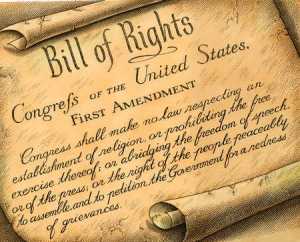
The 1st Amendment
The 1st Amendment

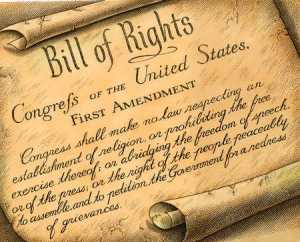
For instance, our first amendment states “Congress shall make no law respecting an establishment of religion…” versus something like “You are free to practice any religion of your choosing.”

This pattern is consistent throughout the Bill Of Rights, and while most see both those phrases as essentially the same, there’s an incredibly important distinction. As the Bill of Rights are written, the people have the power and are imposing a limit on the government’s ability to limit their religious freedom. In the second theoretical example, it implies government has the power and is granting religious rights to the people.

So now that we understand the Bill of Rights (it’s in the name, for Pete’s sake) establishes rights of the people, not of government, and thus contradicts the idea that the 2nd amendment was meant to help local militias to form, let’s move on to issue #2.

THE MEANING OF THE WORD MILITIA

The meaning behind the word “militia” in the second amendment.

If we assume the term “militia” refers to local military and police, which are government entities after all; the people arguing the 2nd amendment was set up to allow local governments to establish militias comprised of the people believe our forefathers wrote an amendment that says that government cannot infringe on government’s rights to bear arms. This is not only inconsistent to the rest of the Bill of Rights, which guarantee individual rights, but its redundancy is nonsensical. If government cannot infringe on government’s rights to carry guns, then there would be no reason to even mention it in the first place.

The militia clause does refer to government, but not just local governments, it means any government. It wasn’t a right of the militia, it was a limit on it. This will make more sense as we move on to the next issues.No_gun[1]

THE MEANING OF THE WORD REGULATED

The third important issue people get wrong with this, is believing “well-regulated” is synonymous with “well-organized.”

Merriam Webster defines “Regulate” as:

A: to govern or direct according to rule

Bto bring under the control of law or constituted authority

If the people arguing it was meant to set up militias were correct, “well-organized” would have been a more proper wording. But instead, the only logical interpretation was that they meant for the militia (the armed wing of government) to be controlled or regulated. They believed the way you do this, is to prohibit government from disarming the public as the British tried to do before the revolutionary war broke out—arguably the prime motivation for the 2nd amendment in the first place.

WHAT IS BEING PROTECTED?

The last issue with the anti-individual-right argument is what it argues is being protected. The incorrect argument is that it’s protecting a country (state) which is free. But the reality is it is protecting freedom itself, ensuring the state remain free. You’d have to deny nearly all of America’s founding history to believe that freedom wasn’t at the core of everything the founding fathers did. Freedom was always more important in their minds. Far more important than the state.

ANOTHER WAY TO WRITE IT

With all that in mind, let me reword the amendment in the way it was intended using language that is maybe more understandable in today’s vernacular.

In order for the people of the United States to remain free, the militia shall be kept under control by the people of the United States who have the right to keep and bear arms.

This is precisely how the amendment was intended, and the only interpretation of it which cannot be easily challenged.

Click here for several quotes by the founding father’s to bear out this claim. It was painfully obvious that they wanted government to fear the people, as many of them specifically wrote.

They knew government will always be prone to becoming bloated and oppressive. And while a government can pass a million laws, those laws have no teeth if there is no militia to enforce them. So in order to keep that government, specifically its enforcement wing (the militia) well-regulated, the people should be armed as well. This way, the government (and militia) always have some level of fear from the people. It’s the only reason to use the word “regulated” that makes sense.

The United States Supreme Court in 2008 with District of Columbia v. Heller held it is an individual right saying the following:

The Second Amendment protects an individual right to possess a firearm unconnected with service in a militia, and to use that arm for traditionally lawful purposes, such as self-defense within the home. (click for entire transcript)

This opinion, being current precedent, effectively settles the argument for now.

IS THIS IDEA OF THE GOVERNMENT FEARING THE PEOPLE EVEN REALISTIC NOW?

Since the United States Military is infinitely more powerful than its armed citizens, many argue the point becomes moot, since we “the people” couldn’t possibly fight them. Which in a narrow scope might seem accurate, but again, if you apply a little skepticism, it isn’t.

While it’s true, the U.S. military’s might is overwhelming—it’s arguably more powerful than nearly all the rest of the world’s military’s combined.

But, they’re still given orders by an elected government. When the military kills the citizens, it usually isn’t well-received by the people who voted for them, threatening their re-electability.

It’s also important to remember ours is a voluntary military comprised of the people, and thus aren’t likely to murder their brothers and sisters for no good cause.

But we actually have evidence it can work.  Nevada Rancher Cliven Bundy, and a large group of supporters showed up armed to the teeth to fight the federal government over a land dispute. No shots were fired, perhaps in remembrance of the Waco Texas incident, and the federal government did back down. Those armed citizens, in this modern era with our massive military prowess, did precisely what the 2nd amendment was designed to enable, they fought the law, and the law didn’t win.

So why do gun control advocates believe this is what the 2nd amendment implies? It’s likely a simple case of confirmation bias—a phenomenon whereby someone attempting to prove something they hope to be true/false, eschew interpretations that conflict with their bias and/or accept suspect data that supports their bias, due to an inner desire to substantiate their argument.

We are all prone to do this, and with the exception of devout skeptics like myself, we’ll rarely even know we’re doing it, nor act to correct it.

Some may have come to these beliefs due to their own life experience. For instance, former US representative Gabby Giffords who was brutally shot in 2011 by a crazed killer on an unhinged political shooting spree, or former Reagan White House Press Secretary James Brady who was shot in a failed presidential assassination attempt.

Their lives were forever changed because of gun violence, so it’s quite reasonable to assume they would advocate limiting our right to bear arms. And when people have been forever affected by senseless gun violence, it behooves all of us to respect their trepidation in respect to lax gun laws. We haven’t walked a mile in their shoes.

James Brady & The Reagan Assassination Attempt

But apologies to those who wish to limit our rights to bear arms, and believe the “militia” clause supports your argument. If you want to argue against gun rights, using the “militia” argument, it just isn’t consistent with the rest of the Constitution, and you’re unfortunately misinterpreting the clause.

Famous People and Their Causes

This may surprise you, but famous people have opinions. Gwyneth Paltrow believes a jade egg shoved in a woman’s hoo-hah somehow makes her healthier (click the link, because it doesn’t).

A large majority of Hollywood believe Trump is basically satan, and many black athletes have taken a knee during the national anthem because they believe the police are too quick to shoot a young black man.

Gwyneth Paltrow/Chris Martin and Family

When they have these opinions, being someone who is used to being in the spotlight, they rarely shy away from sharing their feelings on any given subject—using their bully pulpit to encourage others to follow their lead.

There are a few important facets to these expressions of beliefs that I feel are worth discussion.

First things first. They have a right to an opinion, and they should share such an opinion if they’re passionate about it. They should be shown respect for speaking out on something that’s important to them. Their success means that if it is a cause worth fighting for, they can shine a light on a subject that us non-famous people simply don’t have the ability to do.

I’ve seen the Twitterverse often have regular people telling athletes with an opinion on politics to “Just shut up and play (insert their respective sport here)”, or people tell British physics Professor Brian Cox, who’s quite vocal about Brexit, to “just stick to science.”

Professor Brian Cox

I understand why people might feel this way, since such famous people are not famous for politics, and thus not presumed to be experts on the subject. But politics isn’t science, it’s entirely driven by subjectivity. Meaning one person’s opinion is just as valid as another. And as a libertarian, anyone who speaks truth to power (even if I think they’re misinformed on what is truthful) is still doing something noble.

By all means, make the effort to correct them if you think they’re wrong on the facts, but people should do so respectfully, and applaud anyone with a voice for speaking out.

Phil Mickelson spoke out against California and its high taxes, and was blasted as being an elitist. So what! He’s earned his money with his work ethic. Most people will ever know how hard it is to be that good at anything, and I assure you it didn’t happen with a mere 9-5, 40 hours a week effort.

PGA Tour Golfer Phil Mickelson

Colin Kaepernick started a movement to call out when officers shoot unarmed black men, and little repercussions occur as a result, something we should all be bothered by when it happens. We can quibble over whether some of the shootings he rallied against were justified, some may have very well been, but it does happen nonetheless, and we shouldn’t excuse it.

But all that being said, people should understand that being famous doesn’t make you an expert and thus adds no additional credibility to their argument, versus your neighbor who may be espousing the same opinion, (unless they’re an expert in the field.)

So while we should not discourage them from speaking out with things like, “just shut up and play your sport” or something like that, please bear in mind that you shouldn’t be blindly following them either. You shouldn’t assume they’re in command of the facts, and that the information they provide is truthful. The only thing you could presume to be true, is that their heart is in the right place, and they mean well.

Just about every issue is way more complicated than any non-expert understands. So listen to what people say, but apply your own skepticism, and if you care about the issue, take the time to look up credible sources on the issue, forming your opinions based on them. Doing something, or believing in something because a famous person told you to, is irresponsible at best.

Logically Fallacious – The Misuse of Logical Fallacies

People who fancy themselves as intellectuals often take pride in citing someone’s argument for being a logical fallacy. While it’s good that people are aware of logical fallacies, and know the value of avoiding them in reasoned debate, it appears many know the words, but don’t necessarily understand what they so eloquently recite.

Logical fallacies are ways people make arguments, where they make a definitive statement, as if something must be true or false, when the argument may be either/or.

For instance, there’s the Tu Quoque Fallacy which translates to “you too” is basically that just because someone doesn’t do the thing they said you should do, doesn’t mean it’s invalid. For people not familiar with the name of this fallacy, they might simply argue someone is guilty of  “do as I say, not as I do” hypocrisy.

Imagine I advise you not to drink alcohol, citing all the health issues that go along with it. That is genuinely good advice. Even if I drink myself, it doesn’t mean it’s bad advice. So arguing that because I drink, it must mean that my argument that drinking is bad for you must be invalid, or I wouldn’t drink myself.

These are matter-of-fact statements which is what the tu quoque fallacy seeks to correct. However, it’s not applicable to subjective claims.

For instance, if I say that I believe drinking is immoral, and then I drink anyway, and someone criticizes me for it, they’re not committing the tu quoque fallacy, they’re just rightfully calling me out for being a hypocrite.

In the first example, I made a factual statement, the second example I shared an opinion.

Another example where logical fallacies are mis-attributed is when people assume the answer is binary, in that it must be true or false.

For instance, imagine I say that someone wants to legalize marijuana because they just want to smoke it themselves. That’s a logical fallacy, arguably either a Non-Sequitur, or a Strawman fallacy, depending on how it was presented, because it’s entirely plausible that such a statement is not true.

Click Image for more info

However, that doesn’t mean it is automatically false, either. And this is where many people who correctly cite the argument as logically fallacious go into their own logically fallacious whole, by assuming it must not be true.

What may be logically fallacious may still be more likely than not, or at least plausible. It’s just a logical fallacy because the person who made the argument, argued as if it must be true, which is false. It’s merely plausible.

So I applaud everyone for trying to be a better debater, or for educating people (and themselves) on logical fallacies. It’s just important not to go down your own logically fallacious hole doing it.

A Critical Look At Political Correctness, the Easily Offended, and Why We Should Change This Culture

Political correctness is a term that typically evokes annoyance and hatred from almost anyone who hears the term. Yet despite this nearly universal hatred for it, political correctness seems to be as pervasive as ever.

As an example, in 2017, the TV show Bates Motel, a TV adaptation of Alfred Hitchcock’s 1960 epic thriller Psycho, opted to rescript what is arguably the most famous scene in movie history. The story is about a man (Norman Bates) who suffers from multiple personality disorder. Aside from his own personality, he would also take on the persona of his mother, a psychopathic killer who would murder women she felt were immoral.

No Merchandising. Editorial Use Only. No Book Cover Usage.
Mandatory Credit: Photo by Moviestore/REX/Shutterstock (1622408a)
Psycho (On Set)
Film and Television

When Norman became his mother, he would often dress up as her, and in the original and now famous shower scene, where a young woman is stabbed to death by Norman during a schizophrenic episode, he was wearing his mother’s dress.

However, the Bates Motel show runners, for fear of offending the trans-gender community it seems, opted to not have Norman (played by Freddie Highmore) wearing his mother’s clothes. The argument being they didn’t want to paint transgender people in a negative light. On the face of it, this can sound fair, but political correctness always does at first.

Freddie Highmore as Norman Bates – A&E Series Bates Motel

The first issue should be glaringly obvious. Norman Bates wasn’t transgender, he was schizophrenic with multiple personality disorder. He wasn’t a man who identified as a women. In his mind, he was his mother. So the show runners, for fear of offending people they weren’t even depicting, made the scene less accurate, out of irrational fear.

The referenced article above shows the writers clearly understood this, but the fear of offending someone and having the show be attacked by those who misunderstood the show’s intent was so great, they decided not to risk offending them.

In general, the idea of political correctness can be broken down into a couple of camps.

  • One is a selfless reason—you don’t want to offend someone because you’re a good person, and you just don’t like offending people.
  • The other is selfish—you have concerns that it might harm your brand or business if people happen to be offended. You don’t so much care that they’re offended, but if they make a lot of noise in attacking your business (or you personally), you’re concerned it could harm you financially when they do so. The above example falling into the latter camp.

If either camp is genuinely trying to avoid offending people, why is this a problem, then? Shouldn’t that be a good thing? The answer is a little murky, but let’s dig into the dirt a bit.

The Straw Man Argument

You may have heard of the logical fallacy known as the straw man argument. If not, click the video above from PBS. But the Straw Man Fallacy principle also applies to those who are easily offended.

Imagine I said, “I like Gary Johnson, the Libertarian candidate for president in 2012 and 2016.” Full stop. Now imagine a Trump or Clinton supporter who hears my statement, then gets offended and responds to me, “Oh, so you think Hillary/Trump is a bad person then? You’re a horrible person.”

Hopefully you see the problem here. I didn’t say anything about Hillary or Trump, and it’s genuinely quite possible I like all three people. So they’re mad at a straw man version of my argument, not what I actually said and intended.

This is why being easily offended is often the problem of the person who chose to mischaracterize your argument and be offended by it, and not the problem of the person who said something they were offended by.

For this reason, it’s important we not coddle such people, and give their behavior credence. They’ve made a mistake, and condoning and/or excusing that mistake doesn’t help anyone. Worse yet, it creates a whole new problem.

Factitious Disorder Imposed On Self (Munchausen Syndrome) is a condition where people claim to be ill in some way, when they’re either making it up, or they’ve actually harmed themselves, in order to gain sympathy for their illness from people who don’t know they’ve done it to themselves.

Many people who claim to be offended may not actually be offended per se, but much like those who suffer from factitious disorder, have learned that by proclaiming they’ve been offended on social media or some other public forum, gain sympathy from their followers, fans, or friends. They’re being conditioned to be offended about things going forward to attain even more attention (sympathy), creating this downward spiral of dishonest dialogue, fake outrage, and people who are afraid to be speak their mind.

So just by the virtue of it not even being honest outrage, or an honest assessment of the thing that outraged them, it’s already an illogical and potentially immoral condition. But this isn’t where the negatives end.

The Wisdom Of The First Amendment

Congress shall make no law respecting an establishment of religion, or prohibiting the free exercise thereof; or abridging the freedom of speech, or of the press; or the right of the people peaceably to assemble, and to petition the Government for a redress of grievances

U.S. Constitution: 1st Amendment

As most people know, the first amendment of the US Constitution wasn’t written so we can discuss the weather freely, nor to believe things we all believe. Our founding fathers understood you should have the right to say something offensive if it’s what you truly feel or believe. You should also be encouraged to speak truth to power when leaders say things that simply aren’t true.

This was of course about freedom from prosecution by government for saying such things, but the logic of protecting that speech is important outside of first amendment constraints as well. If people are afraid to speak their mind, you’ll never learn what they’re thinking. They might have ideas that could change the world, or at least maybe your world view—hear them out.

Martin Luther King Jr. for instance, was saying things we understand are true and not controversial now, but were quite controversial then. So much so, he was murdered over them. But you can go a lot further back in history to see why this is important. Galileo for instance, was famously convicted of heresy, and sent to jail for his arguments about the nature of our solar system. He described heliocentrism—the idea that our sun is at the center of the solar system, and not the Earth, as the Catholic church believed at the time. Not only is this not controversial now, only the most delusional of people think it isn’t fact.

Galileo

While some things may be controversial forever, many things that are edgy today, will almost assuredly be commonplace tomorrow, and this should be deemed as typically a good thing. People are often afraid of change, but adaptation is the key to survival, and free speech is key to having the discussions that help us to evolve our way of thinking as time goes on.

Political correctness and being easily offended are the biggest detriment to these discussions, and reasonable people should make an effort to ensure such discussions aren’t quashed by aggressive social justice warriors.

As for how to fix this, the answer isn’t attacking people verbally with insults and such, that’s not going to win over hearts and minds. Technically, I’m arguing that you do nothing. No really, don’t do a thing. if someone gets upset, and demands apologies because they were offended, don’t say a thing. Let them realize no one agrees with them by not agreeing with them.

If you see attention-seeking behavior like this in general, the best thing you can do is simply not respond to it. It’s like the urban legend version of Ferberizing a baby, letting them cry it out alone, but with adults. (Ferber didn’t actually argue for letting kids cry it out. His actual arguments are here.)

These people are seeking attention. If you don’t give them any, they will be conditioned to not waste the energy for their ineffective technique. We made it effective in the first place, we can make it ineffective, too.

Internet Troll

There will surely be a knee-jerk reaction  to respond by either giving in, if you’re not buying into my idea that it’s a problem, or to troll by lashing out at them for behaving childishly. You would think that those options are opposite each other, but the fact is that they’re both attention. And if you respond negatively to it in an effort to get them to “grow up,” others who don’t share your view (and mine) will sympathize with them even more because you were such a meanie to them.

Now that we’ve talked about how to stifle the political correct and easily offended, how do we promote the reasons for stifling them in the first place?

Also a pretty simple answer. Talk. Not yell or attack, but have respectful discourse with people. If you’re the type to avoid discussions that might get contentious, don’t. If they can’t respond in kind, then again, go back to not responding.

You can also stand up for facts. If someone says something you know isn’t true, chime in respectfully, and let them know they may be incorrect. Cite sources for extra credit. If at any point the conversation devolves, again…walk away. If enough people do this, eventually, reasonable discourse can and will prevail.