Category Archives: Labor Unions

Job Emigration – Place Blame Where It Belongs

Gary Nolan (and THE Scrappy Doo)

This past election, Barrack Obama and the DNC-loyals were attacking Mitt Romney and other business people for shipping jobs overseas. Like most patriotic Americans, it upsets me to see jobs leave the United States as well. But was this really a fair criticism of business owners?

No FartingAs a former entrepreneur myself, let me give you an analogy. This criticism is akin to farting while sitting next to me, then getting upset when I leave because you’ve made the room smell like three-month-old milk and despair.

If we were a statist nation like former Russia, China, Cuba, etc., businesses would exist to serve the state; something many on the left seem to wish were the case here—you know, the people who supported millionaire capitalist Michael Moore by attending his movies bashing capitalism yet fail to see the hypocrisy in that?

The reason I believe this idea is so ridiculous, is because despite my requests, not one of these people can name a statist nation whose people don’t live in absolute squalor. Note that Russia’s GDP has nearly quadrupled in the last 12 years, and they’re budding ideas on capitalism are still being ironed out. So I’ll be happy to consider statism a practical system of governance for maintaining quality of life and basic human rights when a successful example arises.

In our capitalist system however, businesses are the product of a risk an entrepreneur takes to offer a good or service to the public to make a living for themselves, as opposed to working at the behest of someone else. We all know that the greater the risk, the greater possibility for reward. This carrot on a stick is what makes entrepreneurs take such a risk.

Carrot On A StickSo to explain my flatulence analogy; America has the third highest corporate tax rate  on the planet. We also have one of the most intrusive regulatory networks as well, thanks to NHTSA, OSHA, the EPA, and other federal and local legislations and regulators. Add labor unions to that, which infect businesses like a cancer feeding off the host until the Hostess dies. All these roadblocks make America a very expensive place to do business. So how is it fair to blame people who leave America when we make it such an inhospitable place to do business?

Let’s ignore all the ideology for a moment and think about this skeptically and empathetically. What are some of the issues of doing business outside the United States?:

  • There are regulatory issues of your home country and the one you’re doing business in, requiring you to hire a plethora of compliance lawyers and staff just to make sure what you are doing is even legal.
  • Language barriers exist for nations that do not have English as their primary language.
  • Shipping, tariffs, and customs expenses increase.
  • Massive expenses in building a new facility and moving operations from a U.S. based plant to a foreign one.
  • Travel expenses increase for those headquartered in the United States that have to often visit overseas facilities.
  • Loss in quality assurances due to lack of direct oversight.

These are but a few issues I can think of off the top of my head; certainly there are many more. So if all these issues exist, why even do it? Because doing it is still more profitable than doing business here in the United States. Stop and think about that for a minute—let it fester in any liberty-minded bones you have in your body. If you’re like me, it should offend you to the core.

Because we are one of the richest nations in the world, American workers are not going to work for the pennies a day that some third world nations consider a reasonable salary, so if we intend to compete in the world market, you’d like to think our legislators would make every effort to overcome our higher wage demands by keeping corporate taxes and regulations as unobtrusive as possible so we can be competitive. Greater expenses make it more expensive to the consumer. Yet, during the election, the people like Mitt Romney were vilified as heartless rich bastards for attempting to rectify this.

I propose we start calling out those who want to bash the rich, playing the hero while doing it. This pure ignorance of economics, history, and logic is offensive. Our economy depends on people with money investing in American products and workers. But why would they when we treat them like dirt, tax them to hell and back, and regulate them like a dog on a choker chain dying to run ahead of its master?

Dog Pulling ON LeashIf you’ve ever been in the middle of a productive task and had someone interrupt to “help” you, only to slow you down and make matters worse, then you should inherently understand what government does to entrepreneurship every single day.

Unless we vote for liberty minded candidates, entrepreneurs will observe the basic physics principle of taking the path of least resistance. We have no one to blame but ourselves for electing and re-electing those who are content to push them away to pass “feel-good” legislation that is a product of jealousy as opposed to evidence based hypotheses. When emotion trumps logic, we all lose.


Involuntary Collusion: A Regulation Even This Libertarian Can Embrace

Gary Nolan (and THE Scrappy Doo)

Libertarians and capitalists rightfully despise regulations in a free market since it erodes, thwarts, and deincentivizes innovation. But one thing that has always caused me to wrestle with my non-regulation-is-king beliefs is the concept of regulating involuntary collusion. I’m coining the phrase mind you, so don’t bother Googling it.

Companies are supposed to compete with one another by either lowering prices, increasing quality, or both—each one taking a unique approach to the same end. If they are free to innovate, the consumers win as companies go to war on the gridiron of commerce.  Anyone who has ever ran faster than the person next to them, solely because that person was running faster than them, knows that competition yields greater performance.Foot Race

Now let’s talk about collusion. It is illegal for business heads to get together and agree to cooperate in some way as to benefit themselves at the expense of the consumer or worker.

For instance, NFL team owners could not collectively decide that they are paying the players too much and all agree to cut payroll across the board. Nor could they decide they don’t consider game jersey profits high enough and agree to bump the price 10% across the board. I’m not going to go into the  history of collusion, but suffice it to say that it violates the concept of free market capitalism because it’s the opposite of competition; it’s cooperation.

The astute of you will notice I used the word collectively that last paragraph. So you might ask why it’s OK for employees to collectively bargain? It is certainly legalized collusion after all. Short answer—I have no %$#&ing idea why it’s allowed. I covered this in my article Why is this even legal? so I won’t go into it here.Rally Held To Stand In Solidarity With Union Workers Across The Country

Now that we understand what a free market is supposed to be and what collusion is, what do I mean by involuntary collusion?

Free market capitalism allows for consumers who don’t like what one company is doing, to find another that doesn’t engage in that practice. However, in industry there exists the term Industry Standards which threaten this principle. Sometimes it just refers to a best practice where years of competing have brought all companies to a similar ultimate conclusion. For instance: tool companies like Mac or Snap-On who give a lifetime warranty on their tools because their competition is doing it and they need to keep up. Since you can’t “one-up” a lifetime warranty, it just becomes an industry standard best practice. But other times it involves companies doing something that the public despises, yet because all companies do it, consumers can no longer avoid the practice.

A perfect example of government regulating this is the National Do-Not-Call List. Companies found that automated telemarketing was cheap, easy, and effective. Even though consumers hated these robo-calls, many corporations adopted this practice leaving consumers without the ability to avoid it. So we the people had to look to government to make them stop.

In these situations, companies all do the same thing, just as they would be if they were colluding against the consumer, but they never agreed to it—it just happened involuntarily through corporate evolution.

Let me give a non-government example of how such legislation can be effective and important. In auto racing, weight is the enemy; therefore nothing is needlessly added to a car that would add weight, unless that thing generates more speed that overcomes the loss of speed from the added weight.

However, safety equipment doesn’t make a car go faster, the weight is a hindrance; it exists solely to protect the driver in an accident. So race series directors often must enact regulations that require such safety equipment be on the cars of all participants. Race teams are paid to win, so if you don’t force them all to comply, the ones who do, always lose to the teams who throw caution to the wind. The only way to get one team to comply and make life safe for their drivers is to require they all comply—leaving no one with a competitive advantage. Think of it as the governing body of racing protecting the rights to life of the driver.070812_dd_ww_IMG_6162[1]

So in the same vein, I do believe that because our country is based on free market capitalist principles, it’s important our government ensure the market is indeed free. It isn’t enough to know there are multiple companies in the marketplace—we must insure they are indeed competing with each other.

With this in mind, I feel it important to say that even as a libertarian and free market guy, I am 100% behind the new laws in six states prohibiting employers from requiring employees to disclose personal online passwords and data. Companies are hiring you for your ability to work. Whether you like to bathe in peanut oil and play with Barbies while watching Big Bang Theory reruns on your own time has no consequence on your ability to enter data into a computer. What you do in the privacy of your own home or amongst friends is none of their business.

My right to privacy is directly linked to my right to pursue happiness, something our Declaration of Independence says I was born with, and my government has a duty to protect.

Businesses are supposed to succeed by appealing to consumers, not by collectively taking advantage of them. We’ve seen what happens when we allow companies to collude by watching business tycoons past. It was anything but good for the people, the workers, or the economy—it becomes, in effect, a conglomerate monopoly.

Andrew Carnegie, Cornelius Vanderbilt, John D Rockefeller

So while I want us to deregulate on a massive scale that would cause Republicans and Democrats alike to shiver from the cold harshness of liberty, I do think lawmakers would be well served to find instances where companies have adopted an industry standard where by which businesses are no longer competing; unwittingly or not, against the consumer, and then quash it accordingly. The strength of our economy and our liberty depend on it.

Two Great Life Lessons and a Cautionary Tale

Gary Nolan (and THE Scrappy Doo)

I went to a local public school with a legendary band program. Our director had been there for decades, and as a result of his diligence, the school was constantly being invited to perform outside our state and even outside the country. Each year we competed, we performed an “A” rated piece, which are often the most difficult for high school programs, and we always received a “1” rating—the best possible score.

By the time I entered high school, this stellar band program with its aging director, was on educational cruise control. I was an OK trombonist, but I needed someone to give me a swift kick in the petoot. Not only did that not happen my first year there, I didn’t even qualify for the advanced band, and I hated it.

This great director was in his final year before retirement, and taking an interest in my musical future seemed of little interest to him. He wasn’t mean, but I was neither inspired, nor motivated by him either.

The following year, however, brought a new director named Don Nathan – a man who was young, full of steam, and knew he was filling some big shoes. He was also a man who would have been the first victim of last-in-first-out cuts if teachers’ unions had their way in their desire to protect veteran teachers.  His first order of business went something like this.Rally Held To Stand In Solidarity With Union Workers Across The Country

This band program has been going to contests, playing an “A” level piece, and getting a “1” rating for decades. Clearly you’re capable of more, and we’re going to do more.

This young teacher decided that, instead of filling legendary shoes, he’d one up them. Some saw it as arrogant, but I saw it as ambitious, and I loved it. He picked a majestic piece called Lincolnshire Posy by Percy Grainger. It was a beautiful work that I encourage any classical music buff to seek out. It was also an “AA” rated piece, which is often reserved for college level musicians and something we had never attempted before.

The piece was the most difficult challenge I had ever endeavored to play as a musician. For those of you who are musicians, you’ll understand the difficulty put forth by a piece with time signatures including 5/8, 13/16, and even instances with no time signature where we simply followed the conductor’s baton for each beat.

Percy Aldridge Grainger

As I struggled to learn this piece, there was one section where I was the featured instrument, but, because I was still struggling to learn it, I played very quietly in fear of someone hearing how badly I was butchering this inspiring verse. In front of everyone, Mr. Nathan stops the rehearsal, looks over at me and asks, “Where are you? I can’t hear you.”

I explained I didn’t want my errors to be heard, and I’ll never forget his response: “It’s OK if you screw up, but at least screw up with feeling.”

This was 20 years ago, but I still remember this like it was yesterday. I advanced to the premier band–thanks to him pushing me—and I remember, most of all, doing something our great program had never before attempted to achieve. We went to contest, played an “AA” rated piece, and still got our “1.” I also remember our sense of accomplishment when we actually did what we feared we may not be able to do.

There are two lessons to be learned here, and I carry them with me always.

First, what you’ve done isn’t what matters; it is what you do in your future that will define you. Until you are dead, your legacy is not complete. One need only look at Joe Paterno to understand how a legacy can be destroyed in an instant.

Joe Paterno
Joe Paterno

If you look at some of the greatest successes in life, whether it be athletes like Tiger Woods and Michael Jordan or entrepreneurs like Bill Gates and Steve Jobs, all their interviews have a common theme. They don’t brag about what they’ve done nor rest on their laurels. They talk about what their weaknesses are and what they need to work on so that they can improve and be better.

Second, don’t be afraid to fail. If you’re going to do something, do it proudly, errors and all. Every business you see today started out as the financial risk of a dreamer, and they each could have failed. If you look at all they’ve done, they probably erred often along the way.

Steve Jobs got fired from Apple at one point, and Tiger Woods thrice reinvented his swing, playing horribly by his standards until he learned to trust his work and live with the results. But both achieved greater success as a result of forging ahead and facing their fears.

Tiger Woods
Tiger Woods

My cautionary tale is this. I have made no bones about my disdain for unions, and Mr. Nathan is one reason why. These are the two most valuable lessons I personally learned from high school. I owe Mr. Nathan for a lot of who I am as a person, and I can directly point to those lessons when I look at my successes in life. He was one of my favorite and certainly one of my best teachers.

However, he was one of our school’s newest teachers at the time. If there had been cuts, he would have been the first to go in favor of more tenured seat warmers that I sadly learned almost nothing from. I’d be a lesser man because of it. Lucky for me, I was in school during the Reagan years, and the economy was strong enough that didn’t happen.

I believe these lessons will help anyone, and I wanted to share them. I also hope you’ll fight to rid our schools of policies that would eschew great teachers in favor of the ones biding their time until retirement. It’s yours and your children’s future. Teach them well, and fight to be sure they are taught well by others.


Labor Unions: Quality and Legality Run Amok

Gary Nolan (and THE Scrappy Doo)

When I entered the work force, I attained a job at a local GM dealer washing cars. By law, dealers are privately owned entities, so while we sold GM products, we were not owned or operated by General Motors Corporation. I worked there for five years, learning all I could about the business, striving to earn raises and promotions that might come my way.

In previous years, GM factories had created a group of stand-by employees to their labor pool. It consisted of workers that were hired to sit idly in an office for a shift in case subs were needed for normal laborers who missed work or had to leave unexpectedly.General Motors

This might seem frivolous to pay people whom often did nothing, but at the time, factories were running at full capacity. GM determined that as people missed work, the costs of having stand-bys compared to the cost of assembly slow-downs if they didn’t have stand-bys made fiscal sense.

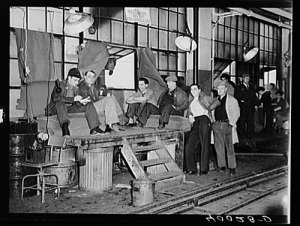
Eventually, the quality of the overseas competition caught up to the domestic trio of Ford, Chrysler, and GM, and demand for domestic autos waned. As a result, GM had no need for such extra workers; they needed more money to build a better product by cutting that staff to free up money for research and development. However, because of the United Auto Workers’ contracts and their unwillingness for concessions for the good of the company, GM was required to keep them on staff for a period of time. So GM opted to send them as helpers to the dealers and give us some free “labor”. The hope being that their assistance help cut costs for the dealers, who then might invest in more product.

Photo: Sheldon Dick, Strikers guarding window entrance to Fisher body plant #3, Flint, Michigan - via Library of Congress
Photo: Sheldon Dick, Strikers guarding window entrance to Fisher body plant #3, Flint, Michigan – via Library of Congress

The observant of you will notice I put quotation marks around labor. Let me explain. The “labor” we were provided took a 10-minute break every hour, moved at a snail’s pace, and he couldn’t even spell quality, nevertheless deliver it.

One day we had 24 cars to clean that came back from auction. The day we were to do this, I did 21 of them in the time he did the other three. Knowing that he was making well over twice my pay, I was furious. I asked if this was how he always worked. He didn’t seem to understand the meaning of the question, for indeed, it was his normal work ethic. He was twice my size, so I let it go.

For the record, I fully understand one instance doesn’t constitute a pattern, but almost all my subsequent encounters with unions have been equally disturbing, leading me to believe that I cannot argue in any way, that they provide superior labor to their employers, a claim that unions often try to make.

While the quality of their labor is sub-par compared to their non-union counterparts, the issue that truly troubles me, are the laws they’re allowed to break, specifically because legislators have carved out exceptions for them in the law.

I only have a layman’s understanding of law, but here are what I believe to be, some reasonable questions:

  • If I take the financial risk to start a company and grow it into a large corporation, what right does someone I hire have to tell me what I will or won’t do for them? I’m the one that took the financial risk; I own it, and it’s my property. If I choose to hire someone, shouldn’t I have the right to determine how they work and how they are compensated?
  • Monopolies are illegal. Yet, if I go to work for GM, I can only join the UAW, there’s no other union I can choose. This is true for all unionized businesses as far as I know and even true for most unions in an industry. So is this not a monopoly?
  • Some states have right to work laws, but in others, if you go to work for a company whose labor force is unionized, they don’t have a choice. They must join the union. How can a union legally force me to join them? What’s next? If I buy a house next to a golf club, I will legally be forced to become a member there as well?
  • People say that the unions “negotiate” with the employers. But is is an actual negotiation? In a normal negotiation, if the two parties cannot agree to a mutually beneficial deal, they will decide not to do business together. However, if a company doesn’t like the deal the union is offering, the law says they legally can’t just walk away; they call that “union-busting,” a practice that can sometimes be illegal. In a normal free market capitalist environment, I would choose to do business with someone if I saw value in doing so. But with unions, I’m not REALLY given a choice.
  • The documentary “Waiting for Superman,” pointed out that one out of every 57 doctors loses their license to practice; one out of every 97 lawyers loses their license; but union teachers lose their job one out of every 1000. The private sector averages around 3 out of 20 as a whole. Unless one is attempting to argue that teachers are universally 10-20 times better at what they do than everyone else, this is clearly an indication that unions are preventing proper turnover that weeds out under-performing employees. It’s not important though, they’re only teaching YOUR children.


The fact is that there is likely no organization that would choose to do business with unions if they weren’t forced to and likely none that have benefited financially from that relationship. In a free country, it should be their right to do business with whomever they want. If unions offered a valuable product, people would gladly do business with them. So the idea that we have laws forcing people to join is contradictory to a capitalist system. Let them compete in a free market like everyone else under the same laws as everyone else so that they can evolve like everyone else. Enough is enough with allowing them to infect and destroy the wallet of American businesses and our government.