Category Archives: Capitalism

The Point Of A Gun

Gary Nolan (and THE Scrappy Doo)

On any given day, we are bombarded with news media, film stars, and sometimes just random citizens who champion the idea of government doing more to solve all the world’s woes. Those of us on the side of liberty think these folks are misguided and/or ignorant, but the question has always troubled me as to why two people, often of similar intellect, can come to two drastically different conclusions about the role of government.

I pride myself on embracing empathy. I try to imagine what it is like to think the way my ideological opponents think; it helps to break down any claims of theirs I consider erroneous, if I first understand them. While sometimes I get frustrated to no end with the semi-socialist mantra, I give them credit for simply wanting no person left behind. There is a beautiful altruism in the idea that people should always help other people in need.

So why can’t I come on board with them?

Socialism has been tried many times in history; we have four nations in the world today that practice it as official policy. China, Lao, North Korea, and Cuba. As near as I can tell, living conditions in these nations, by no account whatsoever, can be considered even remotely as nice as what we have in America or most other capitalist nations.

Russia, a former communist nation with similar land mass and natural resources to America collapsed under communist rule while trying to compete with us. We hardly batted an eye vying with them for economic might.

Even comparing same cultures, look no further than Hong Kong versus the motherland China. Where capitalist Hong Kong natives live largely free, make good wages, and enjoy a strong economy; the Chinese struggle to keep workers from just killing themselves.

Suicide Prevention Nets at Foxconn factory

Altruistic or not, history has shown complete socialism, as official policy, doesn’t have any successful examples (from the perspective of the citizenry) to choose from. So being someone who tries to approach everything with logic, why would I champion something so historically laden with failure?

But if someone eschews history, and simply believes that somehow the only reason a government controlled economy has always failed is because they haven’t been the one running it, that person may be stuck in an ideological Alcatraz.

For those who are willing to consider a different viewpoint however, I wish to ask you to empathize with me. I’m going to give you an exercise to try to understand how I think of government, then pick any government policy you condone and apply this simple test.

First, I want you to remember one thing:

Everything government does, it does so at the point of a gun—sometimes just implied, but the threat is always real.

I know that may seem like hyperbole, but I assure you it’s not. The IRS will show up with guns on the doorsteps of those who simply refuse to pay taxes. If you fail to comply with a government demand (they don’t make requests) every step of the way, as the situation escalates, government will not simply say, “OK,” and walk away; the ultimate conclusion will either be you or a government official getting shot and killed.Bad-boys-bad-boys-watcha-gunna-do-courtesy-freepatriot.org_[1]

So when I consider any law, the first thing I imagine is whether I would be willing to put my own gun on that person to make them do what the law being proposed is asked.

For instance, I do not use recreational drugs—I think doing so is an illogical act and they simply do not interest me. But if my neighbor were next door smoking a joint, would I be compelled to walk over there, put a gun to his head, and tell him stop immediately or I’ll shoot?

Of course not.

Yet every one of you who argue to keep marijuana illegal are asking the government to ultimately do exactly that in your name. Government is an extension of you in this country, so if you’re not comfortable doing it yourself, you’re being lazy and hypocritical asking government to do it.

Conversely, if my neighbor were next door molesting a child, would I be compelled to go over and tell him to stop at the point of my gun? Honestly, I’m not so sure I’d even pause to ask him to stop. I’d probably go straight to “kill” mode. Therefore, I’m very comfortable asking government to enforce such a law.

I am firmly convinced that those of you who will not acquiesce to calling yourself a libertarian have never applied this simple principle to every single law you’ve considered a good idea.

But that’s sticking your head in the sand, because you cannot remove “being compelled by lethal force” from the equation of legislation.

Would the average Democrat put a gun to Bill Gates head and demand he pay a welfare mom who refuses to work, despite being physically able to, a chunk of the salary he worked so hard to attain?

Would the average environmentalist put a gun to the CEO of General Motors head and demand his vehicles get 30 mpg or you’ll splatter his brains all over the wall?

Would the average Republican put a gun to the head of a gay couple and tell them they had better not try to marry one another?

I’d like to think none would. But unlike me, they wrongly never take the time to think of considering the government in the proper way I proposed.

Libertarian Party Logo

So I ask all of you, think about a law either proposed or on the books that you condone. Then imagine putting a gun to the head of the would-be violator and honestly ask yourself if you still feel the same.

If you do, I would like to think that for many of you, I can now warmly welcome you into realm of libertarianism. We’re glad to have you.

Let them be jerks! Deregulating the Heinous.

Gary Nolan (and THE Scrappy Doo)

Imagine you’ve just left your local mom and pop hardware store and mom or pop treated you like an idiot because you didn’t know the difference between a ball peen versus a claw hammer. It happens all the time, right? We get bad service everywhere these days, and that’s part of life. How do we react to it? We don’t frequent that store again unless we absolutely have to.

Dick's Last Resort. The only restaurant famous for being rude. It's their thing.
Dick’s Last Resort. The only restaurant famous for being rude. It’s their thing.

So what actually transpires in this example? You have, in effect, fired that particular store. They work for you for a fee to make a living, and you’ve decided that you no longer wish them to do so. We often consider the firing of an employee a bad or immoral act if the person has committed no crime, but is this hypocrisy? Many of the same people who make such criticisms are the same people who lambaste a company for bad service, vowing never to return, to their friends.

So I want to go out on a bit of a blue-sky limb here with a unique proposal. There should be no regulations in the marketplace unless they fall under two basic parameters:

  • Laws that protect a corporation from violating a persons rights: These would be regulations against practices like dumping toxic waste; stealing intellectual property, patents, etc.; or laws preventing practices that risk the lives of patrons and employees alike not disclosed at the outset. For instance, people who change light bulbs on radio towers or people taking sky-diving lessons are certainly at risk, but they knew that before they agreed to do business together, not afterwards.
  • Laws that preserve competitive capitalism. Regulations such as anti-collusion and antitrust laws that ensure the marketplace remains competitive.

At first, this seems innocent enough, but when I outline what this potentially entails, you may think senility has overcome me. However, hear me out before you dismiss this off the cuff.

Laws that prevent discrimination, harassment, or any other behaviors commonly considered immoral may seem like the right thing to do, but as with any such laws they have unintended consequences.

One issue is that they mask a business owner’s true character, which may be one that you might avoid if they were allowed to be themselves. In doing so, we are affording a person you wouldn’t dream of doing business with greater success than they would get otherwise.

One look at the train wreck known as Amy’s Baking Company and their ensuing media meltdown after Gordon Ramsay had to walk away for the first time in the 100-episode history of Kitchen Nightmares is all it takes to see what free press, word of mouth, and social media can do to right a wronged marketplace of bottom feeders like this couple, and it’s happening without government intervention.

Imagine the New Black Panthers wanted to open up a “African-American Only” restaurant. Obviously I would not be allowed in, but would I want to? Even if the food is great, if the owners and customers are vehemently racist and really don’t like white people, then so be it. I think it’s morally wrong, but the government’s duty isn’t to legislate morality, it’s there to protect my rights—period. I’ll take my business elsewhere just like anyone else who would find this practice offensive.

Just as I never liked Augusta National‘s outdated racist/sexist policies of old, I never felt it was anyone’s right to dictate to them otherwise at the point of a gun, which is ultimately what government regulations are if taken to their ultimate conclusion.

But look what happened with Augusta. The press and people chastised them for being this way, and they eventually got sick of being hated by those of us who actually have a moral compass, and softened their stance accordingly. But to this day, and I know to some this is sacrilege, but if offered a once-in-a-lifetime chance of playing Augusta or TPC Sawgrass Stadium Course, I choose the latter without batting an eye—I doubt Augusta cares though. Freedom dictates Augusta and Sawgrass both be allowed to exist as they wish and fight for market share without government getting involved.

TPC Sawgrass 17th Hole

Going back to Amy’s Baking Company, it was revealed during the show that the owner was not paying his servers the tips they had earned. He was pocketing it himself because he said he was doing much of the work, which was clearly debatable. To Gordon Ramsay’s credit, he announced this to the restaurant, and patrons were none too pleased. At this point, I have little doubt that many of them, as well as the employees and potential future employees and patrons, will never return to this little fascist bistro.

But what if there were laws preventing this? (Actually, I suspect that maybe there are and they just aren’t complying)

Why let the government hide an entrepreneur’s true nature just because it feels right? I want to know what kind of person I’m doing business with, and these morality laws hide that; making me an uninformed consumer in the process. If that business owner hates me because of my race, sex, or religious philosophy, I don’t want to do business with them. So I want them  free to show me who they really are so that I may choose to stay or go.

People often lose sight of what a business is—an investment property owned by an entrepreneur. Just as you wouldn’t want the government prohibiting you from enjoying a stogie in your car, the government shouldn’t be dictating whether the owner of a business can allow people to smoke there. If it were a restaurant and you liked the food, but not the smoke, you can carry out, eat outside, or find another restaurant. You can also suggest to the owner that you may not patron their establishment so long as they allow people to smoke, and let them decide how they wish to proceed. But you, and by virtue of the phrase, “We The People,” the government, have no right dictating to a business owner how they should run their business.US Constitution

So when it comes to business, let them be the jerks that they are, then let the market sort it out accordingly.


Let’s not play Monopoly!

Gary Nolan (and THE Scrappy Doo)

Most people know that monopolies are illegal, but not everyone understands the history of antitrust and collusion laws or why they exist at all.

As a libertarian, I basically support free market capitalism and laissez-faire, but why do we libertarians and other liberty minded people support this? Because free people who run free enterprise are free to innovate and this innovation brings us a superior product. Competition among innovators also drives down the price as they seek to gain market-share. It’s why you can get a miracle of modern technology like the iPhone or Droid for a mere pittance—with a 2-year contract anyway.

U.S. Steel - Youngstown Ohio
U.S. Steel – Youngstown Ohio

But if we look at the history of monopolies here in America, Standard Oil and U.S. Steel were the most popular in our history, and what transpired was not good. Thus making the case for some semblance of government oversight.

I am often berated by anarchist-like libertarians for championing even the most minor government regulations in our marketplace, ensuring they compete and that they don’t violate our rights, but these people are ignoring historical evidence to promote an ideal I agree with, yet know doesn’t work if left unchecked. History has already proven it. Just because none of us were alive during that era, doesn’t mean we don’t have the documentation to know what happened when we had market-anarchy.

Standard Oil Common Stock

Prior to antitrust and collusion regulations, the quality of goods from these trusts was poor, the working conditions were so atrocious that workplace deaths and injuries were quite common, and the cost of what came off the production lines wasn’t cheap. Why would it be? If you’re the only game in town, providing a quality product, safe work environment, and competitive pricing and wages, simply aren’t needed. Just as absolute power in government corrupts, absolute power in business corrupts too. The moment a business owner needn’t fear people buying from his/her competitor because no competitor exists, corruption can, and likely will, be born.

Anarchists argue that if workers don’t like it, they can go work somewhere else. But where do you propose people go work? The very definition of a monopoly is that it’s the only business in an industry. Thus, there is nowhere else to work. If an enterprising person attempts to go into business for themselves, they’re either forced to sell to the monopoly, or crushed by it if they don’t. These are not wild conspiracy theories I’m floating, it’s historically documented evidence.

The design of free-market capitalism, is not dissimilar to socialism or anarchy. In a perfect world, they would work as intended and yield the desired positive result. History has proven however, that they also have the same flaw. There will always be sociopaths among us who don’t have the power of empathy or value the benefits of being societal. The only decent way mankind has ever dealt with these people is via rule of law. Such people have no qualms about taking advantage of others and doing them harm for personal gain. Our Constitution is designed to prevent these people from corrupting our government, and competition should prevent them from corrupting our markets. So ensuring competition is vital to our society, our rights, and our economy.

Andrew Carnegie, Cornelius Vanderbilt, John D Rockefeller

John D. Rockefeller, J.P. Morgan, and Andrew Carnegie proved that there’s a point at which if you do something right, you can control an industry to such an extent that no one else can compete. These men were likely decent people who considered themselves altruistic and good, but the unfettered power they eventually wielded corrupted them in such a way that they became consumed with winning and had little issue engaging in immoral practices to accomplish this goal.

So aside from protecting our rights to life, liberty, and property, in my opinion, government should justly be ensuring our markets stay competitive and uncorrupted.

So now that we understand, and hopefully agree with regulations preventing monopolies, I’d like to point something out:

Government is a monopoly!

The federal government competes with no one. State and local governments may seem to compete with each other, but if you live in Ohio and don’t like the service the Ohio government provides you, you can’t choose to do business with the Virginia government unless you move to Virginia. It’s quasi-competition at best where states compete to lure residents and businesses, but it’s certainly nothing like Apple versus Microsoft or Ford versus Chevrolet.

So when people like me beg and plead voters to elect more libertarian-like officials, it’s because we know that they’re the only politicians who intend to rebuke and regulate away power bestowed to their predecessors once they inherit it. In doing so, lowering the possibility of corruption, because the smaller government is, the less opportunity for corruption to occur. In the face of the IRS, Benghazi, and press scandals committed against the AP and Fox News, I sincerely hope you understand why we libertarians have been right all along, and are starting to feel vindicated for making these arguments so many seem to laugh away not long ago.

Do you remember Barack Obama making this commencement address speech at my beloved Ohio State University about a month ago?

The irony of this speech that occurred as all three conspiracies started to break into the mainstream media is chilling. It is exactly why we must only trust a politician who tells us not to trust him/her, not to grant them authority, and not to give up your freedom to their ideas of how we should be ruled.

“Experience has shown, that even under the best forms of government those entrusted with power have, in time, and by slow operations, perverted it into tyranny.”
― Thomas Jefferson

Job Emigration – Place Blame Where It Belongs

Gary Nolan (and THE Scrappy Doo)

This past election, Barrack Obama and the DNC-loyals were attacking Mitt Romney and other business people for shipping jobs overseas. Like most patriotic Americans, it upsets me to see jobs leave the United States as well. But was this really a fair criticism of business owners?

No FartingAs a former entrepreneur myself, let me give you an analogy. This criticism is akin to farting while sitting next to me, then getting upset when I leave because you’ve made the room smell like three-month-old milk and despair.

If we were a statist nation like former Russia, China, Cuba, etc., businesses would exist to serve the state; something many on the left seem to wish were the case here—you know, the people who supported millionaire capitalist Michael Moore by attending his movies bashing capitalism yet fail to see the hypocrisy in that?

The reason I believe this idea is so ridiculous, is because despite my requests, not one of these people can name a statist nation whose people don’t live in absolute squalor. Note that Russia’s GDP has nearly quadrupled in the last 12 years, and they’re budding ideas on capitalism are still being ironed out. So I’ll be happy to consider statism a practical system of governance for maintaining quality of life and basic human rights when a successful example arises.

In our capitalist system however, businesses are the product of a risk an entrepreneur takes to offer a good or service to the public to make a living for themselves, as opposed to working at the behest of someone else. We all know that the greater the risk, the greater possibility for reward. This carrot on a stick is what makes entrepreneurs take such a risk.

Carrot On A StickSo to explain my flatulence analogy; America has the third highest corporate tax rate  on the planet. We also have one of the most intrusive regulatory networks as well, thanks to NHTSA, OSHA, the EPA, and other federal and local legislations and regulators. Add labor unions to that, which infect businesses like a cancer feeding off the host until the Hostess dies. All these roadblocks make America a very expensive place to do business. So how is it fair to blame people who leave America when we make it such an inhospitable place to do business?

Let’s ignore all the ideology for a moment and think about this skeptically and empathetically. What are some of the issues of doing business outside the United States?:

  • There are regulatory issues of your home country and the one you’re doing business in, requiring you to hire a plethora of compliance lawyers and staff just to make sure what you are doing is even legal.
  • Language barriers exist for nations that do not have English as their primary language.
  • Shipping, tariffs, and customs expenses increase.
  • Massive expenses in building a new facility and moving operations from a U.S. based plant to a foreign one.
  • Travel expenses increase for those headquartered in the United States that have to often visit overseas facilities.
  • Loss in quality assurances due to lack of direct oversight.

These are but a few issues I can think of off the top of my head; certainly there are many more. So if all these issues exist, why even do it? Because doing it is still more profitable than doing business here in the United States. Stop and think about that for a minute—let it fester in any liberty-minded bones you have in your body. If you’re like me, it should offend you to the core.

Because we are one of the richest nations in the world, American workers are not going to work for the pennies a day that some third world nations consider a reasonable salary, so if we intend to compete in the world market, you’d like to think our legislators would make every effort to overcome our higher wage demands by keeping corporate taxes and regulations as unobtrusive as possible so we can be competitive. Greater expenses make it more expensive to the consumer. Yet, during the election, the people like Mitt Romney were vilified as heartless rich bastards for attempting to rectify this.

I propose we start calling out those who want to bash the rich, playing the hero while doing it. This pure ignorance of economics, history, and logic is offensive. Our economy depends on people with money investing in American products and workers. But why would they when we treat them like dirt, tax them to hell and back, and regulate them like a dog on a choker chain dying to run ahead of its master?

Dog Pulling ON LeashIf you’ve ever been in the middle of a productive task and had someone interrupt to “help” you, only to slow you down and make matters worse, then you should inherently understand what government does to entrepreneurship every single day.

Unless we vote for liberty minded candidates, entrepreneurs will observe the basic physics principle of taking the path of least resistance. We have no one to blame but ourselves for electing and re-electing those who are content to push them away to pass “feel-good” legislation that is a product of jealousy as opposed to evidence based hypotheses. When emotion trumps logic, we all lose.


Business People In Office: A Good Thing?

Gary Nolan (and THE Scrappy Doo)

I’m going to try an interesting op-ed approach; debating with myself. While this may seem silly, this is how logical thinking and skepticism usually works. I list the pros and cons in order to come to a logical conclusion and attempt to refute my own theories to see if they hold up. The latter part, a version of falsification, being the most important.

Normally I do this before I write something, then write my opinion once I’ve come to a conclusion. But on this one, I just cannot commit to a particular opinion. So instead, I’ll lay out my arguments, and at the end, just leave it open for further discussion. I would love to hear your own opinions and why.


GCaseAs a young man, I had been initially enamored with the idea of Ross Perot as president (as evidenced by my trusty old guitar case). I don’t even remember any of his actual positions, I was just beginning my politically literate phase in life. But what I did know is that this man, having borrowed $1,000 in 1962 to start a company called EDS (I believe his wife had to sign because he had bad credit, no less), later sold that company to General Motors for an astounding $2.5 billion in 1984. By all accounts, a pretty good investment and an amazing American success story.

I say initially interested, because as you may know, his campaign soured in the end with claims of death threats and such that seemed to indicate Ross might be either succumbing to senility, or was honestly just a kook.

The part that interested me about Ross though, was the generic idea of a businessman in office. Whether it be as a president or legislator, I felt that the people running our government should have business acumen so that they actually knew how to manage employees and solve problems—something successful business owners do in the marketplace every day.

But is this really logical?

H. Ross Perot
H. Ross Perot

Let’s first ask if we’ve had any successful businessmen as president. Herbert Hoover stands out as the only truly successful businessman who went on to become president, and in the scientific community, when trying to establish a pattern, only one data point isn’t exactly helpful. We’ve likely had numerous successful businessmen as legislators, but it’s nearly impossible to judge a single legislator’s success when everything they do is by committee. So for now, we’ll stick to theoretical arguments as we can’t really use history.

I believe that one of the problems of government is that it is inefficient. In the business world, this is the path to insolvency, but in government, it is quite common and somewhat by design.

Inefficiencies in the government work place are indeed problematic though, and having a leader that not only inspires people to be better, but holds them accountable when they’re not, should improve productivity and reduce waste. This is my initial case for a businessman as president.

But when it comes to a president who works with legislators, they’re not supposed to be efficient at making change. The point of our Constitution and resultant system of government is one that is intended to be insusceptible to changing on a whim. A constitutional republic protects the minority from the majority, whereas a pure democracy could change in a heartbeat due to panicked legislators making knee-jerk reactions or merely those wishing to serve at the whim of a charismatic president.

Huyton Internment Camp

An easy hypothetical to explain my meaning on this would be to go back to September 11, 2001 and imagine we were a pure democracy. Once we were aware that it was radical religious zealots at the behest of Osama Bin Laden who attacked us, the majority of America could have easily demanded that we deport all Muslim immigrants, instate Muslim internment camps, and/or attempt to close any Muslim mosques. There was a significant amount of anti-Muslim sentiment in those following months; if they were the majority, it would have been a real possibility without our Constitution and the 1st amendment to prevent such actions.

So would a businessman who is used to being able to put their foot down be able to deal with a Constitution, legislative branch, and judicial branch telling them what they may or may not do? I’m not convinced someone used to having “the power” could make the change without becoming jaded and end up giving up. Arnold Schwarzenegger seems to be a perfect example of this.

One of the other problems I perceive is of a fundamental nature. A successful businessman achieves success by growing his business. But in a free country, a successful politician should be one that shrinks government to what is considered to be the bare essentials. Two diametrically opposed philosophies, and ones that may not translate well.

Businesspeople solve problems, politicians fancy themselves as people who solve problems; but, unlike a business person a good politician should recognize when it’s not their problem to solve. That more often than not, they should simply abstain and let free people work it out.

What about combined experience? Clint Eastwood famously ran for mayor of a little town called Carmel, California after being offended by the bureaucracy of zoning laws and other restrictions that he felt were unfair. He understood how government affected him and would go on to make decisions accordingly.

I have conversely read news stories (can’t remember the name) of a legislator leaving office for the private sector only to get frustrated by laws that he had been instrumental in getting passed in the first place; showing regret for all he surely must have done to harm businesses he had intended to help.

Ted Kennedy
Ted Kennedy

In both situations, an opinion on politics was formed due to the effect of government on the private sector. This is something that life long politicians like the late Ted Kennedy likely never understood.

So I do believe that any politician should have some understanding of how laws they might pass will affect those being governed—it’s the difference between theory and reality. I hope there is not a capitalist among us that doesn’t want to vomit every time they hear the words “Compliance-lawyer.” The thought of having to pay someone to make sure you’re legal, in a free country, seems ridiculous. Shouldn’t one know when they’re doing something wrong?

So here is where I throw it to you the reader. Surely there are other pros and cons to be considered, what say you?

Great leaders make results, not excuses. Reagan v Obama

Gary Nolan (and THE Scrappy Doo)

For many, an interest in politics, who our leaders are, and which political side we’ll choose to stand on is sparked by single events. For me, as a pre-teen adolescent, it was the Iran hostage situation. I could not fathom how one of the world’s two superpowers was allowing a little 3rd world country to hold our people hostage. It was troubling, and I detested Jimmy Carter for not sorting it out. To be fair to Carter; being so young, I was blissfully ignorant of the behind the scenes actions that were being attempted—all I saw was the big picture.

Carter Era Gas Shortage Sign

The long lines at gas pumps, thanks to Carter’s poor handling of OPEC, were hurting adults trying to make a living as well, but as a kid, I simply didn’t understand economic issues yet, so it didn’t really affect me like the Iran hostage situation. As we all know, Ronald Reagan took office, and our hostages came home. From then on, I was a Reaganite.

One of the things that upset me this past election was the notion that the economy was still so horrible because of what Obama inherited. While we all mostly agree he did inherit a poor economy, four years later, is it really an acceptable excuse?

 As Reagan took office, he inherited a misery index of 20.76. It was the highest recorded misery index in history going back to that statistic’s inception in 1948—it hasn’t been to a higher level since either. Carter may have been a nice man and a brilliant scientist, but as a president, he failed miserably at maintaining America’s economic strength, much less growing it.

By comparison, Barack Obama inherited a misery index of 9.65. Less than half of Carter’s benchmark. While I agree G.W. Bush’s handling of the economy at the end was poor, it was a far cry from the disaster Carter presided over.

So approaching the “Inherited a poor economy” argument, let’s see how Reagan and Obama handled what they inherited:

After four years under Reagan, the misery index improved from the aforementioned 20.76 to 11.81—a significant improvement. After four years of Obama, it went from 9.65 to a slightly worse 10.15. Reagan wins this battle; one point for the Gipper.

But let’s delve further. If we look at GDP numbers, at the end of the Carter administration, dividing our total GDP by our population, we have approximately $11,433 per person in 1979. After 1983, that number improved to $15,171; an improvement of 25%.

Now let’s look at Obama. In 2008, the average GDP per capita was $47,363. At the end of 2012, that number grew to $49,494; an improvement of 4.3%. Reagan wins again; two points for the Gipper.

1984 Election Results

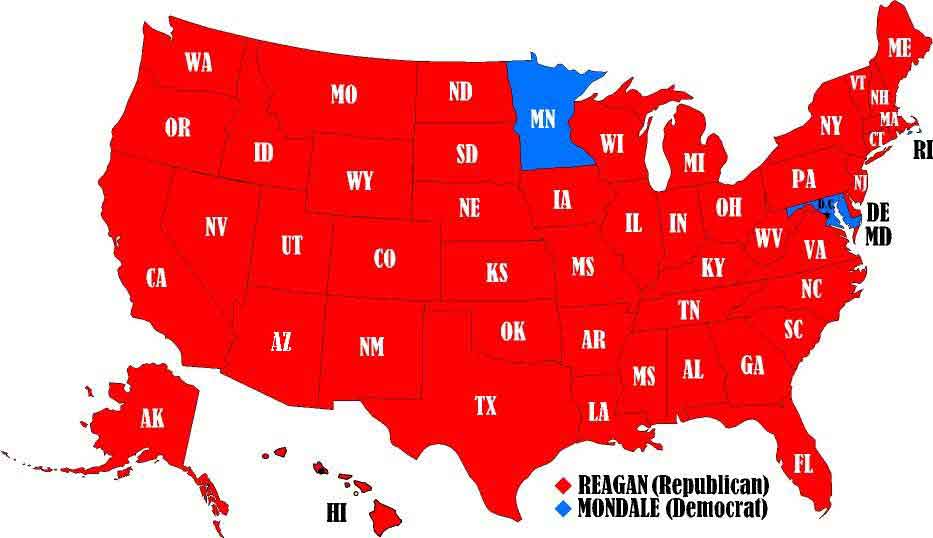
All that being said, one of the fairest tests of a president in a democratically-elected contest is how he is judged by the people he governs during a reelection. After four years of Reagan, he resoundingly beat Walter Mondale 49 to 1 states—Minnesota the lone stand out. He won 525 electoral votes compared to 13 for Mondale, and a popular vote of 58.8% vs 40.6% (54,455,472 to 37,577,352 votes). This means that a Republican actually won the left-wing bastions of California and New York! It was the greatest election defeat in history.

Barack Obama against Mitt Romney on the other hand was 26 to 24 states; 332 to 206 electoral votes; 51.1% to 47.2% with 65,910,437 votes to 60,932,795. We’ll call that an easy Reagan victory as well—three to nil; the Gipper.

Ronald Reagan
Ronald Reagan

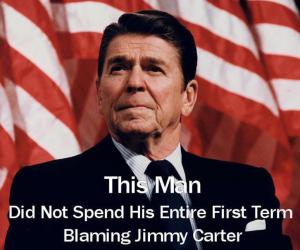
It was a long time ago, but when questioned about the state of the economy, I don’t remember Reagan blaming Carter his complete first term; he was too busy making his case for the future. He lowered the top-tier tax rate from 70% to 28%, gave people their money back, and just as planned, the economy took off like a rocket. So well in fact, that we reduced the world’s superpower population by half as Russia crumbled while attempting to compete. It was capitalism versus communism; capitalism won.

So why am I promoting Ronald Reagan if I’m a libertarian? Because not only do I believe that the GOP should be the libertarian party, I believe Ronald Reagan was my generation’s closest thing to a libertarian president, and this excerpt from a 1975 interview with Reason Magazine should illustrate why:

If you analyze it I believe the very heart and soul of conservatism is libertarianism. I think conservatism is really a misnomer just as liberalism is a misnomer for the liberals–if we were back in the days of the Revolution, so-called conservatives today would be the Liberals and the liberals would be the Tories. The basis of conservatism is a desire for less government interference or less centralized authority or more individual freedom and this is a pretty general description also of what libertarianism is.

Now, I can’t say that I will agree with all the things that the present group who call themselves Libertarians in the sense of a party say, because I think that like in any political movement there are shades, and there are libertarians who are almost over at the point of wanting no government at all or anarchy. I believe there are legitimate government functions. There is a legitimate need in an orderly society for some government to maintain freedom or we will have tyranny by individuals. The strongest man on the block will run the neighborhood. We have government to ensure that we don’t each one of us have to carry a club to defend ourselves. But again, I stand on my statement that I think that libertarianism and conservatism are traveling the same path.

One of the constant knocks against Reagan by libertarians and liberals was his massive spending on defense—a criticism he fairly leveled at himself. But people seem to lose sight of the fact that for all of Reagan’s spending on defense, every succeeding president has put more troops in harm’s way than Reagan did. Contrary to belief, he avoided conflicts as well as any president could.

What he did do however, was ensure that America was deemed to be so powerful, that any nation endeavoring to threaten us would understand it would be assured destruction. And with the exception of Russia, it wouldn’t be mutual. He referred to it as peace through strength.

When America was founded, there were many superpowers—we weren’t yet even one of them. But by the end of 1988, in no small part thanks to Reagan, we were the only one left standing, and remain as the only one still today.

If you lead by example, others will follow. America was a leader 200+ years ago in adopting a principle of liberty, and as a result of our success, there are free nations all over the world who followed our lead; including the monarchies we rebelled against so many years ago. Sadly, they may never give us credit for inspiring them, but true greatness doesn’t need acknowledgement, it’s content in the knowledge it is great.


Can I be GM’s new CEO?

Gary Nolan (and THE Scrappy Doo)

In 2009, a very bad thing happened. GM went from being General Motors, a privately held and operated corporation, to General Motors, a majority-share government-owned corporation. After a Chapter 11 filing, in order to save a company deemed too big to fail, the government bought out 864 million shares of the available 1.4 billion. While it was not a hostile state takeover that would make Fidel Castro proud, let’s look at some of the highlights here.General Motors

  • In 2008, GM began losing money, partly due to a crippled economy. However, this could have been managed if not for unreasonable and unwavering demands from the UAW. GM executives at the time, headed by then CEO Rick Wagoner, had decided that bankruptcy would likely be the solution. This would allow GM to terminate and renegotiate new, more manageable union contracts, enabling GM to survive into 2009 and beyond.
  • December 19th 2008: Then President George W. Bush approved TARP which in total, gave $17.4 billion to General Motors and Chrysler in an effort to prevent such a bankruptcy.
  • February of 2009: GM makes it known that the bailouts had not solved their solvency issues and bankruptcy still seems to be the most likely option.
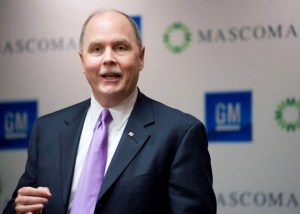
  • March 29, 2009: In a deal we will likely never know the details of, current president Barack Obama ousters CEO Rick Wagoner in hopes of preventing a bankruptcy that would ultimately harm the UAW. It was stated that Wagoner “agreed to step down,” which we all know is code for “He was offered something to step down and shut up so that we didn’t have to fire him publicly and have him tell people what actually happened.” There can be no doubt Wagoner did not want to step down, he was turning GM around. Obama then replaces him with Fritz Henderson.
  • July 2009: Federal government buys a controlling interest in the new General Motors after bankruptcy.
  • November 2010, Government sells approximately 358 million of its 864 million shares back to private investors, thus relinquishing a controlling interest, but losing $11 billion dollars of taxpayer money doing so.

    Rick Wagoner
    Rick Wagoner

I understand that Bush and Obama felt GM was too big to fail, and certainly had GM closed its doors, it could have seriously hurt the American economy. But no one was proposing that, nor even reasonably insinuating it would happen. The intent was to reorganize and draft more manageable UAW contracts, not close the doors.

As this debate raged on, I watched a labor union rep say in an interview that GM’s issues had nothing to do with labor unions; that it was purely about the economy. Interesting argument since the facts were that non-union automakers, with significantly lower labor costs, while hurting from the economy, were still quite solvent. Such lies and/or delusions are quite common among the UAW ranks.

In a properly free market, as GM sales were down, GM should have had the flexibility to cut staff, lessen benefit expenditures, reduce hours, or whatever it took in order to insure the solvency of their organization; something labor unions simply won’t allow. The idea that the UAW weren’t contributing to the problem is absurd.

However, the UAW isn’t the only villain. Since Obama is a friend to the unions, he felt it was his duty to intervene and protect them as best he could from the bankruptcy Wagoner would have negotiated. So Rick Wagoner was forcibly removed from office so that Obama could bring in new CEO Fritz Henderson; one who would manage such a bankruptcy if it occurred, in such a way as to benefit the UAW the greatest.

Fritz Henderson
Fritz Henderson

The problem? Any contract GM signs should be done with the best interests of GM in mind, period. The UAW conversely should negotiate the best deal for themselves. But when both sides are working for the betterment of one side over the other, that’s not a negotiation, that’s corruption.

And so it was, the UAW got a fully loaded Cadillac, and the taxpayers and General Motors got a driveshaft in the rear entrance. You can read about this UAW inspired, Obama approved corruption here.

So the money Bush approved in order to prevent bankruptcy was a waste. It obviously didn’t work; GM filed for bankruptcy anyway. The sale of GM stock later by the government, another big loss. Whether we lose on what we still own—only time will tell.

In my opinion, the problems don’t end there though.

President Obama knows that the people frown on government directing a private company, but he’s not exactly known for his humility. He has demonstrated he will do what he desires to do, then figure out a way to present it to the American people in such a way that they’ll accept something they would otherwise not support.

So a man who has zero private sector experience, zero automotive experience, zero management experience, and zero business administration experience decided that in an ultimate show of hubris, he somehow knew what was better for America’s largest corporation than its current CEO who had a significant amount of experience in all the aforementioned areas.

Barack Obama
Barack Obama

Imagine if Obama decided he could perform surgery better than a practicing physician who may have just lost a patient. Then he gives medical advice to this doctor’s patients contrary to what the doctor prescribed. Whether the doctor is sub-par or not, Obama would have absolutely no business doing this—it would be a serious breech of ethics.

As a person who spent over 20 years of my professional life involved in both the sales and service management of new and used automobiles, I literally have infinitely more experience in this arena than Obama. Anything times zero is infinity before you accuse me of hyperbole. The only difference? I’m smart and humble enough to know that I’m not qualified to run General Motors.

When Dr Rand Paul weighs in on medical issues, he knows what he’s talking about. When Obama weighs in on legal issues, he knows what he’s talking about, even if he’s not a practicing lawyer. But nothing qualified him to make a single decision regarding the management of General Motors.

We expect our presidents to be strong, confident, even a little arrogant on occasion. Maybe it’s the same phenomenon of implied danger that drives good people to date bad people. But if America is to have an effective leader, that person should have the humility to understand their duties are to protect our rights, not drive a market which has a nearly infinite greater wealth of experience than any one person could have.

This boondoggle cost us taxpayers billions, and we are no better for it. Much like the false belief that Roosevelt saved the American economy after the great depression, Obama didn’t save the auto industry either.

The president represents the state, and state-run markets are never good—there’s more than enough history in this world to know free-markets are always better. If GM manages to achieve success again, it will be despite Obama and the UAW, not because of it.

Sources:

http://en.wikipedia.org/wiki/General_Motors_Chapter_11_reorganization

http://www.treasury.gov/press-center/press-releases/Pages/tg959.aspx

http://autos.yahoo.com/blogs/motoramic/march-29-president-obama-fires-ceo-general-motors-132056452.html

http://online.wsj.com/article/SB123836090755767077.html